
 Excavator
294 models
Excavator
294 models  Backhoe Loader
51 models
Backhoe Loader
51 models  Crane
68 models
Crane
68 models  Concrete Mixer
79 models
Concrete Mixer
79 models  Wheel Loader
54 models
Wheel Loader
54 models  Compactor / Roller
45 models
Compactor / Roller
45 models  Motor Grader
42 models
Motor Grader
42 models  Concrete Pump
66 models
Concrete Pump
66 models  Skid Steer Loader
11 models
Skid Steer Loader
11 models  Telehandler
13 models
Telehandler
13 models  Dozer
Dozer 


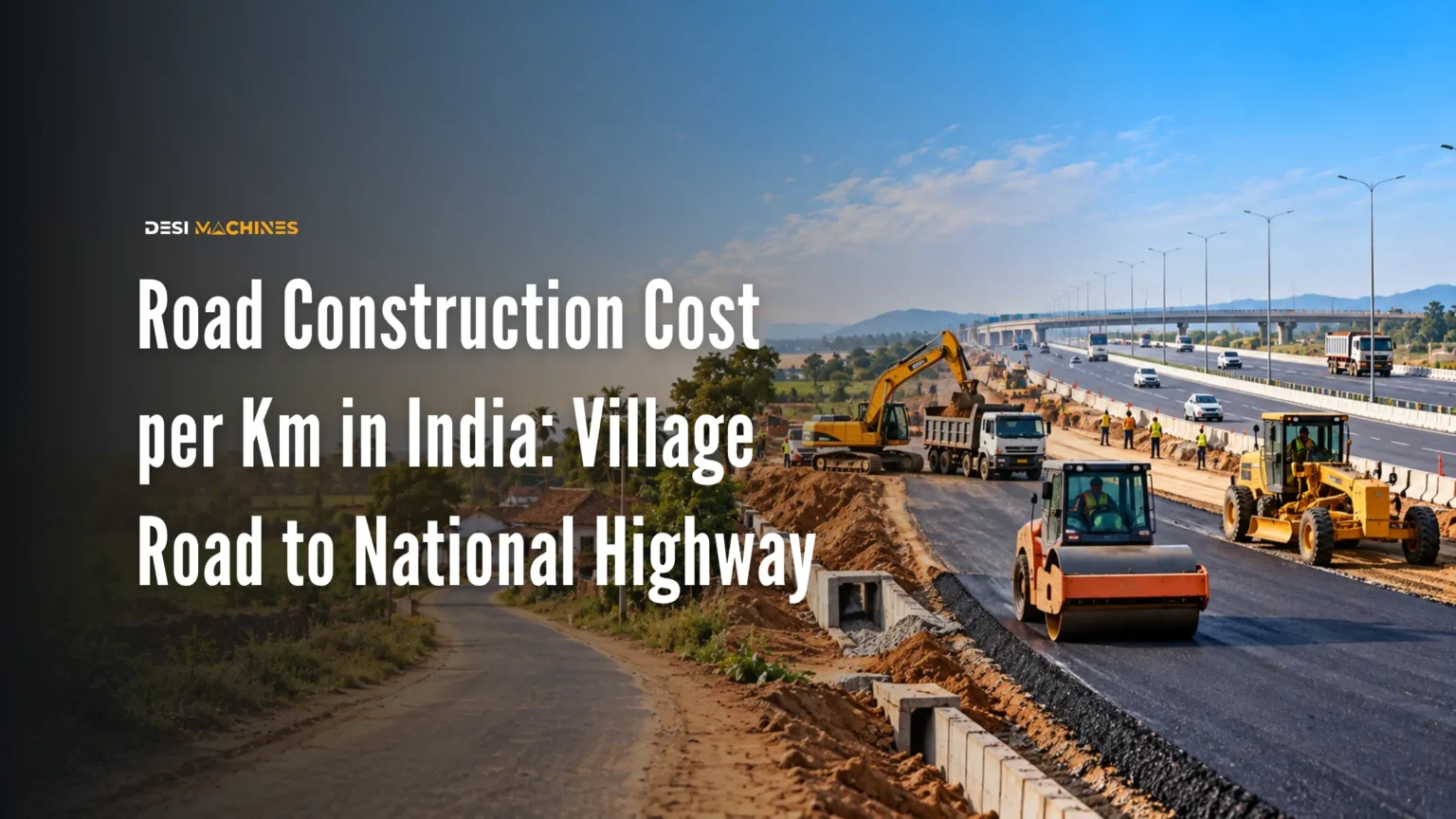
Road construction cost per km in India runs from about ₹71 lakh for a PMGSY village road to nearly ₹69 crore for a new access-controlled four-lane national highway. That is a ninety-fold spread between two roads that both get called “a road”, which is why a single cost-per-km figure is worth very little until you say which road you mean.
The three figures below are worked out from government approvals, not from estimates. Each one is a real sanctioned project or a real scheme allocation, divided by its own length.
| Road class | What the work is | Cost per km | Where the figure comes from |
|---|---|---|---|
| Village road (PMGSY) | New single-lane rural connectivity, 3.0 to 3.75 m wide | About ₹71 lakh | ₹18,907 crore sanctioned for 26,474 km in FY 2026-27 |
| Two-lane national highway, upgraded | Existing 2-lane widened to 2-lane with paved shoulder | About ₹7.4 crore | NH-326 Odisha: ₹1,526.21 crore for about 206 km |
| Four-lane access-controlled highway, new | Greenfield 4-lane with service roads and structures | About ₹68.7 crore | NH-927 Uttar Pradesh: ₹6,969.04 crore for 101.515 km |
Read the middle row first. It is the one most contractors actually work on, and at roughly ₹7.4 crore per km it sits closer to the village road than to the highway everyone quotes.
Why there is no single cost per km figure
The number moves because five separate things move, and only one of them is the road surface.
Width and lanes. Cost scales with the area you build. A 3.75 m village road and a 7 m two-lane carriageway differ by nearly twice the material before any specification changes.
New road or upgrade. This is the biggest single lever, and it is the one the aggregator figures hide. NH-326 is an upgrade: the alignment exists, the land is already the government’s, and the work is widening and strengthening. NH-927 is greenfield, meaning a fresh alignment on new land. Same country, same year, both four-lane-class national highway money, and the greenfield job costs about nine times as much per kilometre.
Land. On a greenfield project, land acquisition can rival the civil work. It is why a highway through farmland and a highway bypassing a town are not comparable, even at identical widths.
Structures. Bridges, culverts, underpasses and service roads are priced into that per-km average. A stretch with a river crossing carries the crossing’s cost spread across every kilometre of the contract.
Terrain and soil. Hill roads need cutting and retaining walls. Weak black cotton soil needs the subgrade improved before anything is laid on it. Neither shows up in a headline figure.
So when a site quotes “₹3 to ₹6 crore per km” with no road class attached, it is describing a two-lane job on easy ground with the land already in hand. That is a real case. It is not the general case.
What does a village road cost per km?
A PMGSY village road works out to roughly ₹71 lakh per km. For FY 2026-27 the government earmarked ₹18,907 crore to build 26,474 km of rural roads under the Pradhan Mantri Gram Sadak Yojana and the related rural connectivity schemes, as recorded in the Ministry of Rural Development’s review of PMGSY progress. Divide the money by the length and you get about ₹71.4 lakh for each kilometre.
Treat that as a scheme average, because that is what it is. It mixes plain states with hill states, and it mixes new construction with upgrades of existing tracks. A single-lane road across flat Punjab farmland and the same road in Arunachal Pradesh do not cost the same, and the average sits between them.
What the figure is genuinely good for is a sanity check. If a rural road is quoted to you at ₹3 crore per km, something in the specification is far above PMGSY standard, or something is wrong. Rural roads are built to a lighter section than highways: thinner layers, lighter traffic, and often water bound macadam with a thin bituminous seal rather than the full highway crust.
What does a national highway cost per km?
Between about ₹7.4 crore and ₹69 crore per km, and the gap is explained by what is being built rather than by inflation or by the state.
The Union Cabinet approved the widening and strengthening of NH-326 in southern Odisha from two lanes to two lanes with a paved shoulder, covering about 206 km at a cost of ₹1,526.21 crore on EPC mode. EPC means engineering, procurement and construction, where the government pays and the contractor builds to a fixed scope. That is about ₹7.4 crore per km. A paved shoulder, for anyone who has not met the term, is the strip beside the running lane built to the same standard as the lane, so a truck can pull off without breaking the edge.
The same year, the Cabinet approved the four-lane access-controlled NH-927 from Barabanki to Bahraich in Uttar Pradesh, 101.515 km at ₹6,969.04 crore on Hybrid Annuity Mode, as set out in the Cabinet decision on NH-927. Hybrid Annuity Mode splits the funding: the government pays part during construction and the rest in instalments afterwards. That works out to about ₹68.7 crore per km.
Access-controlled is the phrase doing the heavy lifting. It means no one joins or leaves the highway except at planned points, which forces continuous service roads, grade-separated crossings and bypasses around habitations. Add fresh land for the whole alignment, and the per-km figure multiplies.
The lesson for anyone pricing work is straightforward. Ask whether the project is brownfield or greenfield before you ask what it costs, because that single answer moves the number more than everything else put together.
Where does the money actually go?
Most of it goes into moving and compacting stone. A road is not a surface, it is a stack of engineered layers, and the depth of that stack is what drives the bill.
Take one kilometre of a standard 7 m two-lane carriageway and work out the material from the designed layer thicknesses in the guide to road construction layers. The arithmetic is length times width times thickness, and it is worth doing once because the answer surprises people.
| Layer | Designed thickness | Volume per km of 7 m carriageway |
|---|---|---|
| Granular sub-base (GSB) | 200 to 300 mm | 1,400 to 2,100 cubic metres |
| Wet mix macadam (WMM) | 75 to 100 mm | 525 to 700 cubic metres |
| Dense bituminous macadam (DBM) | 50 to 100 mm | 350 to 700 cubic metres |
| Bituminous concrete (BC) | 30 to 50 mm | 210 to 350 cubic metres |
That is roughly 2,500 to 3,850 cubic metres of graded stone and bituminous mix for every kilometre, before any earthwork below it. The full designed crust on a normal Indian road lands between about 600 and 800 mm deep, so counting the subgrade improvement takes the figure past 4,000 cubic metres per km.
Every cubic metre of that has to be quarried, crushed, graded, hauled, spread and rolled to a specified density. Once you see the volume, the cost stops being mysterious. The two layers at the bottom, GSB and WMM, are the cheapest per tonne and the largest by far, which is why quarry distance and haulage matter so much to a road contractor’s margin. The bitumen used in the top two layers is the expensive material by weight, and it is the thinnest part of the stack.
Is a concrete road more expensive than a bitumen road?
To build, yes, by roughly a quarter to a third. Over its life, the answer flips.
GCCA India, the Indian arm of the Global Cement and Concrete Association, puts the initial cost of a cement concrete road at about 28 per cent above an equivalent bitumen road, falling to around 20 per cent when fly ash replaces part of the cement. The same report puts the life-cycle and maintenance cost of the concrete road about 19 per cent below the bitumen road. Worth knowing the source’s interest: GCCA is a cement industry body, so treat the direction as reliable and the exact percentage as an advocate’s figure. Municipal costing supports the same ratio independently — Pune Municipal Corporation’s own comparison of per-square-metre rates for the two pavement types implies a premium of about the same size.
The reason is structural. A concrete road carries load by bending as a rigid slab, so it needs a thinner granular base but a lot of cement and steel. A bitumen road is flexible and spreads load down through its layers, so it needs a deeper stone stack and periodic resurfacing. Concrete is the usual answer where drainage is bad, where traffic is slow and heavy, or where a road sits under standing water in the monsoon. The thickness and joint decisions behind it are set out in the guide to CC road construction, and the lean concrete layer that goes underneath the slab is covered in the guide to DLC.
For a small contractor the practical point is that you are rarely choosing. The tender specifies the pavement type, and your job is to price the specification in front of you.
How much of the cost is machinery?
Less than most first-time contractors expect, and it is the part you can control. Material and haulage dominate a road bill. Machines are the line that decides whether you finish on time, which is what protects the rest of your costing.
A road gang needs a motor grader to spread and trim to level, a single drum soil compactor for the subgrade and granular layers, a tandem roller and a pneumatic tyred roller for the bituminous layers, a paver for DBM and BC, and tippers to feed all of it. Which machine handles which layer is set out in the guide to road construction equipment.
On the hire side, our own equipment rental rate card puts a soil compactor or road roller at ₹800 to ₹1,500 an hour, or ₹15,000 to ₹25,000 a day (indicative, as of Jul 2026), and a 20-tonne excavator at ₹1,400 to ₹2,200 an hour on wet hire, meaning machine plus operator. Graders and pavers are not on that card, so ask for a quoted rate rather than working from a published one.
On the ownership side, the 21 single drum soil compactors we list run from ₹30 lakh to ₹40 lakh (indicative, as of Sep 2026), with class weights measured at 9.7 to 22 tonnes (9,700 to 22,000 kg). Compare live soil compactor models and prices and the wider compactor range, or the 42 motor graders if grading is the work you are bidding for. Where buying outright is not the right call yet, leasing sits between hire and a loan and the equipment finance options are worth comparing before you commit.
How do you work out your own road construction cost per km?
Build it up from quantities, never down from a per-km figure you read somewhere. The order below is the order a rate analysis follows.
Start with the cross-section you have been given: carriageway width, shoulder width, and the designed thickness of each layer. Multiply length by width by thickness to get the volume of each layer, exactly as in the table above. Price each volume at your own delivered rate for that material, which means the quarry or plant rate plus haulage to your chainage — haulage is where two contractors bidding the same job separate. Add the bitumen for the prime coat, tack coat and the two bituminous layers, priced by weight. Add earthwork for cutting, filling and subgrade preparation. Add drainage, culverts and any structure in your stretch. Add your machine time, either at hire rates or at your own owning-and-operating cost. Then add labour, establishment, and your margin.
Two habits protect the number. Price the haulage distance honestly, because an optimistic lead distance is the most common way a road bid goes wrong. And keep the quantities and the rates in separate columns, so that when a rate moves you can re-price without rebuilding the estimate. The construction cost guide covers how a bill of quantities and rate analysis are set out, and the cost calculator walkthrough shows the same build-up method on a smaller job.
Road construction cost per km, in short
Village roads under PMGSY cost about ₹71 lakh per km. A two-lane national highway upgraded to a paved shoulder standard costs about ₹7.4 crore per km. A new access-controlled four-lane highway costs about ₹68.7 crore per km. The single biggest reason for the spread is not the surface and not the state, it is whether the road is an upgrade on land the government already holds or a fresh alignment on land it has to buy.
For your own job, the per-km figures above are a sanity check and nothing more. The estimate that matters is the one built from your cross-section, your quantities and your haulage distance. Browse the full range of compactors and motor graders to price the machine line, and read the complete guide to road construction for the layers, materials and methods behind these numbers.
Cost figures on this page are indicative and current as of September 2026. Project costs are derived from published government approvals by dividing sanctioned cost by sanctioned length, and a sanctioned cost is not a final executed cost.
Prices, specifications and features are indicative, vary by variant, location and date, and should always be confirmed with the official OEM or authorised dealer before any purchase decision. DesiMachines is not liable for decisions taken on the basis of information that may have changed after publication.
Frequently Asked Questions (FAQ)
It depends entirely on the road class. A PMGSY village road works out to about Rs 71 lakh per km, a two-lane national highway upgraded to paved-shoulder standard to about Rs 7.4 crore per km, and a new access-controlled four-lane highway to about Rs 68.7 crore per km. All three are derived from sanctioned government project costs divided by sanctioned length, and are indicative as of September 2026.
About Rs 71.4 lakh per km. For FY 2026-27 the government earmarked Rs 18,907 crore to build 26,474 km of rural roads under PMGSY and related schemes, which works out to roughly Rs 71 lakh for each kilometre. Treat it as a scheme average across plain and hill states, not as a quote for one road.
Because of land and access control. Upgrading NH-326 in Odisha from two lanes to two lanes with paved shoulder cost about Rs 7.4 crore per km on an alignment the government already held. The new access-controlled four-lane NH-927 in Uttar Pradesh cost about Rs 68.7 crore per km, because it needed fresh land, continuous service roads, grade-separated crossings and bypasses around habitations.
Usually yes, although it costs more to build. GCCA India puts the initial cost of a cement concrete road at roughly 28 per cent above an equivalent bitumen road, and its life-cycle and maintenance cost about 19 per cent below. GCCA is a cement industry body, so treat the direction as sound and the exact percentage as an advocate’s figure.
Less than material and haulage, which dominate a road bill. On hire, a soil compactor or road roller runs about Rs 800 to Rs 1,500 an hour or Rs 15,000 to Rs 25,000 a day (indicative, as of July 2026). To own, the 21 single drum soil compactors listed on DesiMachines run from about Rs 30 lakh to Rs 40 lakh (indicative, as of September 2026).