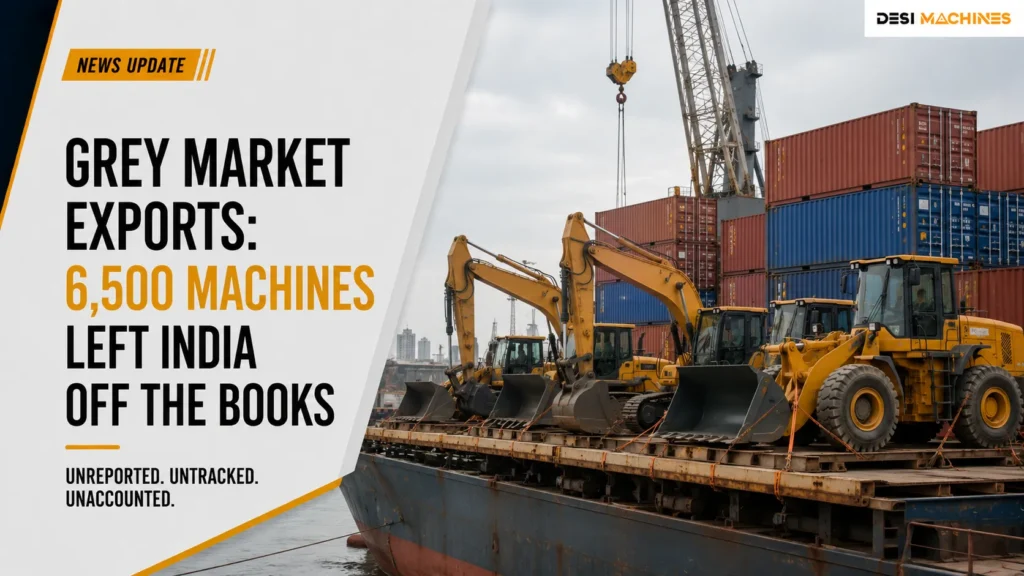
Roughly 6,500 Indian-built excavators and backhoe loaders left the country through unauthorised channels last year, a trade the managing director of CASE Construction Equipment India puts at Rs 3,900-4,500 crore. For anyone buying, financing or reselling a machine in India, that leakage is not an abstract customs problem. It quietly props up used prices, and it is why your dealer now wants to see your site before handing over a four-wheel-drive backhoe.
The quick facts
- About 6,500 machines went out without authorisation last year on CASE India’s estimate, split roughly 5,000 excavators and 1,500 backhoe loaders.
- Value put at Rs 3,900-4,500 crore (about $410-475 million). Excavators are company-stated to fetch $70,000-80,000 a unit overseas and backhoe loaders $40,000-50,000, against lower Indian prices.
- Telematics is the counter-measure. Fitted tracking now raises an alert when a machine drifts towards Mumbai or Mundra port, and CASE says it restricts sale of the four-wheel-drive configurations most likely to be diverted.
- The official record is thin. ICEMA-reported exports rose 31.5% to 17,394 units in FY26 while domestic sales fell about 7%, but the industry has lost access to the customs data that would size the unofficial flow.
What CASE India disclosed
The figures come from an interview Shalabh Chaturvedi, managing director of CASE Construction Equipment India and SAARC, gave to Autocar Professional, published on 31 July 2026. CASE is CNH Industrial’s construction-equipment brand. Treat the numbers as an industry estimate rather than a customs count, and that caveat is the story: Chaturvedi says manufacturers once tracked the pattern through customs-based trade reports, and a clampdown on agencies publishing export data has removed that visibility. “We still don’t have a clear, definitive answer from the government on how we can get access to this data,” he said. ICEMA has separately asked the customs board and the commerce ministry to restore aggregated access.
The pull is price arbitrage: a machine bought in India sells for materially more in African and West Asian markets. The twist is that the machines often do not survive the trip. Indian equipment now meets BS-V norms with after-treatment built for low-sulphur diesel, while much of the destination market runs Stage 3 or unregulated fuel. “When you take a Stage 5 machine there and you put in fuel with high sulphur content, in just two or three tanks of fuel, the engine comes off,” Chaturvedi said. He conceded the counter-measures are partial: “None of these are foolproof.”
What it means for buyers
Start with resale. If 5,000 excavators and 1,500 backhoes a year are pulled out of the domestic parc, the used market is tighter than headline demand suggests. Domestic sales fell about 7% in FY26, which reads like a slump, yet used excavator and backhoe values have held better than that. Export pull is a plausible part of the reason. Selling a five-year-old 20-tonne machine, you likely have more room than the sales data implies. Buying used, expect less of a bargain.
Second, friction is rising on exactly the specs most in demand. Dealer verification of your work site before delivery, and restricted availability of four-wheel-drive variants, are aimed at proxy buyers rather than at you, but they still land as extra paperwork and longer lead times. Budget for that if a 4WD backhoe is what the job actually needs.
Third, assume your machine is visible. Telematics is fitted and actively monitored, so a resale that ends at a port can be traced. That matters most if the machine is still hypothecated: diverting financed equipment during the charge period is the failure lenders worry about, and it feeds the tighter end-use and RC transfer checks buyers already meet when financing a machine.
Our take: the Rs 4,000 crore figure is one manufacturer’s estimate of something nobody can currently measure, so hold the precision lightly. The direction is harder to argue with. Exports are the one part of this industry growing while domestic demand shrinks, and some of that growth is happening outside the official channel.
What to watch
- Whether the customs board or commerce ministry restores aggregated trade-data access to ICEMA, replacing estimates with a real number.
- Whether other OEMs follow CASE in restricting four-wheel-drive configurations, and how fast that shows up in dealer lead times.
- Whether the proposed port revalidation mechanism, where manufacturers confirm an export is authorised, gets formal customs backing.
Pricing a machine right now? Check what the EMI looks like on the equipment finance pages before you talk to our team.
FAQ
How many construction machines leave India through grey-market exports?
CASE Construction Equipment India estimates about 6,500 machines went out without authorisation last year, roughly 5,000 excavators and 1,500 backhoe loaders, worth Rs 3,900-4,500 crore. It is an industry estimate rather than an official customs count, because manufacturers no longer have access to the export data that would confirm it.
Why do Indian excavators and backhoe loaders get exported unofficially?
Price arbitrage. The same machine sells for considerably more in African and West Asian markets than in India, so traders buy locally and ship abroad for the margin. CASE puts overseas excavator prices at $70,000-80,000 and backhoe loaders at $40,000-50,000 a unit.
Does this affect what I pay for a used machine in India?
Probably yes, indirectly. Machines leaving the country do not return to the domestic used market, so supply of late-model excavators and backhoe loaders is thinner than domestic sales figures alone suggest. That supports resale values for sellers and reduces bargaining room for buyers.
Related on DesiMachines: ICEMA FY26 data: what slower sales mean for equipment buyers
Source: Autocar Professional

 Excavator
294 models
Excavator
294 models  Backhoe Loader
51 models
Backhoe Loader
51 models  Crane
68 models
Crane
68 models  Concrete Mixer
79 models
Concrete Mixer
79 models  Wheel Loader
54 models
Wheel Loader
54 models  Compactor / Roller
45 models
Compactor / Roller
45 models  Motor Grader
42 models
Motor Grader
42 models  Concrete Pump
66 models
Concrete Pump
66 models  Skid Steer Loader
11 models
Skid Steer Loader
11 models  Telehandler
13 models
Telehandler
13 models