Excavator
294 models
Excavator
294 models  Backhoe Loader
51 models
Backhoe Loader
51 models  Crane
68 models
Crane
68 models  Concrete Mixer
79 models
Concrete Mixer
79 models  Wheel Loader
54 models
Wheel Loader
54 models  Compactor / Roller
45 models
Compactor / Roller
45 models  Motor Grader
42 models
Motor Grader
42 models  Concrete Pump
66 models
Concrete Pump
66 models  Skid Steer Loader
11 models
Skid Steer Loader
11 models  Telehandler
13 models
Telehandler
13 models 


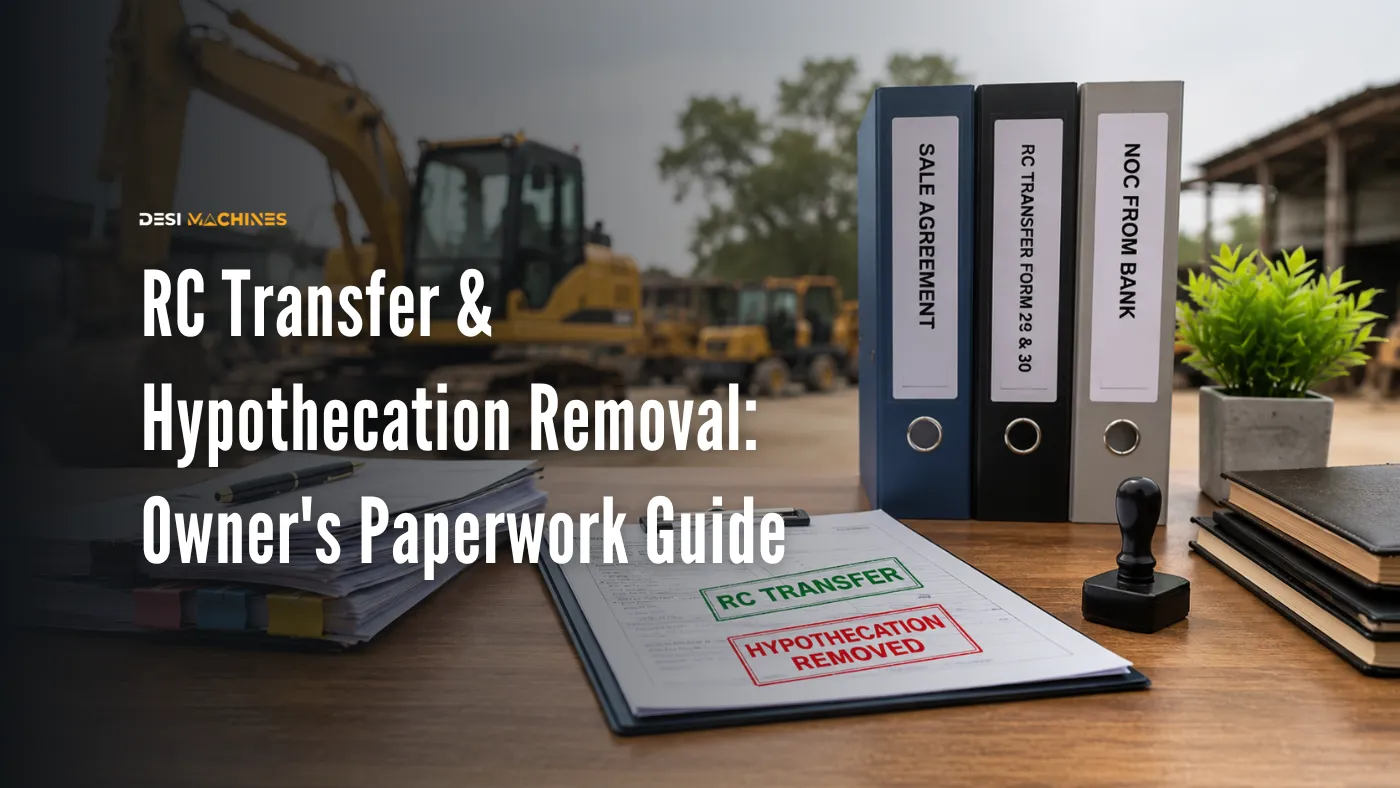
In short: RC transfer construction equipment paperwork only applies to machines actually registered with the RTO — road-going machines like backhoe loaders, cranes and rollers. The transferor files Form 29, the buyer files Form 30 within 14 days (same state) or 45 days (registered in another state), and a loan on the machine comes off with Form 35 plus the financier’s clearance certificate. Tracked excavators are usually unregistered — there is no RC to transfer, and your protection is the invoice trail, the chassis and engine numbers and a written financier clearance instead.
First question: does this machine even have an RC?
Buyers assume every machine works like a car. It does not, and getting this wrong is why some used deals stall for weeks.
| Machine | Usually registered? | What proves ownership |
|---|---|---|
| Backhoe loader | Yes | RC, plus invoice trail |
| Wheeled crane, pick-and-carry crane | Yes | RC, plus invoice trail |
| Road roller, compactor (self-propelled on road) | Usually | RC, plus invoice trail |
| Wheel loader | Often | RC if road-going, else invoice |
| Tracked excavator | Usually not | Invoice, chassis and engine numbers, sale agreement |
| Mini excavator, skid steer | Usually not | Invoice, chassis and engine numbers, sale agreement |
The line is roughly this: if the machine drives itself on a public road, it is a motor vehicle and the RTO is involved. The tax that follows that status is covered in what a machine owner actually pays as road tax. If it is loaded onto a trailer to move between sites, it generally is not.
So before you discuss forms, ask the seller one question — is it registered? — and then verify the answer rather than accepting it. An unregistered machine is perfectly normal and perfectly saleable. An unregistered machine being sold to you with a photocopied RC is a warning sign worth walking away from.
RC transfer construction equipment paperwork: Form 29, Form 30 and the clock
For a machine that does have an RC, ownership transfer follows the ordinary motor vehicle process, and it has two halves that people forget are separate.
- Form 29 — the seller reports the fact of transfer to the registering authority. This is the seller’s obligation and it protects the seller: until it is filed, the machine is still theirs on record, and so is anything it does.
- Form 30 — the buyer applies for the transfer of ownership to be recorded. This is what actually puts your name on the RC.
The deadlines are the part that catches people out. Form 30 is filed within fourteen days of the transfer where the machine is registered in the same state, and within forty-five days where it is registered in another state. The longer window for out-of-state machines exists because there is more to do — an out-of-state purchase also needs a no objection certificate from the original registering authority before re-registration, and that is the step that adds weeks to interstate deals. If you are buying across a state boundary, our guide to buying heavy machinery across states in India covers the transport, invoicing and delivery side of the same transaction.
Both forms and the related services are handled through the Parivahan portal, with the physical file at the RTO that holds the record.
Getting the loan off the RC: Form 35 and the clearance certificate
If the machine was bought on finance — and most were — the RC carries a hypothecation entry naming the financier. Until that entry is cancelled, the lender has a recorded interest in the machine, and no amount of goodwill between buyer and seller changes it.
Removing it takes two documents together:
- The financier’s clearance certificate or no objection certificate, confirming the loan is fully repaid. This is issued by the lender, on their letterhead, and it is the document the whole deal hangs on.
- Form 35, the notice of termination of the hire-purchase, lease or hypothecation agreement, signed by both the registered owner and the financier and filed with the registering authority so the entry is cancelled in the record and on the certificate.
Two practical warnings from deals that go wrong:
- Do not pay in full against a promise. If the seller still owes money, the clean structure is to pay the outstanding loan directly to the financier and the balance to the seller, against a written settlement. A seller who takes the whole amount and then does not close the loan leaves you holding a machine you cannot get registered in your name.
- NOCs expire and lenders are slow. Financier clearance letters routinely take days to weeks, and often carry a validity window. Start that process before you agree a delivery date, not after.
If you are financing the purchase yourself, the new lender will place its own hypothecation on the machine as soon as the old one comes off — the terms are different from a new-machine loan, as our guide to a used construction equipment loan explains.
The unregistered machine: what replaces the RC
For a tracked excavator with no registration, the paperwork discipline matters more, not less, because there is no government record backing your claim to the machine.
Collect and verify:
- The original purchase invoice, in the name of the person selling to you. If the invoice names someone else, ask why and get the chain documented.
- Chassis and engine numbers physically checked against the papers, on the machine, by you. Photograph them.
- Any existing finance or lease agreement, with a written clearance from that financier. Unregistered machines are still hypothecated and still repossessed.
- Service and repair history from the dealer, which doubles as evidence of who has been operating it.
- A sale agreement identifying the machine by serial numbers, stating the price, and confirming the seller’s clear title.
This list sits alongside the mechanical checks — hours, undercarriage, hydraulics, smoke — covered in our guide to buying used construction equipment safely. Both halves matter. A machine in excellent mechanical condition with a broken paper trail is still a bad buy.
A sequence that keeps you safe
- Establish whether the machine is registered, and get the RC or the invoice trail in front of you.
- Check for a hypothecation entry, and ask for the outstanding figure in writing from the financier.
- Inspect the machine and match chassis and engine numbers to the documents.
- Agree the payment structure: outstanding loan to the financier, balance to the seller.
- Collect the clearance certificate, and file Form 35 to cancel the hypothecation.
- Seller files Form 29; you file Form 30 inside the 14 or 45 day window.
- Move insurance into your name from the day you take delivery, not the day the RC updates.
Point seven is the one owners skip. The transfer of the RC and the transfer of the insurance are separate acts, and a machine working under your control on someone else’s policy is an uninsured machine in practice.
The bottom line
Used machine paperwork is not complicated, but it is sequential, and every step that gets done out of order costs weeks. Establish registration status first, resolve hypothecation before money moves, and file the transfer forms inside the window. On an unregistered machine, the invoice trail and the serial numbers are your RC — treat them with the same seriousness.
Looking at used machines now? Start with our used construction equipment listings and buyer resources, compare the total cost against a new purchase using our new versus used excavator comparison, and check what a comparable new machine costs on our excavator models and prices page before you commit.
The paperwork is one step in a longer purchase, and where it fits in the sequence is covered in our guide to how to buy used construction equipment step by step.
Procedures, forms, timelines and fees under the motor vehicle rules vary by state and are periodically amended, and the requirements here are summarised in plain terms rather than reproduced in full. Nothing here is legal advice. Confirm the current process and documents with your RTO, your financier and the seller before you pay or take delivery.