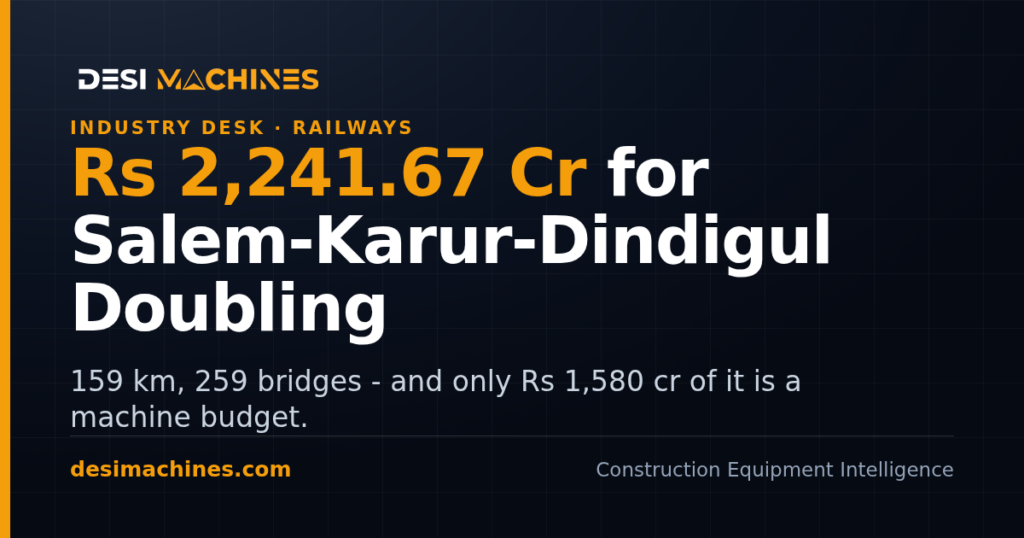
The Railway Board has put a number on one of the eight rail multitracking projects the Union Cabinet cleared earlier this month: Rs 2,241.67 crore for doubling the 159 km Salem-Karur-Dindigul section in Tamil Nadu. For anyone who owns or hires earthmoving iron in the western districts, the useful part is not the headline. It is the cost split underneath it, because only one of the three lines in that split buys machine time.
The quick facts
- Sanctioned cost Rs 2,241.67 crore for doubling 159 km of single line between Salem, Karur and Dindigul, via Namakkal.
- Split: civil works Rs 1,580.33 crore, electrical and traction Rs 379.56 crore, signalling and telecom Rs 281.78 crore.
- The alignment carries 18 major bridges and 241 minor bridges, including a Cauvery crossing between Mohanur and Vangal.
- Southern Railway has already started preliminary work: geotechnical investigation, boundary stone fixing, and piling and concrete foundations at the river crossing.
What the Railway Board sanctioned
The sanction is the project-specific stage that follows a Cabinet approval, and it is where the money is finally broken into heads. DT Next reported the figures on 23 September, with the Tamil edition of Oneindia carrying the same split alongside the structures count and a completion target of 2029-30. The three heads add up exactly to the sanctioned total, so nothing in this project is sitting unallocated. The section is currently single line and forms part of the route linking Bengaluru with southern Tamil Nadu.
What it means for buyers
Start by throwing away the headline as a demand number. Signalling, telecom, traction and general electrical works account for Rs 661.34 crore, close to 30 per cent of the sanction, and that spend buys cable, masts, relay huts and overhead equipment. It pulls almost no heavy iron. The civil line of Rs 1,580.33 crore is the machine budget, and across 159 km that works out to roughly Rs 9.94 crore per kilometre against about Rs 14.1 crore per km on the full sanction. A contractor sizing a fleet off the bigger figure will over-forecast the work by nearly a third.
The second thing worth reading is the structures count. Two hundred and fifty-nine bridges over 159 km is one roughly every 600 metres, which tells you this is not a long continuous earthwork front. It is a scatter of point works strung along an existing alignment, and that changes the ownership maths more than the value does. Our take: this looks like a hire job on the earthmoving side. When fleets move between short fronts every few weeks, low-bed charges and idle days eat the margin that buying an excavator outright is supposed to earn. The concrete side reads the other way, because 259 structures over four years is steady enough volume to justify owning batching capacity and transit mixers rather than buying ready-mix at a site rate.
Then there is the live-track constraint. Doubling runs beside a section that keeps carrying traffic, so girder erection over the 18 major bridges happens inside granted possession blocks, not on an open site. Heavy lifting in short booked windows is classic hire territory: you want the crane capacity for the block and off your books afterwards. Formation and approach work, by contrast, runs on your own schedule, which is where owned compaction plant and tippers pay. The preliminary activity already under way is the real timing signal here. Geotechnical investigation and boundary stones mean the main civil packages are being prepared now, not in some distant year, and fleet owners across Tamil Nadu should be watching the tender notices rather than the sanction.
What to watch
- Southern Railway floating the civil packages, and whether the 159 km is split into two or three contracts or awarded as one.
- The Cauvery bridge scope at Mohanur-Vangal, which sets the piling rig and crane class for the whole job.
- Whether the 2029-30 target holds once possession blocks on the live single line are scheduled.
Pricing a fleet for rail work? Compare excavator, crane and compaction models side by side on DesiMachines, and check finance options before you commit to a purchase against a single project.
FAQ
How much of the Rs 2,241.67 crore is actually civil work?
Rs 1,580.33 crore. The balance of Rs 661.34 crore covers signalling, telecom, traction and general electrical works, which buy equipment of a very different kind.
Does a doubling project need as much machinery as a new line?
Not in the same pattern. A doubling follows an existing formation and works next to live track, so the earthwork is shorter and more broken up, and much of the heavy lifting has to fit inside granted traffic blocks.
When is the work expected to finish?
Reports put the target at 2029-30. Preliminary activity including geotechnical investigation and foundation work at the Cauvery crossing has already begun.
Related on DesiMachines: Cabinet Clears Rs 20,804 Crore of Railway Multitracking: 1,196 Km Across Nine States
Source: DT Next

 Excavator
294 models
Excavator
294 models  Backhoe Loader
51 models
Backhoe Loader
51 models  Crane
68 models
Crane
68 models  Concrete Mixer
79 models
Concrete Mixer
79 models  Wheel Loader
54 models
Wheel Loader
54 models  Compactor / Roller
45 models
Compactor / Roller
45 models  Motor Grader
42 models
Motor Grader
42 models  Concrete Pump
66 models
Concrete Pump
66 models  Skid Steer Loader
11 models
Skid Steer Loader
11 models  Telehandler
13 models
Telehandler
13 models  Dozer
Dozer