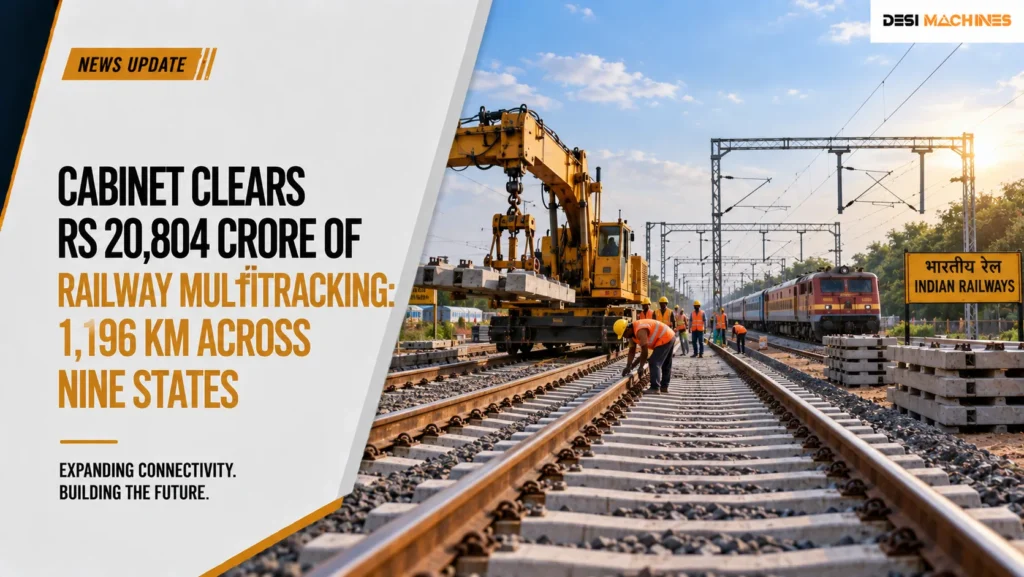
The Cabinet Committee on Economic Affairs cleared eight railway multitracking projects on 9 September 2026, worth Rs 20,804 crore across roughly 1,196 route km and nine states. For anyone who owns or hires out earthmoving plant, the headline is not the interesting number. Rs 17.4 crore per km is. That is about a quarter below the rate the same committee sanctioned for rail multitracking three weeks ago, and the gap tells you what kind of work is actually coming.
The quick facts
- Two packages, approved the same day: Rs 10,783 crore for three projects in the east and centre, and Rs 10,021 crore for five in the south. The two sums give the Rs 20,804 crore total.
- Eastern set, about 656 km: Kharagpur to Jharsuguda (Bagdehi) 4th line, Katni to Pendra Road 4th line, and Bilaspur (Uslapur) to Pendra Road 3rd line, spread over 14 districts of West Bengal, Jharkhand, Odisha, Madhya Pradesh and Chhattisgarh. Target completion 2029-30.
- Southern set, 540 km: Arakkonam to Renigunta 3rd and 4th lines (77 km), Whitefield to Bangarapet 3rd and 4th lines (47 km), Hosur to Omalur doubling (147 km), Salem to Karur to Dindigul doubling (159 km), and Secunderabad (Ghatkesar) to Kazipet multitracking (110 km), across 17 districts of Tamil Nadu, Andhra Pradesh, Karnataka and Telangana.
- The two packages together are expected to carry an extra 74 million tonnes of freight a year. No project-wise cost split was released, and no completion year was stated for the southern package.
What the Cabinet approved
Both decisions came out of the same sitting, chaired by the Prime Minister, and were carried the same afternoon by Pragativadi and Prameya News on the eastern package and by Tripura Star News on the southern one, with the rail trade site HelloRail putting the two together. The arithmetic ties in four separate places: the costs sum to Rs 20,804 crore, the route lengths to 1,196 km, the districts to 31 and the states to nine. The five southern project lengths also add up exactly to the stated 540 km.
What does the per-km rate tell an equipment buyer?
Side by side, the eastern set works out near Rs 16.4 crore per km and the southern near Rs 18.6 crore, against Rs 23 crore per km on the four-project rail package cleared in August that we covered at the time. Neither figure is a pure civil rate, since signalling, overhead equipment and land sit inside both, so treat them as a rough classifier rather than a budget.
What drags this batch down is scope. More than half the southern kilometres, the 147 km Hosur to Omalur and the 159 km Salem to Karur to Dindigul stretches, are plain doubling: one more line beside an existing single line, largely on land the railway already holds. That is thin, long, repetitive formation work rather than the structure-heavy 3rd and 4th line jobs in congested port and coal corridors that pushed the August rate up.
The fleet that follows is predictable. Borrow pits and cuttings pull 20-tonne class excavators and tippers; embankment and blanket layers pull single-drum vibratory soil compactors and tandem rollers from the compactor range; formation trimming is motor grader work repeated over hundreds of kilometres. Bridges and road overbridges bring in cranes for girder erection, and drains, cable trenching and utility diversion keep a backhoe loader busy throughout.
The catch is where the machines have to stand. Multitracking happens on the cess beside a live, heavily used running line. Traffic blocks decide when you can work, and the working width plus overhead line clearance caps how big a machine you can put there at all. A rupee of multitracking spend therefore buys fewer machine hours per day than the same rupee on a greenfield alignment, which favours hiring over buying trackside. Borrow areas and bridge substructures are open sites and behave normally, and that is where an owned fleet earns its keep.
Our take: the second-order signal may matter more than the civil work. Kharagpur to Jharsuguda, and both Pendra Road projects, sit in the Mahanadi and South East Central coal belt; Ghatkesar to Kazipet runs through Telangana’s coal and cement traffic. Evacuation capacity has been the binding constraint on despatch from several of those loading points, and 74 MTPA of extra path is a demand signal for mining fleets at the pit end as much as for civil plant along the track. Worth noting too that Katni to Pendra Road and Bilaspur to Pendra Road converge on the same junction, so one hire fleet based around Bilaspur could serve both.
What to watch
- Zonal and RVNL tender packages over the next 12 to 18 months. A sanction names no contractor, and nothing here is biddable yet.
- Whether a project-wise cost split is published. Without it there is no way to tell the doubling rates from the 3rd and 4th line rates.
- Coal and mineral despatch plans on the SECR and Mahanadi routes, which is where the extra 74 MTPA is meant to go.
Planning a fleet around rail formation work? Compare excavator, compactor and grader models on DesiMachines by price, class and running cost, and check what equipment finance looks like before the tenders land. Start with our equipment guides.
FAQ
What is railway multitracking?
It means adding one or more parallel lines to a route that already has track, usually a 3rd or 4th line on a busy corridor or a second line on a single-line section. The alignment and much of the land already exist, so the work is mostly formation earthwork, blanketing, ballast and bridges rather than a new corridor from scratch.
When can contractors bid for this work?
Not yet. The Cabinet decision sanctions the money; the zonal railways and executing agencies then break the routes into packages and tender them. On comparable sanctions that process has run 12 to 18 months, so the realistic window for bidding is 2027 onward, with completion targeted at 2029-30 for the eastern set.
Which states get the work?
Nine in total. West Bengal, Jharkhand, Odisha, Madhya Pradesh and Chhattisgarh in the eastern package, and Tamil Nadu, Andhra Pradesh, Karnataka and Telangana in the southern one, covering 31 districts between them.
Related on DesiMachines: Cabinet Clears Rs 13,041 Crore of Rail and Road Work: 410 km of Multitracking Plus NH-22 Four-Laning
Source: HelloRail
Machines, tenders and news for this industry: Railway and Metro

 Excavator
294 models
Excavator
294 models  Backhoe Loader
51 models
Backhoe Loader
51 models  Crane
68 models
Crane
68 models  Concrete Mixer
79 models
Concrete Mixer
79 models  Wheel Loader
54 models
Wheel Loader
54 models  Compactor / Roller
45 models
Compactor / Roller
45 models  Motor Grader
42 models
Motor Grader
42 models  Dozer
41 models
Dozer
41 models  Concrete Pump
66 models
Concrete Pump
66 models  Skid Steer Loader
11 models
Skid Steer Loader
11 models  Telehandler
13 models
Telehandler
13 models