Excavator
294 models
Excavator
294 models  Backhoe Loader
51 models
Backhoe Loader
51 models  Crane
68 models
Crane
68 models  Concrete Mixer
79 models
Concrete Mixer
79 models  Wheel Loader
54 models
Wheel Loader
54 models  Compactor / Roller
45 models
Compactor / Roller
45 models  Motor Grader
42 models
Motor Grader
42 models  Concrete Pump
66 models
Concrete Pump
66 models  Skid Steer Loader
11 models
Skid Steer Loader
11 models  Telehandler
13 models
Telehandler
13 models 


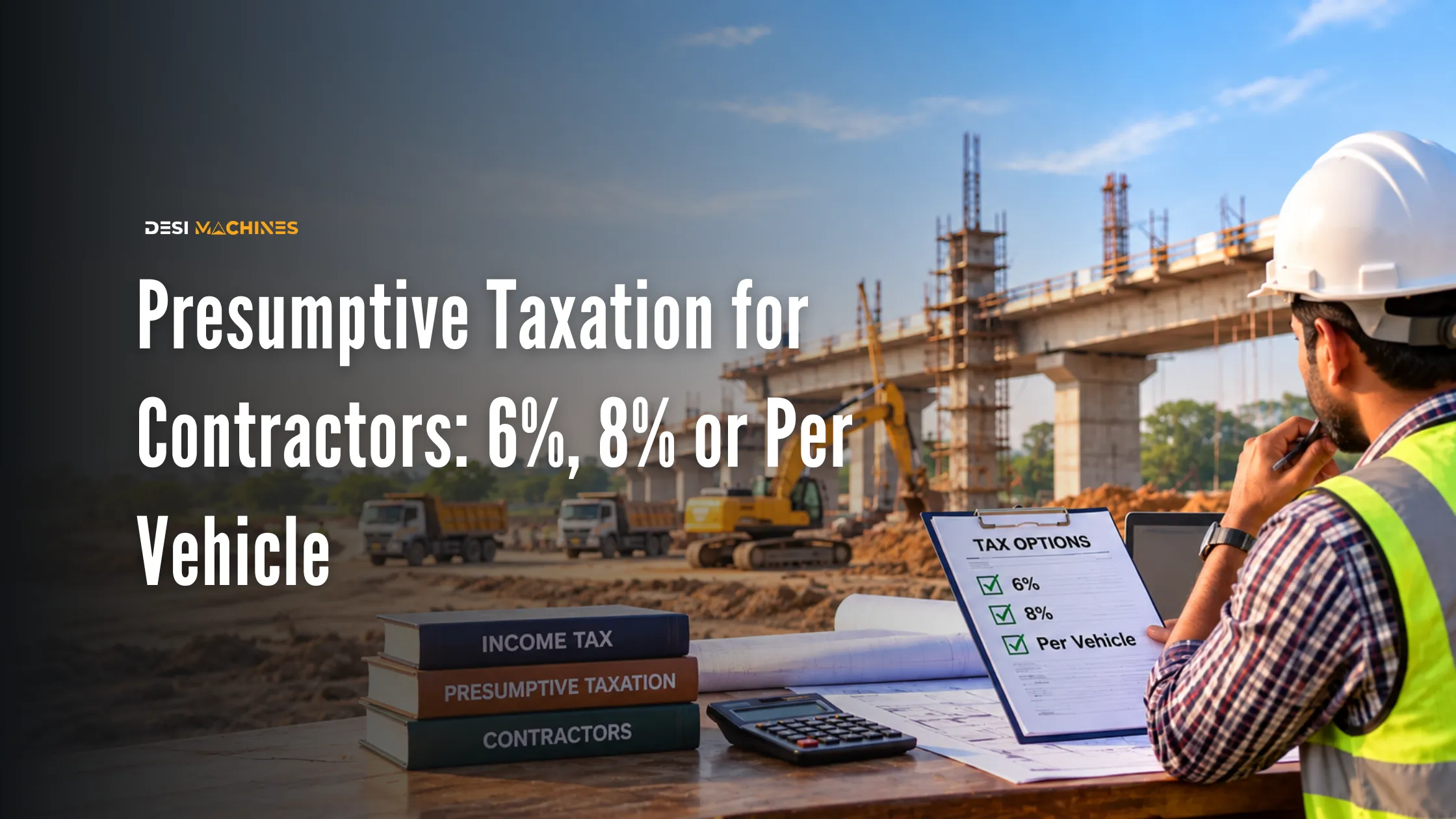
In short: Presumptive taxation for contractors runs on Section 58 of the Income-tax Act 2025, in force from 1 April 2026, and it offers two different routes. If you take works contracts or hire out machines, you declare 6% of what reached you through a bank or online mode and 8% of the rest, with turnover capped at ₹2 crore (₹3 crore where cash receipts stay within 5%). If you run tippers or trucks, you instead declare a flat sum per vehicle per month — ₹7,500 for a vehicle up to 12,000 kg and ₹1,000 per tonne above that — with a ceiling of ten vehicles and no turnover limit at all. Both routes declare the higher of the formula and your actual profit, and both quietly keep running your depreciation down.
What the scheme actually replaces
Most owners meet presumptive taxation as a shortcut: no books, no audit, one percentage, done. That is half true, and the half that gets left out is the expensive half.
What Section 58 replaces is the computation. Instead of adding up receipts, subtracting diesel, operator wages, repairs, insurance, interest and depreciation, and arriving at a profit, you declare a figure the law deems to be your profit. The saving is in the accounting work and the audit fee. It is not, on its own, a saving in tax — and for a business whose largest deduction is depreciation on a machine, the arithmetic often runs the other way.
The section sits under the Income-tax Act 2025, which commenced on 1 April 2026 under its own Section 1(3). The old 44AD and 44AE numbering that every accountant still says out loud belongs to the 1961 Act and is no longer the live reference.
Presumptive taxation for contractors runs on two routes — and one is yours
Section 58 sets out a table. Two of its three entries matter to a machine-owning business, and which one you fall in is decided by what you do, not by what you would prefer.
| Percentage route | Per-vehicle route | |
|---|---|---|
| Covers | Any business other than plying, hiring or leasing goods carriages — works contracts, earthwork, machine hire | The business of plying, hiring or leasing goods carriages |
| Who can use it | A resident individual, Hindu undivided family, or firm that is not an LLP | An assessee owning not more than ten goods carriages at any time in the tax year |
| Turnover ceiling | ₹2 crore, or ₹3 crore where cash receipts are 5% or less | None |
| Declared profit | 6% of banked or online receipts plus 8% of the rest | ₹7,500 per vehicle per month, or ₹1,000 per tonne where the vehicle is over 12,000 kg |
| Five-year lock on exit | Yes | No |
The dividing line is the phrase goods carriage, and Section 58 does not define it for itself — it borrows the meaning from Section 2 of the Motor Vehicles Act, 1988. A tipper, a dumper and a truck are goods carriages. An excavator, a backhoe loader, a crane and a soil compactor are not. So a contractor who owns four tippers and two excavators is not choosing between the routes: the tippers sit in one and the excavator hire sits in the other.
The percentage route: 6% on what was banked, 8% on the rest
The eligibility gate is turnover. Up to ₹2 crore you qualify. The limit stretches to ₹3 crore only where the amount received in cash during the year is 5% or less of total turnover or gross receipts — and Section 58(9) treats a cheque or bank draft that is not account payee as cash for exactly this test. A bearer cheque you happily banked still counts against you.
The computation then splits your receipts by how they arrived. Take a contractor who billed ₹90 lakh in the year, of which ₹85 lakh came by bank transfer and ₹5 lakh in cash:
| Receipt | Amount | Rate | Deemed profit |
|---|---|---|---|
| Received by bank or online mode | ₹85,00,000 | 6% | ₹5,10,000 |
| Everything else | ₹5,00,000 | 8% | ₹40,000 |
| Declared under Section 58 | ₹90,00,000 | ₹5,50,000 |
Two details decide whether this figure is the one you actually declare. The 6% branch applies to receipts banked during the tax year or before the return due date under Section 263(1), so a payment that lands late but before you file still earns the lower rate. And the declared figure is the higher of the formula and the profit you claim to have actually earned. A good year does not get taxed at 6% because the section says 6%.
The per-vehicle route, and the cliff at 12,000 kg
For tippers and trucks the section ignores turnover entirely and prices the vehicle. A heavy goods vehicle — defined in Section 58(11)(e) as a goods carriage whose gross vehicle weight exceeds 12,000 kg — is charged at ₹1,000 per tonne of gross vehicle weight, per vehicle, for every month or part of a month you owned it. Anything at or below 12,000 kg is charged a flat ₹7,500 per vehicle per month.
That produces a sharp step, and it is worth seeing as numbers before a purchase decision rather than after one:
| Gross vehicle weight | Heavy goods vehicle? | Deemed profit per month | Per vehicle, 12 months |
|---|---|---|---|
| 7,500 kg | No | ₹7,500 | ₹90,000 |
| 12,000 kg | No — the section says exceeds | ₹7,500 | ₹90,000 |
| 12,100 kg | Yes | ₹12,100 | ₹1,45,200 |
| 16,200 kg | Yes | ₹16,200 | ₹1,94,400 |
| 25,000 kg | Yes | ₹25,000 | ₹3,00,000 |
Crossing 12,000 kg by a hundred kilograms raises the deemed profit on that vehicle by about ₹55,000 a year. The figures above are arithmetic on the rates in the section, not a schedule the department publishes.
Three conditions catch owners out. The ten-vehicle ceiling is tested at any time during the tax year, so an eleventh tipper held for one month costs you the scheme for the whole year. A vehicle held on hire purchase or on instalments with money still owing is deemed to be owned by you under Section 58(11)(f) — financing it does not keep it off the count. And “every month or part of a month” means a vehicle bought on the 28th of a month is charged for that month in full.
One relief runs only on this route: under Section 58(5), a firm may deduct salary and interest paid to its partners from the computed figure, within the limits in Section 35(e). The percentage route gets no such deduction.
Who is shut out
Section 58(11)(a) defines the eligible assessee for the percentage route narrowly. You must be a resident individual, a Hindu undivided family, or a firm — and a limited liability partnership is expressly excluded. A contractor who converted to an LLP for the liability comfort gave up this scheme in the same move.
You are also outside it if you have claimed a deduction under Section 144 or under Chapter VIII-C, if you carry on a specified profession, or if you earn commission or brokerage or run an agency business. That last pair matters to owners who also arrange machines for others on a cut: the commission income does not merely sit outside the scheme, it disqualifies you from it.
The cost a machine owner should price in before opting
Here is the provision that decides most real cases, and it is the one least often mentioned. Section 58(6) says the written down value of any asset used in the business is computed as if depreciation had been claimed and actually allowed for each relevant year.
Read that against a machine. You do not get the depreciation deduction while you are in the scheme — Section 58(4) blocks any loss, allowance or deduction against presumptive income — but the machine’s tax value falls every year regardless. When you sell it, the gain is measured against that reduced value. You paid tax on a deemed profit that ignored depreciation, and then you pay again on a sale price measured against a value that depreciation had already pulled down. For a fleet whose single largest deduction is the machine itself, that is the number to model, and it is why capital gain on the sale of machinery and the presumptive decision should be looked at together rather than a year apart.
The honest summary: the percentage route tends to favour a labour-heavy, machine-light contractor with clean bank receipts, and to work against an owner who has just financed a new machine and has real depreciation and interest to set off.
What it does to your books and your audit
Declare at or above the presumptive figure and Section 63(2) switches the tax audit requirement off. That is the administrative prize, and it is real.
It reverses the moment you claim less. Under Section 58(3), an assessee who claims profits lower than the presumptive figure and whose total income exceeds the basic exemption must keep books under Section 62 and get them audited under Section 63. The same consequence follows the five-year lock under Section 58(8).
For the goods-carriage route, Section 58(10) goes further: the books and audit provisions do not apply to that business at all, and its receipts are left out when the monetary limits under those sections are worked out. A tipper operator with a separate trading business therefore does not drag his tipper turnover into the audit threshold test.
Worth knowing where the general audit line sits in any case: under Section 63, business turnover above ₹1 crore triggers an audit, and that becomes ₹10 crore where both cash receipts and cash payments stay within 5% of their totals. Keeping payments out of cash is what buys that headroom, which is the same discipline the cash payment limit for contractor bills imposes on the expenditure side.
The five-year lock
The percentage route is not a switch you flip each year. Under Section 58(7), if you declare on the presumptive basis and then, in any of the five following years, declare otherwise, you lose the benefit of the section for five tax years after the year you stopped. Section 58(8) attaches books and audit to that period where income exceeds the basic exemption.
So the decision has a tail. A contractor who opts in for the simplicity, wins a large tender in year three, and needs real deductions against a genuinely thin margin will find the door shut for five years. The per-vehicle route carries no equivalent lock.
One thing this piece deliberately does not give you
Section 58(7) and the audit provisions refer to the “basic exemption” — the maximum amount not chargeable to tax — and Section 63 sets the audit report on a “specified date” one month before the return due date under Section 263(1). The slab figure itself, and the prescribed audit form, live outside the section in material this piece has not verified. Neither is asserted here. Your accountant has both in front of them, and the threshold arithmetic above does not depend on either.
The bottom line
Treat the choice as a costing exercise, not a filing preference. Work out your actual profit for the year with depreciation and interest in it, then work out the Section 58 figure for your route, and remember that the law makes you declare the higher of the two. If the presumptive number is the higher one, you are paying a premium for a lighter compliance load — sometimes a fair trade, sometimes an expensive one.
Then check the tail: the five-year lock, the ten-vehicle ceiling tested at any moment in the year, the LLP exclusion, and the written down value that keeps falling whether or not you claim the deduction. If a new machine is what tipped your margin thin in the first place, compare what the purchase is really costing you on equipment finance before you also give up the depreciation that goes with it. Owners billing government departments should read this alongside TDS on machinery hire charges, since tax already deducted from your bills is credited against whatever the presumptive figure produces, and those chasing fresh work can scan live government construction and equipment tenders in one place.
Rates, thresholds, schemes and prices change — the figures here are the rates written into Section 58 of the Income-tax Act 2025 as in force on the date of writing, and the worked examples are arithmetic on those rates rather than published tables. Confirm your own position with a chartered accountant, and confirm current terms with the bank, dealer or insurer before deciding. DesiMachines is not liable for decisions taken on the basis of information that may have changed after publication.