
 Excavator
294 models
Excavator
294 models  Backhoe Loader
51 models
Backhoe Loader
51 models  Crane
68 models
Crane
68 models  Concrete Mixer
79 models
Concrete Mixer
79 models  Wheel Loader
54 models
Wheel Loader
54 models  Compactor / Roller
45 models
Compactor / Roller
45 models  Motor Grader
42 models
Motor Grader
42 models  Concrete Pump
66 models
Concrete Pump
66 models  Skid Steer Loader
11 models
Skid Steer Loader
11 models  Telehandler
13 models
Telehandler
13 models  Dozer
Dozer 


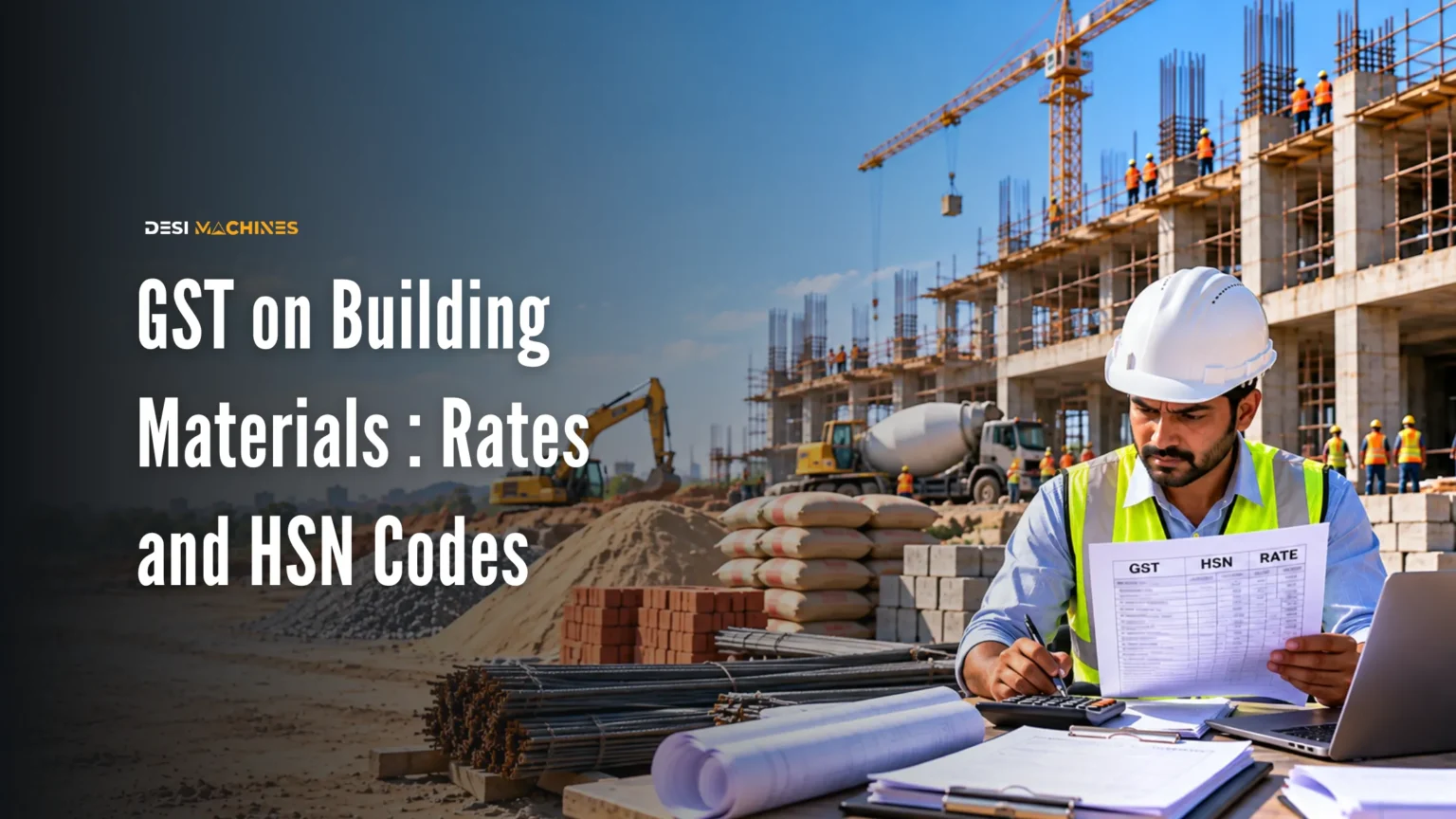
Cement is taxed at 18 per cent. Sand is 5. Bricks sit at 12 per cent, or 6 per cent if the seller has given up his input credit, and that odd little exception is the one most material bills get wrong. GST on building materials in India is set by two documents working together: Notification No. 9/2025 – Integrated Tax (Rate), dated 17 September 2025, which fixes the rate for each material by its HSN code, and a separate brick scheme that the GST Council deliberately left untouched. Both took effect on 22 September 2025.
HSN stands for Harmonised System of Nomenclature. It is the numbering system that decides what a product is for tax purposes, and it is printed on every proper invoice you receive. If you know the HSN code of what you are buying, you know the rate, and you can check whether your supplier has charged it correctly.
The big change is that the 28 per cent slab no longer touches construction at all. Cement, which sat at 28 per cent for eight years, came down to 18. The residual 28 per cent schedule now holds nothing but pan masala and tobacco. So if somebody quotes you 28 per cent GST on a building material today, the figure is out of date.
What is the GST rate on building materials in India?
Almost every building material now falls into one of three buckets: 5 per cent for materials that come more or less straight out of the ground, 18 per cent for anything processed or manufactured, and a special 12 per cent scheme that applies only to bricks. The table below lists the materials an Indian builder actually buys, with the HSN heading each one sits under.
| Material | HSN heading | GST rate | Earlier rate |
|---|---|---|---|
| Portland, slag and aluminous cement | 2523 | 18% | 28% |
| Natural sand of all kinds | 2505 | 5% | 5% |
| Pebbles, gravel, broken or crushed stone | 2517 | 5% | 5% |
| Gypsum and plasters | 2520 | 5% | 5% |
| TMT and all other steel bars and rods | 7213 to 7215 | 18% | 18% |
| Steel angles, shapes and sections | 7216 | 18% | 18% |
| Fabricated steel structures | 7308 | 18% | 18% |
| Concrete blocks, pavers and artificial stone | 6810 | 18% | 18% |
| Ceramic floor and wall tiles | 6907 | 18% | 18% |
| Marble and granite blocks | 2515 11, 2515 12 10, 2516 11 | 5% | 12% |
| Marble and granite other than blocks | 2515 12 20, 2515 12 90, 2516 12 | 18% | 18% |
| Worked building stone | 6802 | 18% | 18% |
| Plaster boards and plaster articles | 6809 | 18% | 18% |
| Paints and varnishes | 3208, 3209 | 18% | 18% |
| Putty and caulking compounds | 3214 | 18% | 18% |
| Plastic pipes and fittings | 3917 | 18% | 18% |
| Particle board and fibreboard | 4410, 4411 | 18% | 18% |
| Wooden doors, windows and joinery | 4418 | 18% | 18% |
| Float and safety glass | 7005, 7007 | 18% | 18% |
| Sand lime bricks | 68 | 5% | 12% |
| All other bricks and earthen roofing tiles | 6901, 6904, 6905, 6815 | 12% with credit, 6% without | same |
The rates in the first twenty rows come from the schedules of Notification No. 9/2025 – Integrated Tax (Rate). Schedule I of that notification carries the 5 per cent list and Schedule II the 18 per cent list. The last row is governed by the separate brick scheme described further down.
What is the GST rate on cement now?
Cement is 18 per cent, down from 28 per cent. The reduction was recommended at the 56th meeting of the GST Council on 3 September 2025 and took effect on 22 September 2025. It covers heading 2523, which is broad: ordinary Portland cement, Portland pozzolana cement, slag cement, aluminous cement and super sulphate cement all sit inside it. Whichever bag your dealer sends, the rate is the same.
Ten percentage points on cement is real money on a house. Cement is usually the second largest material line after steel, so the cut moves the bottom line more than its single-line size suggests. Work out your cement quantity first, then apply the rate — the method for that is set out in how to calculate cement, sand, aggregate and steel.
One thing the rate cut does not do is settle which cement you should buy. Grade and type still matter more to a slab than a few percentage points of tax, and the difference between OPC, PPC and PSC is where that decision actually gets made.
Pre-cast concrete is a different animal from a cement bag. A pre-cast block, paver or pipe is an article of cement or concrete under heading 6810, taxed at 18 per cent. Ready-mixed concrete that arrives on site as part of a job that includes placing and pumping it is usually not a sale of goods at all but a works contract, which is taxed under its own rules. If your contract is for work rather than for material, read the rules on works contracts before you accept the rate on the invoice.
Why are bricks still taxed at 12 per cent?
Because bricks are not taxed under the ordinary rate schedules at all. Since 1 April 2022 they have had their own arrangement, called a special composition scheme, which came out of a Group of Ministers report on capacity-based taxation. A composition scheme is a simplified way of paying tax: the seller pays a flat lower rate and gives up the right to claim credit for the tax he paid on his own purchases.
Under that scheme a brick seller charges either 12 per cent with input tax credit, or 6 per cent without it. When the Council removed the 12 per cent slab for goods generally in September 2025, it left this scheme alone. The Ministry of Finance put it plainly in its own list of answers on the Council’s decisions: all kinds of bricks except sand lime bricks continue to attract GST of 6 per cent without credit and 12 per cent with credit.
The scheme covers more than red clay bricks. Fly ash bricks, fly ash aggregates and fly ash blocks are in it, which is why heading 6815 in the 18 per cent schedule specifically excludes them. Bricks of fossil meals, building bricks and earthen or roofing tiles are all inside it too. Sand lime bricks are the single exception: they were moved from 12 per cent to 5 per cent, and they sit in the ordinary 5 per cent schedule under chapter 68.
There is a second consequence worth knowing if you are the one selling. A brick supplier has to register for GST once his turnover crosses ₹20 lakh, not the ₹40 lakh that applies to goods generally. Small kilns therefore come into the tax net earlier than other small traders, and that lower threshold has not changed either.
Watch the boundary between a brick and a block, because it is where the rate moves. A red clay brick or a fly ash brick is in the 12 per cent scheme. A concrete block or a paver block is an article of cement under heading 6810, taxed at 18 per cent. Two products that do the same job in a wall, six percentage points apart.
Autoclaved aerated concrete blocks sit awkwardly across that line, and it is worth being straight about it rather than quoting one figure. The 18 per cent entry for heading 6815 specifically excludes fly ash bricks, fly ash aggregates and fly ash blocks, so a block that qualifies as a fly ash block is carved out of the 18 per cent list and falls into the brick scheme instead. A block that does not qualify is an article of concrete at 18 per cent. The rate therefore turns on what the block is made of, not on what it is called, so ask your supplier for the HSN code, the rate and the fly ash content on the quotation in writing. Tax aside, the sizes, weight and density of AAC blocks decide most of that choice.
What is the GST rate on steel and TMT bars?
Steel reinforcement is 18 per cent and was not changed in September 2025. The notification is unusually tidy here: one entry covers headings 7213 to 7215 as “all bars and rods, of iron or non-alloy steel”, which takes in every TMT bar a house or a small commercial building will ever use. Alloy steel bars and rods under headings 7227 and 7228 are also 18 per cent, so grade does not shift the rate.
Angles, channels and sections come under heading 7216 at 18 per cent. Once those sections are fabricated into a frame, a roof truss or a shed, the finished item moves to heading 7308 as a fabricated structure, still at 18 per cent. The rate follows the steel through the fabrication shop, which keeps the arithmetic simple even when the product changes shape.
What varies on a steel bill is the basis of the quote rather than the tax. Some suppliers quote per kilogram, some per bundle, and a bundle is not a fixed weight across brands. Settle the unit before you compare two quotes; choosing the right TMT bar grade and brand is a separate question from what the tax adds.
Why are sand, stone and gypsum only 5 per cent?
The 5 per cent list is mostly made of things that are dug, crushed or screened rather than manufactured. Natural sand of all kinds is heading 2505. Pebbles, gravel and broken or crushed stone of the kind used for concrete are heading 2517. Gypsum and plasters are heading 2520. All three are in Schedule I at 5 per cent, and all three were at 5 per cent before September 2025 as well.
Manufactured sand behaves the same way when it is sold as crushed stone. M-sand and quarry dust are products of a crusher working on quarried rock, so they fall under the crushed-stone heading at 5 per cent rather than being treated as a processed good. The sizes and uses of quarry dust and M-sand explain where each one belongs in a mix.
Two cautions on the low rate. First, royalty is not GST: a state levies royalty on minerals separately, and it is charged on the extraction, not on your purchase, so it can appear in the price of sand or aggregate without ever showing on your bill as tax. The rules on mineral royalty set out how that works. Second, much of India’s sand and aggregate moves through unregistered suppliers who issue no tax invoice. A cheaper load with no bill is not a 5 per cent load but an untaxed one, and it leaves you nothing to show if the quantity or quality is short.
Marble and granite: a block and a slab are taxed differently
This is the trap that catches the most invoices. Marble and granite in block form dropped from 12 per cent to 5 per cent in September 2025, as part of a set of reductions aimed at labour-intensive goods. Crude or roughly trimmed marble and travertine under 2515 11, marble blocks under 2515 12 10, and crude granite and granite blocks under 2516 11 are all now 5 per cent.
Cut them into slabs or tiles, though, and they leave the 5 per cent list. Marble and travertine other than blocks, under 2515 12 20 and 2515 12 90, and granite other than blocks, under 2516 12 00, are in the 18 per cent schedule. The stone is identical. What changed is that somebody sawed it, and that is enough to move the rate by thirteen percentage points.
So when a stone dealer quotes you 5 per cent on polished flooring slabs, the rate is wrong even though the same figure would be right for the block that slab was cut from. Worked building stone under heading 6802 is 18 per cent for the same reason. Check which form you are actually buying before you accept the tax on the bill.
Is GST on building materials 18 per cent or 28 per cent?
For building materials, 28 per cent no longer exists. The residual 28 per cent schedule of Notification No. 9/2025 contains six entries and all six are pan masala or tobacco: pan masala under 2106 90 20, unmanufactured tobacco under 2401, cigars and cigarettes under 2402, other manufactured tobacco under 2403, and two inhalation products under 2404. Not one construction material appears in it.
A 40 per cent rate does exist, but only for sweetened and carbonated drinks, larger cars, motorcycles above 350 cc, aircraft, yachts and handguns. No building material sits there either.
That leaves 5, 12 and 18 per cent as the only rates you will meet on a material bill. If a quotation says 28 per cent, it was written against the old schedule, and the supplier is overcharging you by ten percentage points on cement.
How to read GST on a building material bill
A material invoice splits the tax in one of two ways depending on where the supplier is. Buy within your own state and the total splits into CGST and SGST, half each: on cement at 18 per cent you will see 9 per cent CGST and 9 per cent SGST. Buy from another state and the same 18 per cent appears as a single line of IGST. The total is the same either way, so a bill showing 9 plus 9 and a bill showing 18 are not different rates.
Four things are worth checking on every invoice. The HSN code should match what was actually delivered, because the code is what justifies the rate. The rate should match the table above. The supplier’s GSTIN should be printed and should not be blank. And the taxable value should be the price before tax, not after, or the tax gets charged on itself.
Whether you can claim that tax back is a separate question, and for most people building their own house the answer is no. Input tax credit is the mechanism that lets a registered business set the tax it paid on purchases against the tax it collects on sales, and it is restricted for construction of immovable property. If you are a contractor rather than an owner-builder, the position is different and it turns on how your contract is written, which is covered in the rules on works contracts and who gets the input credit. Where a client supplies the cement himself, the treatment changes again, and that sits in the rules on free issue material.
Machines are a different chapter of the tariff altogether. A mixer, a backhoe loader or an excavator is taxed under chapter 84, not under any of the material headings above, and the rate and credit position for equipment is set out separately in GST on construction equipment, rates and HSN codes.
What this means when you are buying
Put the tax in the estimate rather than discovering it at the end. At 18 per cent on cement, steel, tiles, paint and plumbing, and 5 per cent on sand and aggregate, material tax is a visible line in the budget, not a rounding error. Build it into the quantities from the start, the way a proper estimate and rate analysis does, and carry it through your overall cost estimate.
Three habits protect you. Ask for the HSN code on the quotation, not just on the final bill, so a wrong rate surfaces before you have paid it. Treat 28 per cent on any material as an error to be queried. And when a brick seller quotes 6 per cent, understand that it is a legitimate rate under the composition scheme rather than a discount he is offering you.
When your material list is ready and you are costing the machines that will place it, you can compare live concrete mixer models and prices and speak to a dealer.
GST rates and HSN classifications in this guide are taken from Notification No. 9/2025 – Integrated Tax (Rate) dated 17 September 2025 and from the Ministry of Finance’s published answers on the 56th GST Council’s decisions, and are stated as they apply from 22 September 2025. Rates, classifications and thresholds are amended from time to time, and the correct classification of a particular product depends on its exact description. Prices, specifications and features are indicative, vary by variant, location and date, and should always be confirmed with the official OEM or authorised dealer before any purchase decision. Confirm the rate applicable to your own purchase with your supplier or a tax professional. DesiMachines is not liable for decisions taken on the basis of information that may have changed after publication.
Sources: Recommendations of the 56th Meeting of the GST Council and the Ministry of Finance’s second set of answers on those decisions, Press Information Bureau.
Frequently Asked Questions (FAQ)
Cement is taxed at 18 per cent, down from 28 per cent, with effect from 22 September 2025. The rate applies to the whole of HSN heading 2523, so ordinary Portland cement, Portland pozzolana cement, slag cement, aluminous cement and super sulphate cement are all charged at the same 18 per cent.
Bricks are not taxed under the ordinary rate schedules. Every kind of brick except sand lime bricks falls under a special composition scheme at 12 per cent with input tax credit or 6 per cent without it, and the GST Council left that scheme unchanged in September 2025. Sand lime bricks were reduced from 12 per cent to 5 per cent. A brick supplier has to register for GST once turnover crosses ₹20 lakh rather than the ₹40 lakh that applies to goods generally.
Cement is HSN heading 2523. Articles made of cement or concrete, such as blocks, pavers and pipes, sit separately under heading 6810 and are taxed at 18 per cent. The HSN code should be printed on your invoice, because it is the code that justifies the rate you have been charged.
No building material is taxed at 28 per cent any more. The residual 28 per cent schedule now contains only pan masala and tobacco products, and the 40 per cent rate covers items such as aerated drinks, larger cars and yachts. Building materials fall at 5, 12 or 18 per cent only, so a quotation showing 28 per cent has been written against the old schedule.
Natural sand of all kinds is 5 per cent under HSN heading 2505, and pebbles, gravel and broken or crushed stone used for concrete are 5 per cent under heading 2517. Manufactured sand and quarry dust are products of crushed stone and are charged at the same 5 per cent. Gypsum and plasters under heading 2520 are also 5 per cent.
Page Contributers
Costing a build? Compare live concrete mixer models and prices and talk to a dealer.
Disclaimer
Desi Machines is a platform where you can see and compare construction equipment. It showcases images, brochures, features, technical specifications, brand details & dealer information. All these are taken from respective brand websites, brochures, and other public resources. We do not claim ownership of these materials and strive to ensure their accuracy. However, the disparity may happen and we advise users to verify directly with respective brands and dealers. Desi Machines is not liable for any inaccuracies or reliance on the information provided. Use of this website is at your own discretion.
Tell us what you are looking for
Shared only with our team and the dealer or lender you ask for. We call you back; no spam.