
 Excavator
294 models
Excavator
294 models  Backhoe Loader
51 models
Backhoe Loader
51 models  Crane
68 models
Crane
68 models  Concrete Mixer
79 models
Concrete Mixer
79 models  Wheel Loader
54 models
Wheel Loader
54 models  Compactor / Roller
45 models
Compactor / Roller
45 models  Motor Grader
42 models
Motor Grader
42 models  Concrete Pump
66 models
Concrete Pump
66 models  Skid Steer Loader
11 models
Skid Steer Loader
11 models  Telehandler
13 models
Telehandler
13 models  Dozer
Dozer 


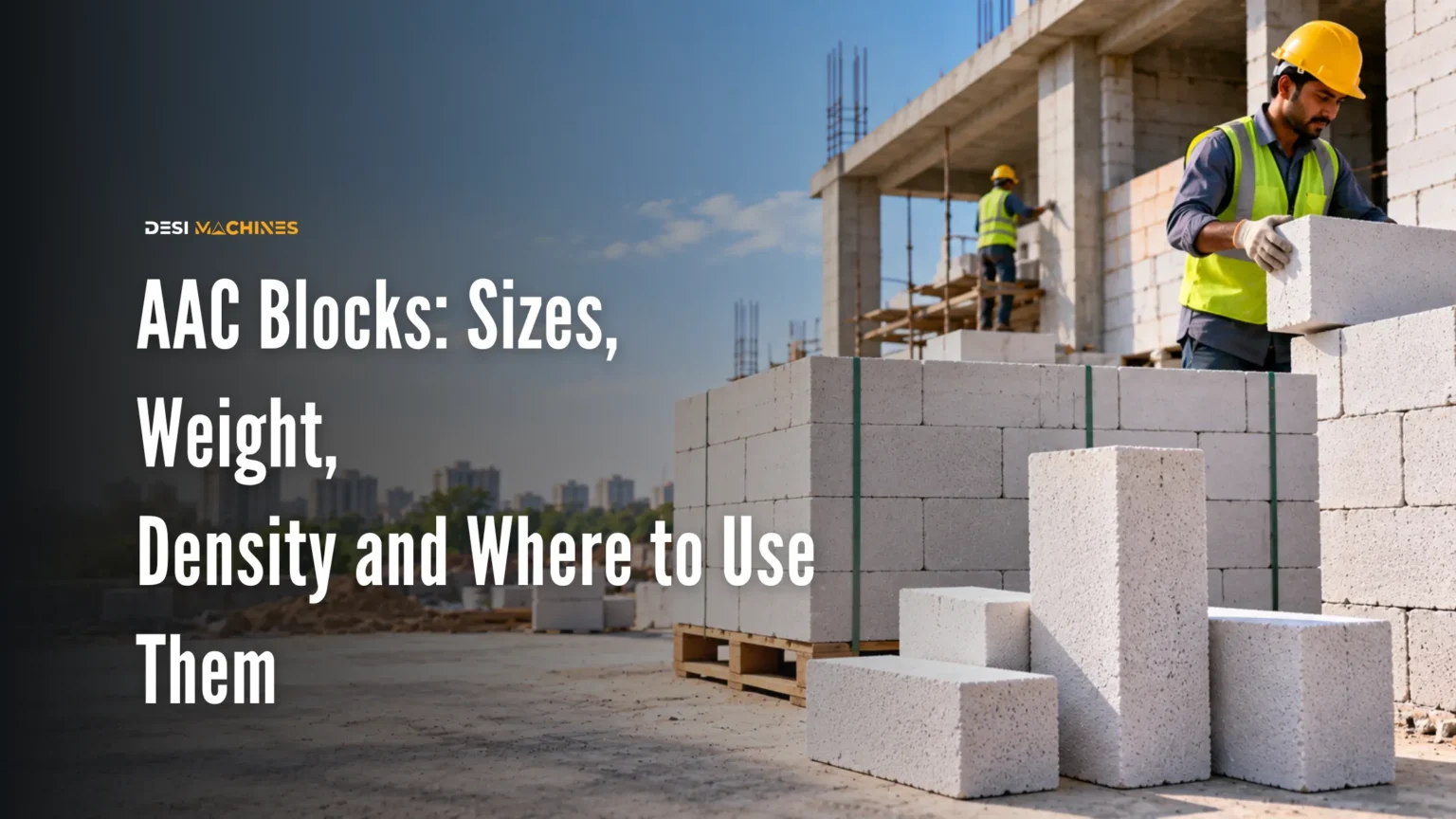
Almost every AAC block sold in India has the same face: 600 mm long and 200 mm tall, about 24 inches by 8 inches. What changes from one order to the next is the thickness, and the choices run 75, 100, 150, 200, 230 and 250 mm. Pick the thickness and the rest of the size chart follows from it, including how many blocks a wall needs and what each one weighs when your labour has to lift it.
This guide gives the sizes in millimetres and in inches, the weight per block, the density and strength grades the Indian standard sets, and which thickness belongs in which wall. It also explains how to read a rate so you can compare two quotes that look nothing alike.
What does AAC stand for, and what is an AAC block?
AAC is short for autoclaved aerated concrete. It is a concrete made from cement, lime, fine sand or fly ash and a small amount of aluminium powder. The aluminium reacts with the lime and releases hydrogen gas, which puffs the wet mix up like dough and leaves millions of tiny sealed air bubbles through it. The swollen cake is then cut to size with wires and cured in an autoclave, which is a large sealed chamber that holds the blocks in high pressure steam for several hours.
Those air bubbles are the whole point. They make the block light enough to pick up in one hand and slow enough at passing heat that the room behind it stays cooler. In much of western and southern India you will hear the blocks called siporex, after an early brand name, in the same way every excavator is a poclain. It is the same product.
The Indian standard that governs them is IS 2185 (Part 3), the specification for autoclaved cellular aerated concrete blocks. Every figure in the tables below comes from it. If you want the background chemistry, autoclaved aerated concrete covers how the material was developed.
What are the standard AAC block sizes in India?
The standard AAC block size in India is 600 mm long by 200 mm tall, with the thickness varying by wall. IS 2185 (Part 3) lists nominal lengths of 400, 500 and 600 mm, heights of 200, 250 and 300 mm, and widths of 100, 150, 200 and 250 mm. The market has settled almost entirely on the 600 by 200 face because it lays fast and suits the way Indian plants cut their cake.
| Thickness | In inches | What it is usually called | Blocks per cubic metre | Weight per block |
|---|---|---|---|---|
| 75 mm | 3 inch | Light partition | 111 | 5.0 to 5.9 kg |
| 100 mm | 4 inch | 4 inch partition wall | 83 | 6.6 to 7.8 kg |
| 150 mm | 6 inch | 6 inch internal wall | 56 | 9.9 to 11.7 kg |
| 200 mm | 8 inch | 8 inch external wall | 42 | 13.2 to 15.6 kg |
| 230 mm | 9 inch | 9 inch external wall | 36 | 15.2 to 17.9 kg |
| 250 mm | 10 inch | Thick external wall | 33 | 16.5 to 19.5 kg |
Weights above are worked out for the 551 to 650 kg per cubic metre density class, which is what most Indian plants make, and for blocks in the oven-dry condition the standard measures. A block that has been sitting in the monsoon will weigh more, because AAC soaks up water.
One number on that chart is worth remembering. The 230 mm size is not in the standard’s list of nominal widths. It exists because Indian masons build 9 inch walls and always have, and the standard allows it: clause 3.2.2 says blocks of sizes other than those listed may be used if specified. So a plant can make a 230 mm block and still supply to IS 2185.
Why is a 600 mm AAC block sometimes not 600 mm?
Because the size written on the quotation may be the nominal size, and a nominal size includes the mortar joint. IS 2185 is explicit about it. A block is referred to by its nominal dimensions, the term nominal means the dimension includes the thickness of the mortar joint, and the actual block is 10 mm shorter than nominal, or 6 mm shorter where finer jointing is specified.
So a block described as 600 by 200 by 200 can arrive measuring 590 by 190. Nothing is wrong with it. The missing 10 mm is the joint you are about to fill, and the arithmetic works out so that a finished wall lands on a round number.
Nominal size against actual size
The tolerance is separate from this, and it is the figure to measure against. IS 2185 allows a variation of plus or minus 5 mm on the length of a unit, and plus or minus 3 mm on the height and the width. A tape measure and three blocks off the pallet will tell you in a minute whether a load is inside that.
In practice most AAC today is laid with thin bed adhesive rather than ordinary cement mortar, which leaves a joint of only 2 to 3 mm. That is closer to the finer jointing case the standard describes. Ask the plant one question before you order: is the size on your quotation the nominal size or the size you actually cut? Two suppliers can quote the same number and deliver blocks that differ by a centimetre.
What do AAC block density and grade mean?
Density is the mass of a block divided by its full volume, air bubbles included, and it is the number that drives everything else about AAC. A lighter block insulates better. A heavier block carries more load. IS 2185 (Part 3) sorts blocks into five density classes and two strength grades, and sets a minimum compressive strength and a maximum thermal conductivity for each.
| Oven-dry density | Grade 1 minimum strength | Grade 2 minimum strength | Maximum thermal conductivity |
|---|---|---|---|
| 451 to 550 kg/m³ | 2.0 N/mm² | 1.5 N/mm² | 0.21 W/m.K |
| 551 to 650 kg/m³ | 4.0 N/mm² | 3.0 N/mm² | 0.24 W/m.K |
| 651 to 750 kg/m³ | 5.0 N/mm² | 4.0 N/mm² | 0.30 W/m.K |
| 751 to 850 kg/m³ | 6.0 N/mm² | 5.0 N/mm² | 0.37 W/m.K |
| 851 to 1000 kg/m³ | 7.0 N/mm² | 6.0 N/mm² | 0.42 W/m.K |
Read that table sideways and the trade-off is plain. Going from the lightest class to the heaviest roughly doubles the conductivity, meaning twice as much heat comes through the wall, and it more than triples the strength. Compressive strength here is measured in newtons per square millimetre, which is the load a block can take before it crushes. Thermal conductivity in watts per metre kelvin measures how readily heat passes through the material, so a smaller number keeps the room cooler.
The standard also caps drying shrinkage, the amount a block shrinks as it dries out, at 0.05 percent for Grade 1 and 0.10 percent for Grade 2. Shrinkage is what puts hairline cracks in a plastered AAC wall, which is why blocks should not be soaked before laying the way clay bricks are.
For a house wall that carries no structural load, the 551 to 650 class at Grade 1 is the usual specification and it is what the weight column in the size chart assumes. Ask for the density class and the grade in writing on the invoice. A plant that cannot tell you either is not testing.
Which AAC block thickness goes where in a house?
Thickness is chosen for three jobs at once: keeping heat out, keeping noise out, and holding up whatever gets hung on the wall. For a normal framed house, where the columns and beams carry the building and the walls only fill in between them, this is how the sizes usually land.
| Wall | Usual thickness | Why |
|---|---|---|
| Toilet and bathroom partitions, cupboard backs | 75 to 100 mm | No load, and thin walls give back floor space in a small room |
| Internal room partitions | 100 to 150 mm | 150 mm cuts noise between bedrooms noticeably better than 100 mm |
| External walls, most of India | 200 mm | The standard outside wall. Enough mass for heat and weather |
| External walls in very hot or very cold districts | 230 to 250 mm | Thicker wall, slower heat transfer, lower cooling bills |
| Walls carrying load in a low-rise build | 200 mm and above, Grade 1 | Needs the strength class checked against the design, not assumed |
Two cautions worth more than any chart. AAC does not hold an ordinary nail or a plain masonry screw the way solid brick does, so anything heavy on the wall, a geyser, a wall-hung basin, a large television, needs the right anchor for aerated concrete or a solid block built into that spot. And where a wall carries real load, the thickness and grade come from whoever designed the structure. That is not a decision to take off a size chart.
How many AAC blocks do you need for a wall?
There is one number that makes this easy, and it does not change with thickness. A 600 by 200 mm face covers 0.12 square metres, so one square metre of wall takes 8.33 blocks whatever the wall thickness. In square feet, one block covers about 1.29 sq ft, so a square foot of wall takes roughly 0.77 blocks.
Work it in three steps. Measure the wall area in square metres, length times height. Subtract the doors and windows. Multiply what is left by 8.33, then add about 5 percent for cutting and breakage, more if the wall has many corners or small returns.
A wall 4 m long and 3 m high is 12 square metres. Take off a 2 square metre door and 10 square metres remain, which is 83 blocks, call it 88 with wastage. That figure is the same whether you build it in 100 mm or 200 mm, because thickness changes the volume and the cost, not the number of faces. Thickness is what the per cubic metre column in the size chart is for. If you are pricing a whole house rather than one wall, the house construction cost calculator sets out how walling fits into the total, and the wider construction cost guides cover the other heads.
You will also need thin bed adhesive, sold in bags and quoted per square metre of wall, and the plant selling you blocks will usually quote it alongside. Where the wall gets a cement plaster finish, the cement type matters as much as the block does, and choosing the right cement goes through which grade suits plaster.
How should you read an AAC block price list?
Rates for AAC blocks are quoted two ways and the two cannot be compared as they stand. A plant may quote per piece, or per cubic metre. A per piece rate means nothing until you know the thickness, because a 100 mm block and a 230 mm block are both one piece and one holds more than twice the material.
Put every quote on the same basis before you look at it. To convert a per piece rate to a per cubic metre rate, multiply it by the blocks per cubic metre figure from the size chart: a 100 mm block quote gets multiplied by 83, a 200 mm by 42. To convert to a rate per square metre of wall, multiply the per piece rate by 8.33 instead. Once both quotes are per cubic metre, or both are per square metre of wall, the cheaper one is actually cheaper.
No national rate is published here, and that is deliberate rather than an omission. AAC block prices are genuinely local. The blocks are bulky and light, so a truck fills up on volume long before it reaches its weight limit and freight becomes a large share of what you pay. Distance from the nearest plant moves the delivered rate more than anything else, which is why rates quoted for Hyderabad or Bengaluru tell you very little about what you will pay in a small town three hundred kilometres away.
Four things move the number: how far the plant is, the thickness, the size of the order, and whether adhesive and delivery are included. Ask for two written quotes, both landed at your site, both stating thickness and density class, and both saying clearly whether the rate is per piece or per cubic metre. That comparison is worth more than any price list.
What should you check before accepting a delivery?
Blocks arrive shrink-wrapped on pallets and the damage that matters happens in handling, so check before the truck leaves. Five things take ten minutes together.
- Measure three blocks from different parts of the load. Length should be within 5 mm of what was ordered, height and width within 3 mm.
- Check the invoice states the density class and the grade. If it does not, ask for it in writing before you pay.
- Look along the edges for chipped corners and cracked blocks. AAC is light and it breaks at the arris, the sharp edge where two faces meet. A few broken ones in a load are normal; a pallet of them is a handling problem you should not pay for.
- Check the blocks are dry and the wrapping is intact. Wet blocks are heavier to lift, slower to lay and more likely to shrink and crack later.
- Count the pallet against the delivery note rather than trusting the number written on the wrap.
On a house build the load comes off by hand. On a multi-storey site the pallets need lifting to each floor, and that is usually a telehandler rather than a crane, because the lift is short and the load is awkward rather than heavy. Store the pallets on level ground, off the soil, with the wrapping left on until the masons reach that wall.
Choosing an AAC block size, in short
Start with the wall, not the price. 100 mm for partitions, 150 mm where you want quiet between rooms, 200 mm for external walls, 230 or 250 mm where the summer is hard. Then fix the density class and grade on the invoice, because that is what decides whether the block is strong enough and how much heat it lets through.
Check the size on the quotation is the cut size and not the nominal size, measure three blocks against the tolerance when the load lands, and convert every rate to per cubic metre before you compare suppliers. Those three habits are worth more than any brand preference.
The rest of the materials that go into the same wall are covered in the building materials guides. Where the material is concrete rather than blockwork, the grade rules are set out in concrete grades and slab thickness and in dry lean concrete. For the machines that mix and place that concrete, compare concrete mixer models and prices or browse the full set of DesiMachines equipment guides.
Prices, specifications and features are indicative, vary by variant, location and date, and should always be confirmed with the official OEM or authorised dealer before any purchase decision. DesiMachines is not liable for decisions taken on the basis of information that may have changed after publication.