
 Excavator
294 models
Excavator
294 models  Backhoe Loader
51 models
Backhoe Loader
51 models  Crane
68 models
Crane
68 models  Concrete Mixer
79 models
Concrete Mixer
79 models  Wheel Loader
54 models
Wheel Loader
54 models  Compactor / Roller
45 models
Compactor / Roller
45 models  Motor Grader
42 models
Motor Grader
42 models  Concrete Pump
66 models
Concrete Pump
66 models  Skid Steer Loader
11 models
Skid Steer Loader
11 models  Telehandler
13 models
Telehandler
13 models  Dozer
Dozer 


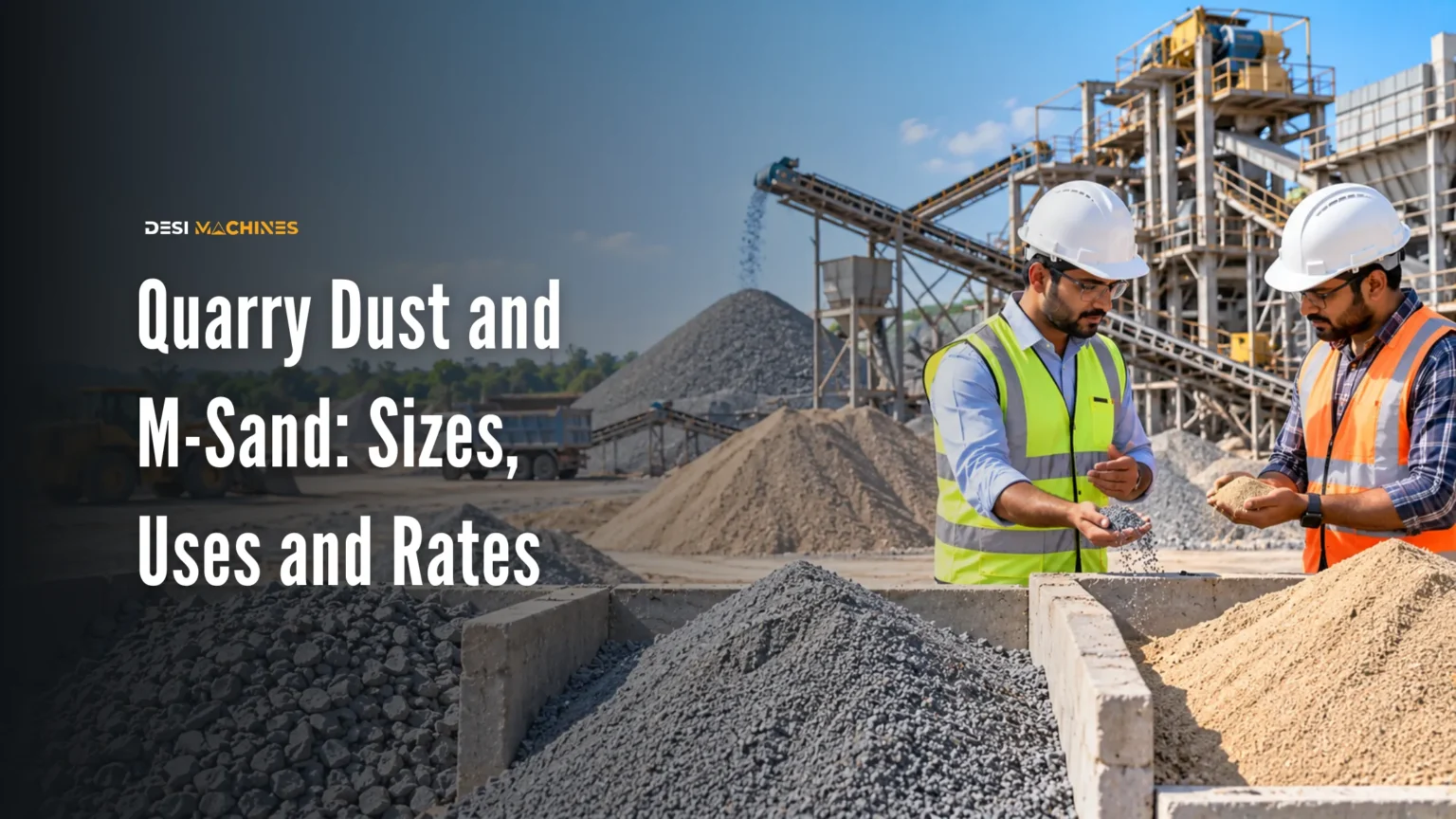
Quarry dust, M-sand and river sand all pass the same 4.75 mm sieve, and that line is where they stop being alike. Quarry dust is the fine material that falls out of a stone crusher without being screened to any grade. M-sand is the same crushed rock, but screened until the spread of grain sizes sits inside a published band. At the producer’s stockyard the first commonly changes hands at roughly ₹500–1,100 per tonne and the second at roughly ₹1,200–2,200 per tonne (indicative market ranges, as of Sep 2026).
That price gap is why the two get confused on site. A contractor is offered sand at half the going rate, takes the load, and then finds the plaster will not close or the concrete drinks water. The material was not fake. It was simply never graded.
Indian practice for both sits in one document: IS 383 : 2016, the Bureau of Indian Standards specification for coarse and fine aggregate for concrete. It defines what counts as sand, names four kinds of it by source, sets four grading zones, and caps how much powder-fine material each kind may carry. This guide works through those numbers, then says plainly where quarry dust earns its keep and where it should not go.
What is quarry dust, and how is it different from M-sand?
Both come off the same machine. Crush hard stone such as granite, basalt or trap rock and you get graded aggregate in several sizes, plus a large volume of fine material at the bottom end. That fine material is quarry dust. It is also sold as crusher dust or stone dust, and the three names mean the same thing.
Left as it comes, quarry dust is whatever the crusher happened to produce that shift. Grain sizes run from just under 4.75 mm down to flour-fine powder, and the share of that powder shifts with the rock, the crusher settings and how worn the liners are. Nothing about it is held to a figure.
M-sand is what you get when a producer treats the same crushed rock as a product. The material goes through a vertical shaft impactor, a crusher that throws stone against a hard surface at speed so the grains break to a more cubical shape instead of staying flaky and splintery. It is then screened, and often washed, until the spread of sizes falls inside one of the bands the standard allows. Many plants also separate a finer product meant for plaster, sold as P-sand. In parts of southern India M-sand is sold under trade names such as robo sand.
So the honest difference is not the rock. It is whether anybody measured the result.
What size is fine aggregate, and what are the grading zones?
IS 383 draws the boundary between fine and coarse aggregate at the 4.75 mm IS sieve. Fine aggregate is material most of which passes that sieve. Coarse aggregate is material most of which is held back by it. Sand, in the standard’s language, is defined by a sieve rather than by where it came from.
Below that boundary the standard sorts sand into four grading zones, Zone I to Zone IV. A zone is a band of permitted percentages passing each sieve in a series, running from the coarsest sand in Zone I to the finest in Zone IV. The sieve that does most of the deciding is the 600 micron one. A micron is one thousandth of a millimetre, so 600 micron is 0.6 mm.
Figure: where each product sits on the size scale
The sieve marks are spaced evenly for readability, not to scale. Quarry dust and M-sand cover the same span; what separates them is how the material is distributed inside it, and how much sits at the powder end.
Table 1: IS 383 : 2016 grading limits for fine aggregate (percentage passing)
| IS sieve | Zone I | Zone II | Zone III | Zone IV |
|---|---|---|---|---|
| 10 mm | 100 | 100 | 100 | 100 |
| 4.75 mm | 90–100 | 90–100 | 90–100 | 95–100 |
| 2.36 mm | 60–95 | 75–100 | 85–100 | 95–100 |
| 1.18 mm | 30–70 | 55–90 | 75–100 | 90–100 |
| 600 micron | 15–34 | 35–59 | 60–79 | 80–100 |
| 300 micron | 5–20 | 8–30 | 12–40 | 15–50 |
| 150 micron | 0–10 | 0–10 | 0–10 | 0–15 |
Two notes sit under that table in the standard, and both matter when you are buying crushed sand. For crushed stone sands the permitted figure on the 150 micron sieve rises to 20 percent, because crushing makes more fines than a river does. And a sand falling outside its zone on any sieve other than the 600 micron one, by not more than 5 percent on that sieve and 10 percent added across sieves, still counts as inside the zone. That tolerance deliberately does not extend to the 600 micron sieve.
In Indian practice Zone II is the band most structural concrete is designed around, and Zone III is the one usually specified for plaster. Zone I is coarse sand. Ask which zone a load is, and you have asked the single most useful question about it.
Is M-sand the same as “manufactured sand”?
In the market, yes. M-sand is read as short for manufactured sand and nobody will misunderstand you. In the standard, no, and the mismatch is worth knowing the first time you read a test report or a tender specification.
IS 383 : 2016 names four kinds of fine aggregate by where they come from. Natural sand is sand that rock produced on its own and a stream or glacier carried and dropped; the standard also calls this uncrushed sand. Crushed sand splits in two, crushed stone sand made by crushing hard stone and crushed gravel sand made by crushing natural gravel. Mixed sand is natural sand blended with one of those crushed sands. And manufactured fine aggregate, which is the term the standard actually attaches to the words manufactured sand, means fine aggregate made from something other than a natural source and processed by thermal or other means. Iron and steel slag, copper slag and recycled concrete aggregate are the examples it gives.
So the M-sand on your delivery note is, in the standard’s own words, crushed stone sand. Manufactured sand under IS 383 is a different family of materials, and the standard caps how much of each of them may replace natural fine aggregate, with tighter caps for reinforced concrete than for plain concrete. When a supplier’s paperwork and a specification seem to be talking past each other, this is usually the reason.
How much fine dust is allowed in sand?
This is the figure that settles most arguments about quarry dust. IS 383 limits the material finer than the 75 micron sieve, which is the powder fraction, and the limit depends on which kind of sand you are holding.
Table 2: maximum material finer than the 75 micron sieve, per IS 383 : 2016
| Type of fine aggregate | Maximum finer than 75 micron (percent by mass) |
|---|---|
| Natural (uncrushed) sand | 3.00 |
| Crushed sand | 15.00 |
| Mixed sand | 12.00 |
| Manufactured fine aggregate | 10.00 |
Read the first two rows together. Crushed sand is allowed five times the powder that river sand is, and that is not a loophole. Crushing makes fines, and a well-graded crushed sand carries them without harm. What the table does not do is allow unlimited fines. Quarry dust straight off the belt can sit well above 15 percent, and once it does it is outside the specification whatever the seller calls it.
Two further conditions are easy to miss. Where a mixed sand is used, the natural sand going into the blend must itself stay under 3 percent finer than 75 micron. And the engineer in charge of a job may relax some of these limits, but only on the strength of further testing and evidence that the aggregate performs, never on a supplier’s assurance.
None of this can be judged by eye or by rubbing the sand between your fingers. A wash test on a sample is cheap. On any load of unbranded dust it is the one test worth insisting on before the truck tips.
Where can you use quarry dust, and where should you not?
Quarry dust has real uses, and pretending it does not is how contractors end up paying sand rates for material that is only going to be filling.
It works as fill and levelling material, as the bedding layer under paver blocks, and as feed for making solid blocks and paver blocks. It also blends into granular sub-base and base layers where the grading of the finished blend is controlled and tested, which is where the largest volumes go; the road construction layers guide sets out which layer takes what. And it is usable in plain and lean concrete, the low-strength concrete poured as a base or a levelling course rather than to carry load, of which dry lean concrete under a rigid pavement is the common example. Block work is the other steady outlet, alongside the lighter products covered in the AAC blocks guide.
Where it should not go without testing and a designed mix is structural concrete, meaning the columns, beams and slabs that carry a building, and finish plaster. Two things go wrong. A high powder content raises the water a mix needs to stay workable, and more water in concrete means less strength once it sets. Separately, flaky ungraded grains give a plaster that is hard to close and more prone to surface cracking. If you are pouring a slab, the cement selection guide and the concrete road guide both assume a graded fine aggregate, not dust.
None of that means crushed rock cannot do structural work. Properly graded crushed stone sand does it across India every day, and river sand is restricted in many states precisely so that it will. The distinction is grading and testing. It was never the rock.
What do quarry dust and M-sand cost in India?
Both are sold by weight across most of the country and by volume through much of the south, which is the first place buyers lose track of what they are actually paying.
As a broad market picture, quarry dust commonly changes hands at roughly ₹500–1,100 per tonne and M-sand at roughly ₹1,200–2,200 per tonne at the producer’s stockyard (indicative ranges, as of Sep 2026). Treat those as a starting point and nothing firmer. The delivered figure is built from several parts, and on a long haul the material rate is not the biggest of them:
- the ex-quarry or stockyard rate for the material itself
- royalty or seigniorage payable to the state on minor minerals, which differs from state to state
- freight, which over 40–60 km can rival the cost of the material
- GST at the applicable rate
- unloading at your site
DesiMachines lists machines rather than materials, so there is no figure of ours to quote you for sand. What is above is market observation, and a local supplier’s written quotation is the only number worth building a budget on. For the wider material bill, the house construction cost calculator shows where sand sits against cement and steel, and the building materials guide covers the rest of the list.
Where sand is sold by the unit, one unit is 100 cubic feet, which is 2.83 cubic metres. Turning that into tonnes depends on the bulk density of the particular material. Reckoning loose M-sand at about 1.6–1.75 tonnes per cubic metre puts one unit at roughly 4.5–5 tonnes. Do that sum before you compare a per-unit quotation against a per-tonne one. The two look far apart on paper and often are not.
Which machines handle quarry dust and M-sand?
At the crusher the fine product is stockpiled and then loaded, and loading is a wheel loader’s job. It lives on the stockyard filling tippers through the shift, and the bucket is sized to the truck rather than to the pile. Browse what we list in wheel loaders if that is the gap in your fleet.
Before any of that, at the quarry face, an excavator works the blasted rock and feeds the primary crusher. The mining equipment guide covers that full machine set with sizes, and the types of mines guide explains how a quarry differs from a mine in law as well as in layout.
On the road job where the dust finally ends up, a compactor does the work that decides whether the layer holds its shape under traffic.
If you are on the producing side rather than the buying side, the economics of running a crusher are a separate question, and the stone crusher business profit analysis works through that sum.
How do you buy either one without getting caught?
Ask for the grading zone and a figure for material finer than 75 micron before you ask the price. A supplier who can produce both is selling graded sand. One who cannot is selling dust, which may be exactly what you want for filling and exactly what you do not want in a slab.
Three habits protect a small contractor here. Buy graded sand for anything that carries load and buy dust for anything that does not, rather than trying to make one load do both jobs. Get the rate in writing with freight, royalty and GST shown separately, so a cheap-looking rate cannot hide an expensive delivery. And take a sample from the first load of any new supplier for a wash test, because the second load is rarely the one that surprises you.
The full text of the specification is published by the Bureau of Indian Standards, and its product manual for IS 383 : 2016, coarse and fine aggregate for concrete lists the sampling and testing scheme a certified producer works to.
Ready to shortlist a machine rather than a material? See what we list in wheel loaders for stockyard and batching-plant duty, and talk to us about the size that matches your tippers.
Read next: the TMT bar guide for the steel side of the same concrete, and the mining guide for how the material gets out of the ground in the first place.
Prices, specifications and features are indicative, vary by variant, location and date, and should always be confirmed with the official OEM or authorised dealer before any purchase decision. DesiMachines is not liable for decisions taken on the basis of information that may have changed after publication.
