
 Excavator
294 models
Excavator
294 models  Backhoe Loader
51 models
Backhoe Loader
51 models  Crane
68 models
Crane
68 models  Concrete Mixer
79 models
Concrete Mixer
79 models  Wheel Loader
54 models
Wheel Loader
54 models  Compactor / Roller
45 models
Compactor / Roller
45 models  Motor Grader
42 models
Motor Grader
42 models  Concrete Pump
66 models
Concrete Pump
66 models  Skid Steer Loader
11 models
Skid Steer Loader
11 models  Telehandler
13 models
Telehandler
13 models  Dozer
Dozer 


A mining lease signed before 12 January 2015 pays about 1.32 times its royalty. A lease granted after that date pays about 1.12 times. Royalty on minerals, the payment a mine or quarry lessee makes to the State for the mineral it takes out of the ground, is only the first of three charges, and the other two are worked out on top of it.
That multiplier is the part most people running a site never see written down, because royalty, the District Mineral Foundation contribution and the exploration trust levy arrive as separate lines and get discussed separately. This page puts them back together. It also answers the question the Supreme Court finally settled in 2024: whether royalty is a tax at all.
What is royalty on minerals, and who gets it?
Royalty is the price of the mineral itself. The minerals under Indian soil belong to the State, and when a private party digs them out, royalty is what it pays the State government for the material it has taken. It is not a licence fee and it is not a charge on profit. A quarry that has a bad year still owes royalty on every tonne it removed.
The two words that appear on every lease are lessor and lessee. The lessor is the State government, which owns the mineral. The lessee is the company or person holding the mining lease. Royalty flows from lessee to lessor, and it is charged on what you remove, not on what you manage to sell.
There is a floor under it called dead rent. Dead rent is a fixed yearly amount tied to the area of the lease, so an idle lease still costs money. Under the MMDR Act the holder pays dead rent or royalty, whichever of the two is higher, never both. A lease that is worked properly pays royalty, because the royalty on real production is larger than the dead rent on the same ground. A lease sitting idle pays dead rent, which is exactly the point of having it.
Who fixes the royalty rate, and why does your state’s murum rate differ?
One split explains almost every disagreement about royalty rates: the law divides minerals into major minerals and minor minerals, and a different government sets the rate for each.
For major minerals such as iron ore, coal, bauxite, limestone and manganese, the rate is fixed centrally. It sits in the Second Schedule to the Mines and Minerals (Development and Regulation) Act, 1957, and the Central Government revises it by notification under Section 9. There is a brake on how often that can happen. Section 9(3) stops the Centre from raising the royalty rate on any one mineral more than once in any three-year period, which is what lets a cement or steel plant plan a decade ahead.
Minor minerals work the other way round. Section 3(e) of the same Act defines them as building stones, gravel, ordinary clay and ordinary sand, plus anything else the Central Government notifies as minor — quartzite and sandstone, for instance, when they are used for building or for road metal. Then Section 15 hands the whole subject to the States. A State Government makes its own rules for granting minor mineral concessions and for levying and collecting the royalty on them.
Reaching the point where you owe royalty at all means clearing a quarry lease and the four approvals stacked on top of it, which run in a fixed order.
So the material a small contractor actually handles is almost entirely state business. Bajri, murum, ordinary sand, stone for road metal and building stone are minor minerals, and their royalty rate is whatever that state has notified. This is the real reason a lorry-load of murum carries one royalty figure in one district and a different figure across the state border. Nobody is overcharging you. You are reading two different state schedules.
| Major minerals | Minor minerals | |
|---|---|---|
| Examples | Iron ore, coal, bauxite, limestone, manganese | Building stone, gravel (bajri), ordinary clay, ordinary sand, murum, road metal |
| Who fixes the rate | Central Government | State Government |
| Where the rate is written | Second Schedule, MMDR Act, 1957 | That state’s minor mineral concession rules |
| Governing section | Section 9 | Section 15 |
| How often it changes | Not more than once in three years per mineral (Section 9(3)) | Whenever the state notifies new rules |
| Usual basis | Mostly a percentage of value | Mostly a flat amount per unit of quantity |
How is royalty on minerals calculated?
There are only two ways to calculate it, and knowing which one applies tells you whether your royalty bill can move on its own.
The first is ad valorem, which simply means “according to value” — the royalty is a percentage of what the mineral is worth. Most major minerals are now charged this way. The value used is not your invoice price but the Average Sale Price, usually shortened to ASP. The Indian Bureau of Mines works out the ASP as a weighted average of ex-mine prices from non-captive mines and publishes it every month. Ex-mine means the price at the mine gate, before any transport is added.
That monthly publication has a consequence worth sitting with. On an ad valorem mineral, the royalty you owe changes every month even when nobody has touched the rate, because the ASP underneath it has moved. A percentage looks like a fixed cost and behaves like a floating one.
The Second Schedule also has a catch-all. Item 55 sets the royalty for any mineral not separately listed in the schedule at 12% of ASP, which is a high default and is meant to be one.
The second basis is a flat amount per unit of quantity — per tonne, per cubic metre, or per brass, the Indian volume unit still used for sand, aggregate and murum. A brass is 100 cubic feet, which is 2.83 cubic metres (2,830 litres). Most minor mineral royalty is charged this way, which is why the number on a state schedule reads as a rate per brass or per tonne rather than as a percentage. Here the royalty per load genuinely is fixed until the state notifies a new figure.
What is DMF in mining, and why does it add 30% to the royalty?
The District Mineral Foundation, or DMF, is a fund that exists in every district affected by mining, set up under Section 9B of the MMDR Act by the 2015 amendment to the Act. Its job is to work for the benefit of the people and the areas that mining has affected — the villages that live with the dust, the traffic, the blasting and the damaged roads.
The lessee pays into it in addition to royalty, as a percentage of the royalty already payable. The percentage depends on one date:
- A mining lease executed before 12 January 2015, the day the 2015 amendment came into force, contributes an amount equal to 30% of the royalty.
- A mining lease granted after that date contributes 10% of the royalty.
The gap between the two is not arbitrary. Leases granted after the amendment come through auction, so the bidder has already committed a share of the mineral’s value to the State in the bid itself, and the DMF share on top is set lower. Older leases were granted without that auction, and they carry the heavier DMF contribution instead.
The money is spent through a central scheme on drinking water, sanitation, health, education, skill development and environmental work in mining-affected areas. It is district money, held and spent locally, and for a quarry operator it is worth knowing that the fund exists in his own district rather than disappearing into a state pool.
What else is charged on top of the royalty?
One more levy rides on the royalty figure. Section 9C created the National Mineral Exploration Trust, and a lease holder pays it a sum equal to 2% of the royalty. That money funds regional and detailed exploration, which is the survey work that finds the next deposit.
Put royalty, DMF and the exploration trust together and you get the multiplier from the top of this page. The figure below shows the whole stack for every 100 units of royalty assessed.
The royalty stack: what 100 units of royalty actually costs
Dark band = royalty (Second Schedule or state rules). Amber band = District Mineral Foundation, Section 9B. Grey band = National Mineral Exploration Trust at 2% of royalty, Section 9C.
| Charge | Basis | Lease before 12 Jan 2015 | Lease after 12 Jan 2015 |
|---|---|---|---|
| Royalty | Second Schedule or state minor mineral rules | 100 | 100 |
| District Mineral Foundation (Section 9B) | % of royalty | 30 | 10 |
| National Mineral Exploration Trust (Section 9C) | 2% of royalty | 2 | 2 |
| Total paid | 132 | 112 | |
| Multiplier on royalty | 1.32× | 1.12× |
Read the stack for what it is and no more. GST, state cesses, transport, and the transit-pass and permit fees your tippers pay all sit outside it and are charged separately. The stack answers one narrow question — what a unit of assessed royalty finally costs — and that is the question people get wrong when they budget from the Second Schedule rate alone.
Is royalty on minerals a tax?
No, and this was an open question in Indian law for thirty-four years until the Supreme Court closed it. On 25 July 2024, a nine-judge Constitution Bench held by a majority of eight to one, in Mineral Area Development Authority v. Steel Authority of India, that royalty under the MMDR Act is not a tax. It is contractual consideration — the price the lessee pays the lessor for the enjoyment of mineral rights under the lease.
The ruling overturned India Cement Ltd v. State of Tamil Nadu, a 1990 seven-judge decision that had treated royalty as a tax. Justice B.V. Nagarathna dissented from the 2024 majority.
The reason a contractor should care is the second half of that judgment. Having held that royalty is not a tax, the majority confirmed that State legislatures do have the power to tax mineral rights and mineral-bearing land in their own right. A state-level tax or cess on mining, charged alongside royalty, is therefore lawful, and more states may introduce one. If a charge on your work order looks like royalty but is not called royalty, it may well be a separate state levy the same ruling permits. Check the wording before you dispute it.
What royalty on minerals means on a working site
Most people who feel royalty never pay it directly. The lessee pays the State, and then the charge travels down the chain and lands as a deduction on a contractor’s running bill for earthwork or aggregate. Seen from that end it is the same money under a different name, and royalty on earthwork covers how the deduction is worked out, what quantity it should be calculated on, and where the arithmetic usually goes wrong.
The weak link is nearly always the tipper. Royalty on minor minerals is enforced through transit passes, and a load moving without a valid pass is treated as unlawful extraction no matter who paid the royalty upstream. That risk sits with whoever owns the load on the road. It is the same discipline that governs lead and lift in earthwork and how soil filling rates are quoted, and it belongs in the rate you quote rather than in a surprise at the end of the month.
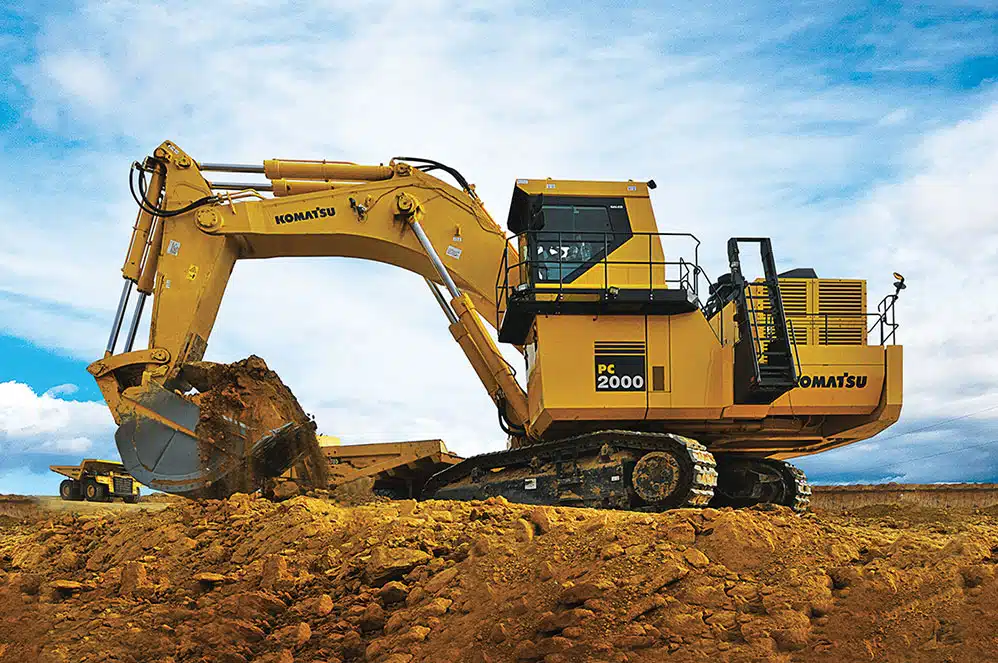
Royalty also behaves unusually as a cost. It is charged per unit of mineral removed, so no amount of machine efficiency reduces it. Dig the same tonnage with a thirstier machine and the royalty is unchanged. What machine choice does move is the part of the job that carries no royalty at all: stripping the overburden, the soil and waste rock lying over the mineral. That material is not the mineral you are paying for, and on many sites it is the larger excavation. Getting overburden removal right is where equipment productivity actually shows up on a mining or quarry budget, and the mining equipment guide sets out the machine classes and running costs for that work.
Which of the three kinds of site you are on changes the picture as well, and types of mines in India explains how open cast mining, underground mining and quarrying differ in who licenses them and what they need. If the material you sell is fine rather than sized, quarry dust and M-sand covers the grading and the rates that decide what it is worth, and stone crusher business profit works through the economics of running a crushing plant on that material.
Two pieces of paper sit beside the royalty file and are worth checking in the same sitting: the consent to establish and consent to operate that a plant needs before it runs, and the GST treatment of works contracts, which decides what input credit you can claim on the work the royalty relates to. When you are building the rate up from scratch, the construction estimate format shows where a royalty line belongs in a BOQ.
Working out what a mining or quarry job needs? Tell us your material and your monthly volume, and we will point you at the machine class that fits. Browse the mining excavator range for the large-class machines that strip overburden, and the wheel loaders that handle loading at the crusher and stockpile.
Read next: the mining guide for the rest of this series, and the full excavator range when you are ready to shortlist a machine.
Royalty rates, contribution percentages and the rules described here are statutory and change by notification. Major mineral rates are revised by the Central Government under Section 9 of the MMDR Act, 1957, and minor mineral rates by each State Government under Section 15, so always confirm the current Second Schedule entry and your own state’s minor mineral concession rules before you price a job. Figures here describe the structure of the charge as of September 2026, not the rate applicable to any particular lease.
Prices, specifications and features are indicative, vary by variant, location and date, and should always be confirmed with the official OEM or authorised dealer before any purchase decision. DesiMachines is not liable for decisions taken on the basis of information that may have changed after publication.
