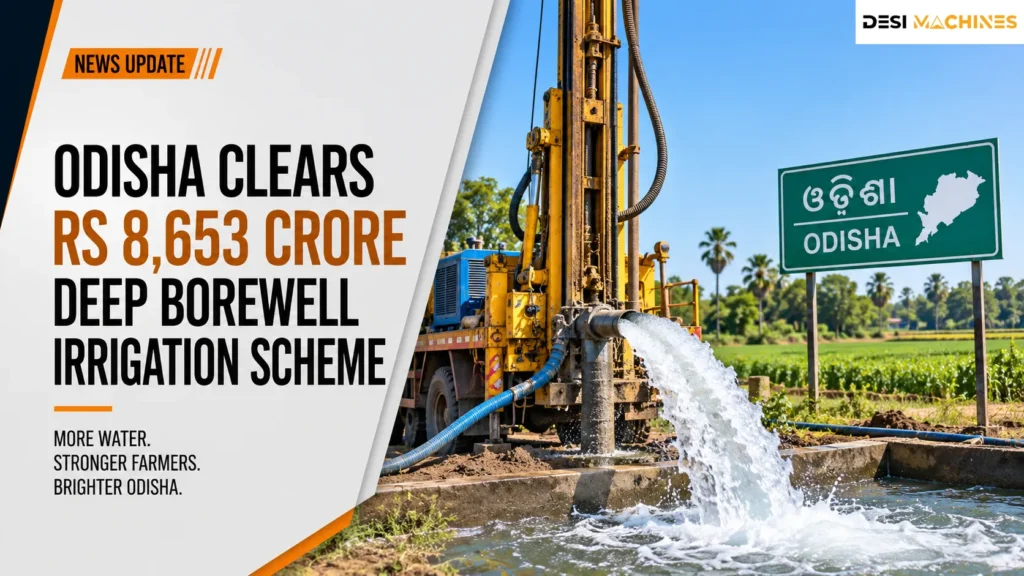
Odisha has cleared the largest borewell irrigation programme the state has attempted, and for equipment buyers it points at a machine class that rarely makes the news: the water-well drilling rig. The cabinet approved Rs 8,653.04 crore on 7 September for 1.5 lakh deep borewells over five years. Spread across 256 blocks, this is distributed, small-machine work rather than a big-civil job.
The quick facts
- Outlay of Rs 8,653.04 crore from Odisha’s own resources, with no central share stated.
- 1.5 lakh deep borewells with solar and non-solar pumping, across 26 districts and 256 blocks.
- Irrigation potential put at 7.5 lakh hectares, over the period 2026-27 to 2030-31.
- Proposed by the Water Resources Department and cleared at the state cabinet’s 47th sitting.
What Odisha approved
The decision came at the cabinet’s 47th sitting in Bhubaneswar on Monday evening, chaired by Chief Minister Mohan Charan Majhi. Sambad English and Pragativadi both carried the Water Resources Department proposal with identical figures. The same sitting cleared 18 proposals in all, among them a Rs 650 crore BOITA scheme to restore heritage irrigation structures and develop them for tourism, and the four road four-laning packages in Odisha that went to Ashribad Engineering.
What does this mean for equipment buyers?
Run the arithmetic the announcement does not. Rs 8,653.04 crore across 1.5 lakh wells works out to roughly Rs 5.77 lakh per borewell, and that envelope has to cover the well, the pump and the solar array, not drilling alone. Odisha Lift Irrigation Corporation’s existing deep-borewell scheme was approved at an average unit cost of Rs 3.88 lakh back in FY2015-16. The new figure is about 49 per cent higher, though the two are not strictly comparable, because solar pumping sits inside the newer number.
The fleet this pulls is narrow and specific. Thirty thousand wells a year is rig work: down-the-hole hammer rigs, tractor and truck mounted, each tied to a high-pressure air compressor. Around every completed well there is a pump platform to build and a delivery pipeline to trench, which is backhoe loader duty in ground that is often lateritic and hard going. What the scheme does not pull is just as worth stating. There are no 20-tonne crawler excavators in this work, no dozers, no graders, no batching plants. Set it against the Rs 12,458 crore Parbati Giri megalift, which is pump houses and long pipelines and genuinely heavy civil.
Our take: the headline hectare number deserves a second look. Divide 7.5 lakh hectares by 1.5 lakh wells and you land on exactly 5 hectares per well. OLIC designs each of its borewells for a 2 hectare rabi ayacut with about 5 hectares of protective cover in kharif. The state appears to be counting on that protective basis, so read 7.5 lakh hectares as monsoon insurance rather than assured year-round command. For a drilling contractor the real signal is the five-year window: visible, repeating volume across 256 blocks is the one condition under which buying a rig beats hiring one.
What to watch
- The tender structure. Block-wise packages would let small drilling contractors bid; a single statewide package would not.
- Whether solar pump supply is bundled with the drilling scope or split into a separate procurement.
- The first year’s target measured against the 30,000-well annual run rate the five-year plan implies.
Sizing a fleet for this work? Compare backhoe loaders and compact machines on specs and running cost before you commit, and work out what a rig or loader purchase does to your monthly outgo. See current project opportunities to judge whether the volume justifies buying.
FAQ
How many borewells will Odisha drill each year?
The scheme covers 1.5 lakh wells over five years to 2030-31, an average of 30,000 a year. The state has not published a year-wise split.
Which machines does a deep borewell scheme actually need?
Mainly down-the-hole hammer drilling rigs paired with air compressors, plus backhoe loaders for pump platforms and pipeline trenching. Heavy earthmoving equipment has little role in this work.
Is the Rs 8,653 crore only for drilling?
No. The outlay covers the wells together with solar and non-solar pumping systems. Our per-well figure of about Rs 5.77 lakh is the full envelope, not a drilling rate.
Related on DesiMachines: Excavator for well digging in India: which machine and how deep
Source: Sambad English
Machines, tenders and news for this industry: Irrigation and Dams

 Excavator
294 models
Excavator
294 models  Backhoe Loader
51 models
Backhoe Loader
51 models  Crane
68 models
Crane
68 models  Concrete Mixer
79 models
Concrete Mixer
79 models  Wheel Loader
54 models
Wheel Loader
54 models  Compactor / Roller
45 models
Compactor / Roller
45 models  Motor Grader
42 models
Motor Grader
42 models  Dozer
41 models
Dozer
41 models  Concrete Pump
66 models
Concrete Pump
66 models  Skid Steer Loader
11 models
Skid Steer Loader
11 models  Telehandler
13 models
Telehandler
13 models