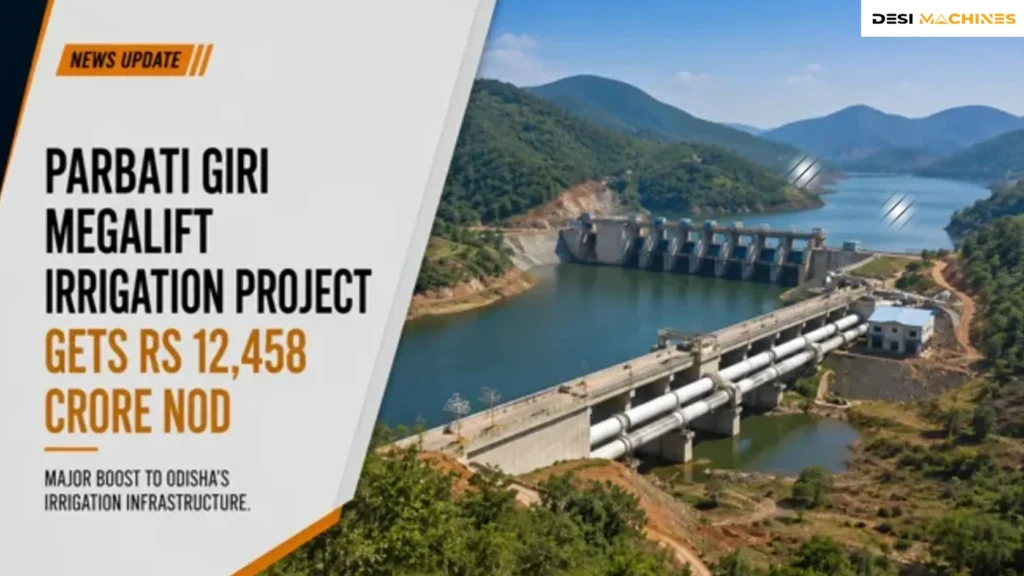
Odisha has committed Rs 12,458.04 crore of its own money to lifting river water onto land that gravity canals cannot reach. For fleet owners in the state, the headline number is not the useful part. The useful part is that it buys 161 separate schemes spread across every district, which is a very different demand pattern from one large project.
The quick facts
- The Odisha cabinet, at its 46th meeting on 12 August 2026 under Chief Minister Mohan Charan Majhi, cleared execution of the Parbati Giri Megalift Irrigation Project at Rs 12,458.04 crore, funded from the state’s own resources.
- 161 schemes across all districts, to be built between FY 2026-27 and FY 2030-31, adding irrigation potential over 2,62,275 hectares.
- Water moves through a pressurised underground pipeline network designed for micro-irrigation, not through open canals.
- The same sitting cleared Improvement to Tanks and Minor Irrigation Projects Phase-III at Rs 389 crore, reviving irrigation over about 15,700 hectares.
What Odisha approved
The state’s Water Resources Department has been sanctioning Parbati Giri lift schemes in clusters for years, a few districts at a time. This decision converts that piecemeal approach into a single five-year execution programme with a fixed outlay and a statewide target. Chief Secretary Anu Garg briefed reporters afterwards; it was one of ten proposals cleared that day. PTI carried the decision, and Odisha desks including Pragativadi and KalingaTV reported it with the same figures. There is no central funding line in it, which matters for pace: the money is Odisha’s, so the schedule is Odisha’s to hold.
What does Rs 12,458 crore actually buy on the ground?
Run the divisions before deciding anything. Rs 12,458.04 crore over 161 schemes averages about Rs 77 crore a scheme. Over five years it is roughly Rs 2,490 crore a year. Across 30 districts it is about five schemes per district, and against the hectare target it works out near Rs 4.75 lakh per hectare. None of those numbers describe a mobilisation. They describe a long, thin, dispersed pipeline of mid-size civil packages.
The bigger correction is to the machine list. A pressurised underground pipeline scheme is a trenching job, not an earthmoving job. There is no mass cut-and-fill front, so no dozer or scraper phase and very little grader work. What the job actually pulls is backhoe loaders for the bulk of trench work, mid-size and compact excavators where the line hits rock or crosses a nallah, tippers for spoil and bedding material, and plate compactors and small rollers on backfill. The concrete side is confined to intake wells, pump houses and delivery chambers, which means transit mixers and the odd mobile crane to set pumps and motors rather than a batching-led site.
Our take: this is a utilisation story, not a purchase story. One scheme per district per year will not keep a machine busy, so the owners who profit are those who win consecutive clusters in the same belt and shuttle a small fleet between them. Odisha also has a contractor base built on the earlier Parbati Giri phases, so much of the iron is already in the state, and buying new against this announcement alone would be premature. Season bites as well: trench and intake work near rivers realistically runs October to May, so quote on about seven working months rather than twelve. The Rs 389 crore tanks and minor irrigation item is the quicker one for small fleets, since desilting, embankment strengthening and canal re-sectioning are excavator and compactor work in small packages.
What to watch
- The first cluster tenders under the new outlay, and how many schemes each package bundles. Bundling decides whether small fleets or mid-size contractors get the work.
- Whether the Rs 389 crore tanks phase is tendered ahead of the megalift schemes. Renovation work usually reaches site faster than new lift schemes.
- District-level splits when they appear. Our opportunities desk tracks the actual bid notices.
Sizing a machine for pipeline work? Compare backhoe loaders and compact excavators on reach, breakout and running cost before you bid, and check what finance is costing right now on equipment loans.
FAQ
What is the Parbati Giri Megalift Irrigation Project?
It is Odisha’s programme of lift irrigation schemes that pump river and reservoir water to upland areas that gravity canals cannot serve. The 12 August 2026 cabinet decision approved a five-year execution plan of 161 schemes worth Rs 12,458.04 crore.
Which machines does a lift irrigation scheme need?
Mostly trenching and pipe-laying plant: backhoe loaders, compact and mid-size excavators, tippers, plate compactors and small rollers. Concrete work is limited to intake structures, pump houses and delivery chambers.
When is the work likely to reach the market?
The programme runs from FY 2026-27 to FY 2030-31, so tendering should begin within this financial year. No district-wise package list had been published at the time of writing.
Related on DesiMachines: Odisha Cabinet Irrigation Approval: Rs 626 Crore Cleared for Pipeline and Lift Work
Source: Pragativadi

 Excavator
294 models
Excavator
294 models  Backhoe Loader
51 models
Backhoe Loader
51 models  Crane
68 models
Crane
68 models  Concrete Mixer
79 models
Concrete Mixer
79 models  Wheel Loader
54 models
Wheel Loader
54 models  Compactor / Roller
45 models
Compactor / Roller
45 models  Motor Grader
42 models
Motor Grader
42 models  Concrete Pump
66 models
Concrete Pump
66 models  Skid Steer Loader
11 models
Skid Steer Loader
11 models  Telehandler
13 models
Telehandler
13 models  Dozer
Dozer