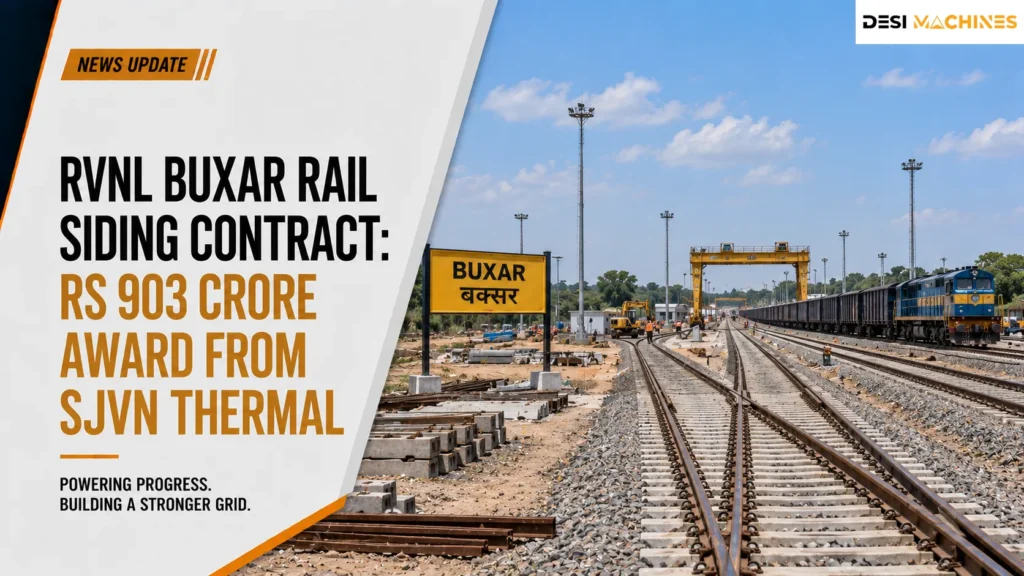
A thermal power station in Bihar has just handed the railway construction market its clearest three-year job of the month. Rail Vikas Nigam has picked up the RVNL Buxar rail siding contract from SJVN Thermal, worth Rs 903 crore including GST, to build the permanent rail link that will feed coal into the 1,320 MW Buxar Thermal Power Project. For anyone running earthmoving or concreting plant in eastern Bihar, this is a 36-month site with a fixed coal-supply deadline behind it.
The quick facts
- Value: Rs 903,00,68,492 (about Rs 903 crore), inclusive of GST. That is the figure as disclosed, not a rounded estimate.
- Client: SJVN Thermal Private Limited, a wholly-owned subsidiary of SJVN, under award reference PCD-133/2026.
- Scope: Phase-III permanent siding plus aerial rail-track connection from the plant boundary to Chausa and Pawani Kamarpur, Buxar district. Items include roadbed, minor bridges, limited height subways, platforms, station buildings, a foot over bridge and allied civil works.
- Duration: 36 months. Unit 1 of the 2×660 MW station reached commercial operation in November 2025.
What RVNL disclosed
RVNL told the exchanges on 4 September that SJVN Thermal had issued it the letter of award. The company also stated that no promoter-group entity holds an interest in SJVN Thermal, so this is an arm’s-length order rather than a related-party transaction. Construction Mirror and Business News This Week both carried the disclosure with the same contract reference and the same exact value. No revised order-book total was published alongside it, so we are not quoting one.
What does it mean for equipment buyers?
Read the scope list, not the headline. A power-plant siding is not track-laying work with a bit of civil attached. The awarded items are almost entirely groundwork. “Roadbed” is the giveaway: formation for a new siding means cut, fill, blanketing and layered compaction over several kilometres of alignment between the plant boundary and the connection points at Chausa and Pawani Kamarpur. That is 20-tonne-class excavators, tippers on short internal hauls, a dozer or two for spreading, and soil compactors working continuously rather than in bursts.
The structures change the fleet again. Minor bridges and limited height subways are small-footprint reinforced concrete jobs: piling or open foundations, a batching plant on site, and a pick-and-carry or small crawler crane parked for months rather than mobilised for a week. Platforms, a station building and a foot over bridge add finishing concrete and light lifting at the end of the programme.
Our take: the buying signal here is modest and the hire signal is strong. Rs 903 crore across 36 months is roughly Rs 25 crore a month of work spread over a linear site. That is enough to keep a mid-sized fleet busy, not enough to justify a contractor buying new heavy iron for it alone. Expect the pull to land on rental yards in Buxar, Ara and Varanasi, and on subcontractors who already own compaction and formation kit. The one genuinely useful detail is the client: a power producer with a live 660 MW unit already exporting to the grid has a commercial reason to push the coal link hard, which usually means fewer possession delays than a pure railway package of the same size.
The counterweight is Bihar’s calendar. Formation earthwork in the Ganga belt effectively runs October to May; the monsoon window is lost to it. A 36-month clock therefore holds roughly two and a half usable earthwork seasons, which is why the compaction and excavation demand will arrive in concentrated bursts rather than evenly.
What to watch
- RVNL’s subcontracting for the formation package — this is where hire enquiries for excavators and compactors will actually surface.
- Whether SJVN Thermal awards further Buxar phases; this one is labelled Phase-III, so earlier and later phases exist.
- Mobilisation timing against the post-monsoon window — an award signed in September usually means first earth moved after Diwali.
Sizing a fleet for a siding job? Compare 20-tonne excavators, soil compactors and pick-and-carry cranes side by side on DesiMachines, and check what finance costs before you commit — see our equipment finance hub.
FAQ
How much is the RVNL Buxar rail siding contract worth?
Rs 903,00,68,492 including GST, or about Rs 903 crore. The value was disclosed by RVNL to the stock exchanges on 4 September 2026 and is consistent across the desks that carried it.
Which machine classes does the work need?
Mostly formation plant: excavators in the 20-tonne class, tippers, dozers and soil compactors for roadbed and blanketing, plus a batching plant and a small crane for the minor bridges, subways and platform structures.
How long will the project run?
Thirty-six months from award. Because earthwork in Bihar is limited to the October-to-May window, the practical earthmoving demand falls into about two and a half working seasons.
Related on DesiMachines: Construction equipment dealers and listings in Bihar
Source: Construction Mirror
Machines, tenders and news for this industry: Material Handling · Power and Renewable Energy · Railway and Metro

 Excavator
294 models
Excavator
294 models  Backhoe Loader
51 models
Backhoe Loader
51 models  Crane
68 models
Crane
68 models  Concrete Mixer
79 models
Concrete Mixer
79 models  Wheel Loader
54 models
Wheel Loader
54 models  Compactor / Roller
45 models
Compactor / Roller
45 models  Motor Grader
42 models
Motor Grader
42 models  Dozer
41 models
Dozer
41 models  Concrete Pump
66 models
Concrete Pump
66 models  Skid Steer Loader
11 models
Skid Steer Loader
11 models  Telehandler
13 models
Telehandler
13 models