
 Excavator
294 models
Excavator
294 models  Backhoe Loader
51 models
Backhoe Loader
51 models  Crane
68 models
Crane
68 models  Concrete Mixer
79 models
Concrete Mixer
79 models  Wheel Loader
54 models
Wheel Loader
54 models  Compactor / Roller
45 models
Compactor / Roller
45 models  Motor Grader
42 models
Motor Grader
42 models  Concrete Pump
66 models
Concrete Pump
66 models  Skid Steer Loader
11 models
Skid Steer Loader
11 models  Telehandler
13 models
Telehandler
13 models 


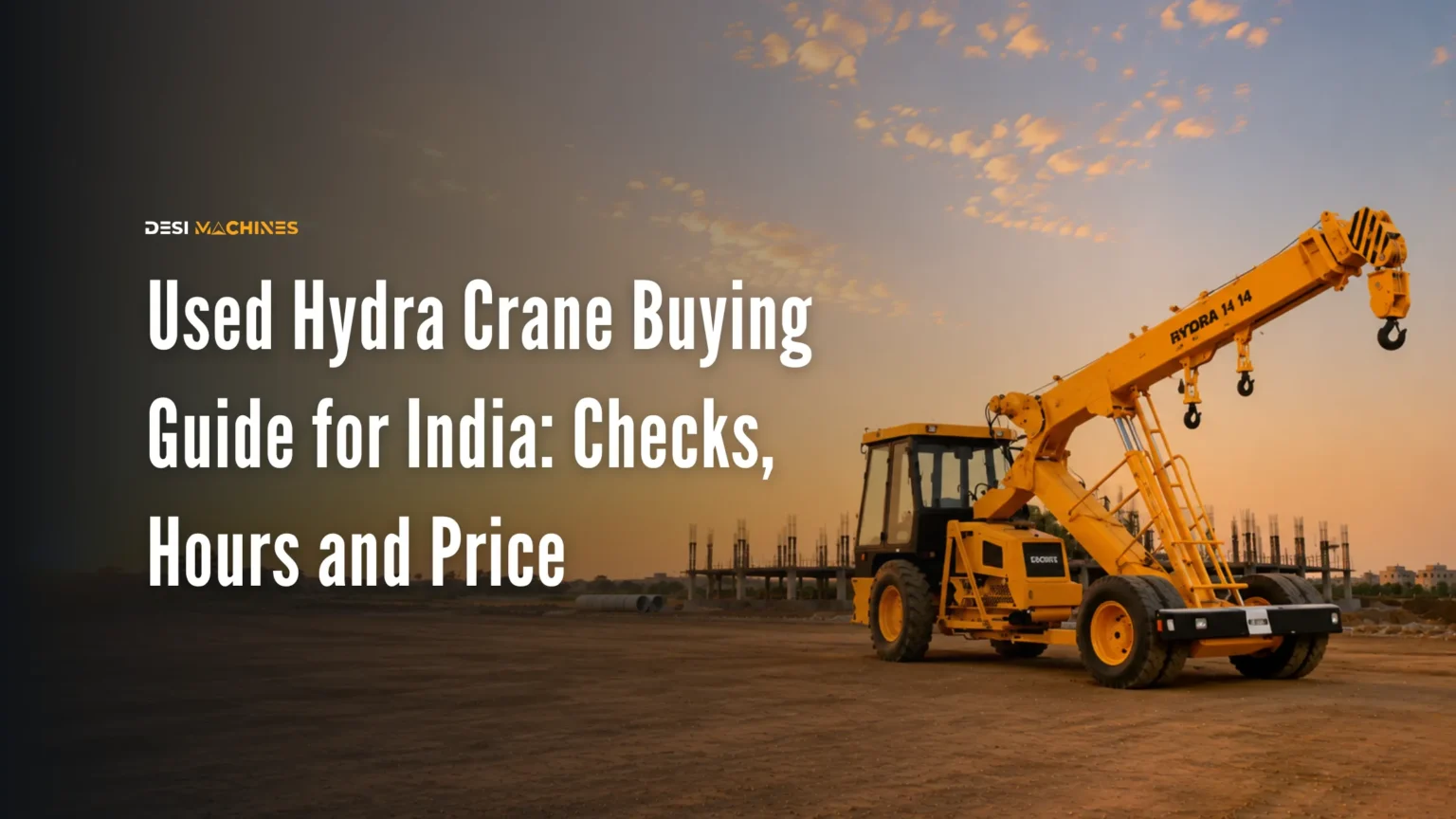
The risk with a hydra is not the same as with a digging machine. A hydra lifts on a rope and a telescopic boom, and it drives on public roads under its own registration, so the money goes either into the lifting side (boom, rope, hook block, winch) or into the road side (tyres, brakes, steering, papers). Both hide well on a short test drive.
This guide covers what to check, what the hours really mean, what these machines cost new, what papers must come with a second-hand one, and when a used hydra is the wrong answer.
What should you check on a used hydra crane?
Start at the boom and work down. On a pick and carry crane, the lifting parts fail expensively and the driving parts fail cheaply, so that is the order to look in.
The boom, section by section. Run it out fully and bring it back in with no load on the hook. It should extend smoothly and evenly, without jerking or a stall halfway. Then walk its length and look at the underside of each section for dents, buckling and any welding that was not done at the factory. A repaired boom is not automatically finished, but it changes what the machine is worth and you must know it is there before you agree a price.
The wire rope. This is the single cheapest thing to inspect and the most dangerous thing to get wrong. On an ACE 14XW the hoist runs a 13 mm rope in a four-fall arrangement, so every strand is carrying real weight. Pull the rope off the drum slowly and look for broken wires, flattened patches, kinks, rust between the strands, and a section near the hook that is visibly thinner than the rest. Rope is a wear item and replacing it is normal, but the seller should be telling you it needs replacing rather than letting you find it.
The hook block and safety latch. Look for a hook that has opened out (the throat wider than the others you have seen), grooving where the sling sits, and a missing or broken safety latch. The hook should also still swivel freely.
The winch and the brake on it. Lift something modest, stop halfway up, and leave it hanging for a minute. The load must not creep down. Creep means the winch brake is worn, and that is the fault that drops loads.
Boom hydraulics and the leaks. Raise and hold, then look at the base of each cylinder and along the hoses. Weeping at a seal is a repair; a cylinder rod that is scored or pitted is a bigger one. A hydra of this size carries roughly 125 litres of hydraulic oil, so a tank that has been topped up recently and a fresh wipe-down under the boom usually means someone has hidden a leak an hour before you arrived.
The articulation joint and steering. A hydra bends in the middle to steer. An ACE 14XW articulates 55° and turns inside a 6.5 metre radius. Get someone to turn the wheel lock to lock while you watch the centre pin. Knocking or visible play there is a workshop job, and a worn joint on a machine that carries its load out in front is a stability problem, not just a comfort problem.
Tyres and brakes. These machines run heavy tyres (11.00 x 20 front, 13.00 x 24 rear on a 14 tonne class machine) and a full set is a serious bill. Check tread on all six, look for sidewall cuts, and take the machine on a short road run to confirm the brakes pull straight and the parking brake holds on a slope. Check which parking brake it has before you test it: on the machines listed, a hand lever always comes with air-assisted hydraulic brakes and a spring fail-safe always comes with full air ones, as set out in Hydra crane brakes explained.
The chassis and outrigger area. Get underneath with a torch. You are looking for cracks and re-welding around the boom mounting, the turret and the chassis rails. Cracks there are the one fault that should end the conversation.
Engine and smoke. Cold-start it yourself, do not let the seller warm it up before you arrive. Black smoke under load is usually fuel or filters; blue smoke is oil and it is the machine telling you about its engine.
How many hours is too many on a used hydra crane?
There is no single number, and on a hydra the hour meter is a weaker guide than on any other machine you will buy. A pick and carry crane splits its life between lifting and driving, so two machines can show the same 6,000 hours where one spent them lifting steel in a fabrication yard on level concrete and the other spent them crawling across broken ground on a road project. The second machine is far older in every way that matters, and the meter cannot tell you that.
Three habits keep you out of trouble.
Read the meter against the age. No manufacturer publishes an expected annual usage figure, but a hydra in steady contracting work generally runs somewhere between 800 and 1,200 hours a year, and that is the band experienced buyers judge against. A ten-year-old machine showing 3,000 hours either sat idle for years, which brings its own problems, mainly seals and rust, or has had a meter change. Ask, and watch how the answer comes out.
Then read the machine against the meter. Pedal rubber, seat, steering wheel, gear lever and the paint on the boom sections all wear at a rate the seller cannot easily reset. If those look like 12,000 hours and the meter says 4,000, believe the machine.
And read the papers against both. Service records, an insurance history and the RC together tell you the real story of the machine’s life. A seller who has none of the three is asking you to buy on trust.
As a rough working line: under about 5,000 hours on a well-kept machine is a straightforward buy, 5,000 to 10,000 is normal second-hand territory where condition decides everything, and beyond that you are buying a machine whose remaining life depends entirely on how it was maintained rather than how old it is.
What does a new hydra crane cost in India?
Knowing the new price is what stops you overpaying for a used one, because every second-hand negotiation is really an argument about how far below new the machine sits.
These are the common pick and carry cranes on Indian sites, with current listed prices.
| Model | Rated capacity | New price (indicative, as of Aug 2026) |
|---|---|---|
| ACE 12XW | 12 Ton (12,000 kg) | ₹16–18 Lakh |
| ACE 14XW | 14 Ton (14,000 kg) | ₹18–20 Lakh |
| Escorts HYDRA 14 | 14 Ton (14,000 kg) | ₹20.5 Lakh onwards |
| Escorts HYDRA 15 | 15 Ton (15,000 kg) | ₹20–22 Lakh |
| ACE 15XW | 15 Ton (15,000 kg) | ₹21–23 Lakh |
| ACE 16XW | 16 Ton (16,000 kg) | ₹24–26 Lakh |
| ACE 20XW | 20 Ton (20,000 kg) | ₹28–30 Lakh |
Prices are as listed at the time of writing and are indicative. Two things move them. Emission norm is the first: an older machine may be a BS III CEV unit, and what you can buy new today is not the same specification. The second is the series. A pick and carry hydra and a Farana-type pick and carry crane are different machines even at the same tonnage — the 15 tonne ACE F150 is listed at ₹34–36 Lakh (indicative, as of Aug 2026) against ₹21–23 Lakh for a 15XW, because the Farana series is built for rough ground and carries a different drivetrain. Never price a used machine off a tonnage figure alone; price it against its own series.
How much should a used hydra crane cost?
Work down from the new price rather than up from the seller’s number.
A machine two to three years old with honest hours, a sound boom, a recent rope and complete papers sits clearly below the new band but nowhere near half of it. By six to eight years the gap widens a lot. Past ten years the price is being set by the condition of the boom, the rope and the tyres, not by the age on the RC at all.
Three adjustments decide whether a discount is real.
The first is the deferred spend. Add up what you will have to spend in the first six months (rope, tyres, a hydraulic service, brake work, pins) and take it off the asking price before you compare two machines. A cheaper hydra is not cheaper once a rope and a set of front tyres go back in.
The second is the certification. A pick and carry crane used on a factory or a large contractor’s site normally has to carry a valid load test and a competent-person examination, and the site will not let it work without one. If the machine is out of test, you are buying the cost of getting it through.
The third is the finance. Used-machine loans run at higher rates and shorter tenures than new ones, so two machines at the same price can end up costing very different amounts. Work out the full outgo using the equipment finance options before you decide, and compare it honestly against buying new — the reason so many first-time owners end up with a new 12 tonne machine is that the EMI difference turns out to be smaller than they expected.
Then check your number against the market. Browse current pick and carry crane models and prices and talk to our team about what a comparable second-hand unit is fetching in your state. Used values move by region far more than new prices do: a 14 tonne hydra in a busy industrial belt does not trade at the same number as the same machine in a district town.
Which papers must come with a used hydra crane?
More than with any other machine you will buy second-hand, because a hydra is a registered road vehicle as well as a lifting machine.
The RC (registration certificate). Pick and carry cranes are registered as construction equipment vehicles, so the machine has an RC in the seller’s name and the transfer is a real motor-vehicle transfer filed through the government’s Parivahan system, not a handshake. Check the chassis and engine numbers on the RC against the numbers stamped on the machine before anything else.
Hypothecation status. If the machine was financed, the RC carries the financier’s name. You need the loan closure letter and the no-objection certificate before the RC can be transferred clean. Buying a hypothecated machine on a promise that the paper will follow is the mistake that turns into a year of chasing, and the full process is set out in the guide to RC transfer and hypothecation removal.
Insurance. Ask for the current policy and the claim history. A crane with several claims has been in incidents, and that tells you about the operator and the work it did.
Fitness and road tax. Both must be current if the machine is going to travel between sites on its own wheels, which is the whole point of a hydra.
Load test and examination records. Lifting machines used at a workplace are required to be examined by a competent person at set intervals, and the certificate is what a client site will ask to see at the gate. Get the last one, and note when the next is due.
Service history. Not a legal document, but the one that tells you whether the hydraulic oil was changed on schedule or only when it got low.
Is a used hydra crane worth buying?
For most first-time owners, yes, with one condition attached.
The case for buying used is strong here. A pick and carry crane is a simple machine, its wear parts are cheap, and mechanics who understand it exist in every industrial town in India. Work that pays for a hydra (precast, transformers, steel structures, water tanks, factory shifting) does not care whether the machine is new, and the entry price is low enough that a second-hand 12 or 14 tonne machine is often the first crane an owner buys outright rather than on finance.
The condition is the boom and the rope. Everything else on a hydra can be repaired at reasonable cost by ordinary workshops. A cracked or badly repaired boom, a worn turret, or a chassis with welding around the mounting cannot, and a machine like that will sit idle while you look for someone competent to touch it. If you take one thing from this guide, take a torch to the boom mounting before you talk about price.
Two situations where used is the wrong answer. If the work is for large industrial clients or EPC sites with their own safety departments, an old machine that struggles to pass examination will lose you the contract whatever it saves you. And if you need the machine on rough, unmade ground, a 2WD pick and carry hydra is the wrong machine second-hand or new — that is Farana territory, or a mobile crane if the lifts are bigger.
Before you commit, read the load chart guide so you can check that the machine actually lifts what you were told at the radius you will work at, and the crane safety and operator training rules so you know what your operator needs. If you are still weighing owning against hiring, the crane buying and rental guide works through both sides, and the buy versus rent comparison puts numbers on the decision.
Buying a used hydra crane, in short
Check the boom, the rope, the hook and the winch brake before you look at anything else, because that is where the money and the danger both sit. Read the hour meter against the age of the machine and against its own wear, not on its own. Price it down from the current new band for its series, not from its tonnage. Get the RC, the hypothecation clearance, the insurance and the last examination certificate in your hand before you pay. And walk away from cracks or welding around the boom mounting, however good the price looks.
If you want a second opinion on a specific machine, or you would rather see what a comparable unit costs new first, compare pick and carry cranes and prices and speak to our team — and if you are buying second-hand across categories, the used construction equipment guide covers the checks common to every machine, with detailed guides for used excavators, used backhoe loaders and used wheel loaders.
Knowing what each component is called makes an inspection far easier: our Hydra crane parts guide walks through the boom, winch, rope and articulation joint one by one.
Prices, specifications and features are indicative, vary by variant, location and date, and should always be confirmed with the official OEM or authorised dealer before any purchase decision. DesiMachines is not liable for decisions taken on the basis of information that may have changed after publication.