
 Excavator
294 models
Excavator
294 models  Backhoe Loader
51 models
Backhoe Loader
51 models  Crane
68 models
Crane
68 models  Concrete Mixer
79 models
Concrete Mixer
79 models  Wheel Loader
54 models
Wheel Loader
54 models  Compactor / Roller
45 models
Compactor / Roller
45 models  Motor Grader
42 models
Motor Grader
42 models  Dozer
41 models
Dozer
41 models  Concrete Pump
66 models
Concrete Pump
66 models  Skid Steer Loader
11 models
Skid Steer Loader
11 models  Telehandler
13 models
Telehandler
13 models 


Buying an excavator — or a “JCB” or “Poclain” as most Indian contractors call it — is one of the biggest capital decisions you’ll make. Get it right, and you’ve got a machine that pays for itself in 18–24 months. Get it wrong, and you’re stuck with high fuel bills, constant breakdowns, and a machine that doesn’t fit your sites. This guide covers everything an Indian contractor needs to know: project requirements, site conditions, size selection, new vs. used, brand comparisons, financing, and the questions you should be asking dealers before signing anything. For the machine itself, how it works, its parts and its size classes, start with our complete excavator guide. Every machine price below is the band listed for that model at the time of writing, as of October 2026.
Why Buying the Right Excavator Matters
The wrong excavator costs you money every single day it runs. An oversized machine on a small site burns ₹30,000–50,000 extra in fuel every month. An undersized machine takes twice as long to finish the same work, and your labour costs double with it. The commonest version of this is a 20-tonne (20,000 kg) excavator bought for basement work that needed a 7-tonne (7,000 kg) machine: months of fighting for access, damaged compound walls, and a client who does not call back.
India’s construction market is growing fast — NHAI highway packages, Smart City projects, PMAY housing, metro corridors in Tier 2 cities. Equipment demand is at an all-time high. But demand also means dealers are pushing whatever stock they have, not necessarily what fits your project. Compare first, buy second. That one habit separates contractors who build wealth from those who only build debt.
The consequences of wrong selection are specific and expensive: project delays of 2–4 weeks, fuel costs 15–25% higher than necessary, site damage that you pay to fix, and poor productivity that eats into your margins. A 21-tonne (21,000 kg) excavator running at 70% utilization on the right projects generates ₹8–12 Lakh in annual profit after EMI and operating costs. The same machine at 40% utilization — because it doesn’t fit your typical jobs — barely breaks even.
Key Factors to Consider Before Buying an Excavator
Every excavator purchase starts with the same question: what exactly will this machine do? Not what you hope it might do. Not what the dealer says it can do. What will it actually do on your sites, week after week?
Determine Your Project Requirements
Primary tasks define your machine class. Digging foundations and trenches? That’s bucket work — standard configuration. Demolition? You need a breaker-compatible hydraulic system. Lifting and placing pipes or precast elements? Check the lifting capacity at full reach, not just the headline number. Grading and finishing? Smaller machines with precise controls work better than brute force.
Project scale and duration matter more than most contractors admit. A 6-month highway package justifies buying. A 3-week basement dig probably doesn’t — unless you have the next project lined up. Calculate your expected running hours per month. Below 150 hours? Renting might make more sense. Above 200 hours consistently? Ownership starts winning.
Material type changes everything. Soft alluvial soil in the Gangetic plains? Almost any excavator handles it. Black cotton soil near Vidarbha that turns to glue in monsoon? You need a machine with serious breakout force and tracks that won’t sink. Rocky terrain in Jharkhand or Bundelkhand? Factor in undercarriage wear — you’ll replace track components 30–40% faster than the brochure suggests.
If you have not settled the machine type yet, work out the right size for your job before you shortlist excavators.
Evaluate Your Job Site Conditions
Space constraints kill productivity faster than any other factor. A 21-tonne (21,000 kg) excavator needs a minimum working radius of 8–9 metres. If your typical sites have 6-metre access roads and tight corners, you’re buying the wrong machine. Simple as that.
Terrain type determines track vs. wheel configuration. Flat, stable ground with good bearing capacity? Standard crawlers work fine. Soft, waterlogged sites in Bengal or coastal areas during monsoon? Consider wider track pads or machines with lower ground pressure. Frequent movement between sites on paved roads? A wheeled excavator like the SANY SY155W (13,500 kg) suits that, at about ₹90–95 Lakh (indicative, as of October 2026).
Height restrictions matter in urban work. Basement excavation under existing structures, work near power lines, sites with overhead obstructions — all require machines with specific boom geometry. Check the transport height and working height before you commit. A machine that can’t fit under a 4-metre bridge on the way to your site is useless, no matter how good the specs look.
Ground bearing capacity is the factor most contractors ignore until their machine sinks. A 20-tonne (20,000 kg) excavator exerts 0.4–0.6 kg/cm² ground pressure depending on track width. Soft clay and waterlogged soil cannot handle that without mats or wider tracks. Recovering a sunk machine with a second machine costs ₹50,000–1,00,000 in hire and lost hours, before any damage.
Assess Digging Depth and Reach Requirements
Match the machine to your actual digging needs — not your theoretical maximum. If 90% of your work is 3–4 metre trenches, a mini excavator with 3.5m digging depth handles it. Buying a 20-tonne (20,000 kg) machine “just in case” means paying for capability you’ll rarely use.
| Size Class | Typical Digging Depth | Max Reach | Best For |
|---|---|---|---|
| Mini (0–6 tonnes) | 2.5–4.0m | 4.5–6.0m | Urban sites, utilities, landscaping |
| Small (6–15 tonnes) | 4.0–5.5m | 7.0–8.5m | Building foundations, drainage, small earthwork |
| Medium (15–25 tonnes) | 5.5–7.0m | 9.0–10.5m | Highway work, large foundations, quarries |
| Large (25–50 tonnes) | 7.0–8.5m | 11.0–13.0m | Mining, major infrastructure, deep excavation |
Long reach excavators serve a specific purpose — canal dredging, pond deepening, work where the machine can’t get close to the digging face. The JCB NXT 245HD LR offers 15.6m reach at 23,850 kg (₹81–83 Lakh, indicative, as of October 2026). The Tata Hitachi EX 215LC-SLR provides 15.6m reach at 21,800–22,200 kg (₹79–84 Lakh, indicative, as of October 2026). But these are specialist machines. If you need long reach once a year, rent it. Each of these size classes, and the crawler-versus-wheeled choice, is covered in more depth in our guide to excavator classes by size and mobility.
Consider Attachment Compatibility
An excavator with the right attachments does the work of three machines. That’s not marketing — that’s math. One excavator with a bucket, a hydraulic breaker and a grapple handles digging, demolition and material handling on the same site. That is where the money comes back.
Hydraulic flow determines what attachments you can run. Standard excavators provide 100–150 litres/minute auxiliary flow. High-flow attachments like mulchers or large breakers need 200+ litres/minute. Check the specs before assuming your machine can run any attachment.
Quick coupler systems save 15–20 minutes per attachment change. Over a year, that’s 50–80 hours of productive time recovered. Most new excavators offer factory-fitted quick couplers. For used machines, retrofitting costs ₹80,000–1,50,000 depending on size class — usually worth it if you change attachments more than twice a week.
Essential attachments for Indian contractors: digging buckets (standard and heavy-duty), rock buckets for abrasive material, hydraulic breakers for demolition and rock breaking, augers for foundation drilling, and grapples for handling debris and scrap. Thumbs — hydraulic clamps that work with the bucket — add versatility for material handling without a dedicated grapple.
Budget and Total Cost of Ownership
Purchase price is maybe 40% of what an excavator actually costs over its working life. The rest is fuel, maintenance, repairs, transport, and operator wages. Compare machines on purchase price alone and you can end up with a “cheap” machine that costs ₹5–8 Lakh more per year to run. We break the full running-cost picture down in our excavator cost of ownership guide.
Fuel consumption varies dramatically. A fuel-efficient 21-tonne (21,000 kg) excavator burns 12–14 litres/hour under load. An inefficient one burns 16–18 litres/hour doing the same work. At ₹90/litre diesel and 1,500 running hours/year, that’s ₹5.4–8.1 Lakh difference annually. Over 5 years? ₹27–40 Lakh. The “expensive” fuel-efficient machine often costs less in the end.
Maintenance and parts depend heavily on brand and dealer network. JCB, Tata Hitachi, and SANY have parts available in most Tier 2 towns within 24–48 hours. Some brands — excellent machines, but parts take a week to arrive from the nearest depot. A breakdown 200 km from a service centre means 3–5 days idle. Three to five days of zero output, EMIs still running, client still calling.
Operating cost per hour is the number that matters. For a 20–22 tonne (20,000–22,000 kg) excavator in India, expect ₹1,800–2,500/hour all-in (fuel, operator, maintenance, depreciation). If you’re billing ₹3,000–3,500/hour on rent or generating equivalent value on owned projects, the math works. If not, reconsider the purchase.
New vs. Used Excavators: Making the Right Choice
This decision comes down to cash flow, risk tolerance, and how much you trust your ability to evaluate a used machine. Both paths work — but they work for different situations.
Benefits of Buying New Excavators
New machines come with certainty. Full manufacturer warranty — typically 2–3 years or 3,000 hours. No hidden maintenance history. No previous operator who ran the machine hard and skipped oil changes. Latest technology: telematics for tracking, fuel-efficient engines meeting the CEV IV and V emission norms, GPS-ready for grade control systems.
Customization matters if you have specific needs. Factory-fitted quick couplers, auxiliary hydraulics configured for your attachments, track pad width matched to your typical terrain. Try getting that on a used machine — you’re stuck with whatever the previous owner ordered.
Resale value holds better on new machines from established brands. A five-year-old JCB or Tata Hitachi with a documented service history fetches a far better price than the same age of machine from a thinly-supported brand with patchy records, and we do not publish a resale percentage because the spread by region and condition is too wide to put a figure on. That difference is real money when you upgrade.
Operator comfort and safety features have improved dramatically in recent models. Climate-controlled cabs, suspension seats, rear-view cameras, ROPS/FOPS certification. Your operators work 8–10 hour shifts. Fatigue affects productivity and safety. Modern cabs aren’t luxury — they’re productivity tools.
Advantages of Buying Used Excavators
Lower purchase price is obvious — 40–60% of new machine cost for a 3–5 year old excavator in good condition. But the real advantage is depreciation. A new excavator loses 15–20% value the moment it leaves the dealer. A used machine has already absorbed that hit. Your depreciation curve is flatter.
Immediate availability matters when you’ve won a tender and need to mobilize in two weeks. New machines often have 6–8 week delivery times, sometimes longer for specific configurations. Used machines are ready now.
For startups and small contractors, used equipment makes sense. Build your track record, establish cash flow, then upgrade to new. Trying to service the EMI on a ₹60 Lakh machine off your first major project is how contractors go bankrupt.
What to Inspect When Buying Used
Engine condition. Start it cold, not warmed up by the seller. Blue smoke means oil burning. Black smoke means fuel system issues. White smoke on a warm engine means coolant leak into combustion chamber. Check the hour meter reading against the machine’s apparent condition. 6,000 hours with original paint and tight controls? Suspicious. 6,000 hours with worn steps, faded paint, and some play in the joints? That’s honest wear.
Hydraulic system. Operate every function at full speed. Slow movement, jerky response, or functions that drift when held indicate worn pumps, valves, or cylinder seals. Check for leaks at every hose connection, cylinder rod, and swivel joint. Hydraulic repairs are expensive — ₹2–5 Lakh for major component replacement.
Undercarriage. This is 30–40% of a used excavator’s remaining value. Check track/shoe wear, roller condition, idler wear, and sprocket teeth. Measure track tension. Loose tracks accelerate wear. A full undercarriage replacement on a 20-tonne (20,000 kg) excavator costs ₹8–12 Lakh. Factor that into your offer price.
Structural integrity. Look for cracks at boom-to-stick connection, stick-to-bucket connection, and around the slew ring mounting. Check for unauthorized welds — they indicate previous damage. Inspect the slew ring for play by trying to rock the upperstructure with the boom extended. Excessive movement means bearing wear.
Maintenance records. No records, no deal. Or at least, a significantly lower price. A machine with complete service history from an authorized dealer is worth 10–15% more than an identical machine with no documentation.
Top Excavator Brands in India
Brand choice in India comes down to three factors: machine quality, service network, and resale value. Here’s the honest assessment:
JCB is the market leader for a reason. Extensive dealer network reaching Tier 3 towns. Parts availability is unmatched. Resale value holds strong. The NXT series (140, 205, 215) is the range you meet most often on highway and infrastructure work. Premium pricing, but you are paying for peace of mind.
Tata Hitachi is the joint venture combining Tata’s distribution strength with Hitachi’s engineering. The EX and ZAXIS series are workhorses on Indian sites. Service network is strong, especially in eastern and central India. The EX 200LC Prime at 20,100 kg (₹59–63 Lakh, indicative, as of October 2026) is a common choice for medium earthwork.
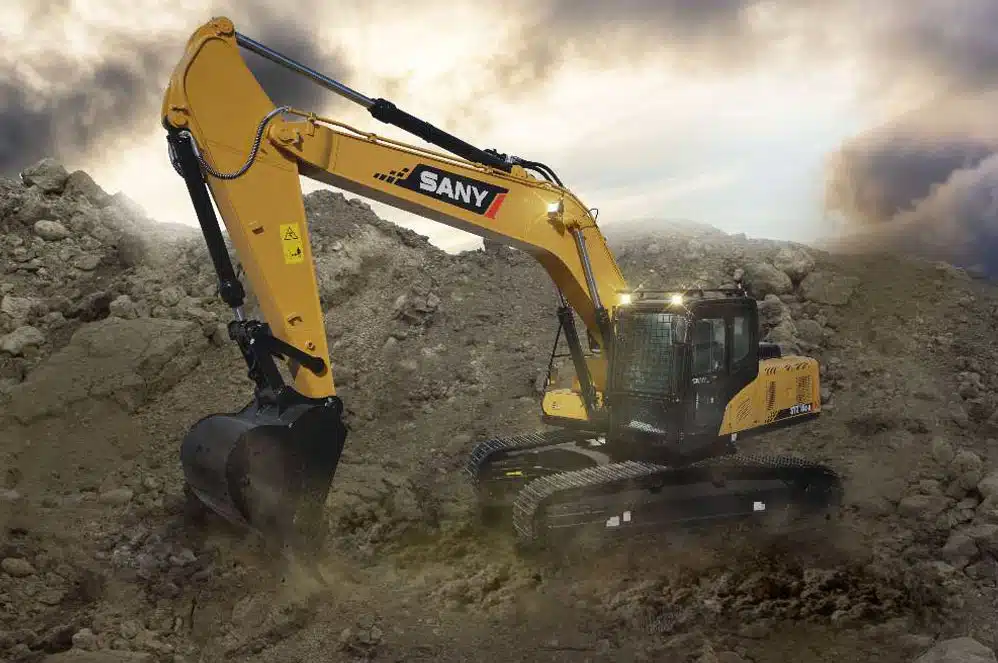
SANY prices aggressively, and the quality and the service network are both still improving. The SY210C-9 at 20,900 kg (₹51–57 Lakh, indicative, as of October 2026) is the value pick in the 20-tonne class. Chinese origin initially raised concerns, but SANY has invested heavily in India — manufacturing facility in Pune, growing dealer network. Resale value is catching up to established brands.
Hyundai builds solid machines and prices them competitively. The R210 SMART X Plus at 21,200 kg (₹63–65 Lakh, indicative, as of October 2026) competes directly with JCB and Tata Hitachi. Service network is good in major markets, thinner in remote areas.
Caterpillar (CAT) is the premium end on price and on performance. The 320D3 at 19,800 kg (₹74–80 Lakh, indicative, as of October 2026) is built for demanding applications. Service through L&T. Best for contractors who prioritize uptime and can afford the investment.
Komatsu is distributed through L&T in India. Excellent engineering, strong in mining and heavy earthwork. The PC210-10M0 at 20,900 kg runs ₹65–75 Lakh (indicative, as of October 2026).
Volvo, Kobelco, XCMG and LiuGong all have a presence in India, with varying dealer coverage. Check service centre proximity before committing. A great machine with poor local support is a liability, not an asset.
Financing Your Excavator Purchase
Most contractors don’t buy excavators with cash. Understanding your financing options helps you structure the deal that fits your cash flow.
Equipment Loans
Traditional financing — you borrow, you pay EMI, you own the machine at the end. Banks and NBFCs offer equipment loans at 9–14% interest depending on your credit profile and the machine’s age. New machines get better rates. Used machines above 5 years old are harder to finance.
Typical terms: 20–30% down payment, 3–5 year repayment period. A ₹60 Lakh excavator with 25% down and 5-year term at 11% interest means roughly ₹98,000 monthly EMI. Make sure your projected utilization supports that payment before signing. You can compare current lender offers and work out an EMI on our equipment finance page.
Building equity matters for long-term fleet owners. Each EMI payment increases your ownership stake. After 5 years, you have a fully-owned asset worth ₹25–35 Lakh on the resale market — that’s capital for your next machine.
Leasing Options
Leasing keeps the machine off your balance sheet and provides predictable monthly costs. Lower payments than loan EMIs because you’re not building equity — you’re paying for usage. At lease end, you typically have three options: return the machine, purchase at residual value, or renew with a newer model.
Leasing works well for contractors with variable project pipelines. If work slows down, you’re not stuck with a depreciating asset and loan payments. The downside: you never own the machine, and total payments over 5 years often exceed purchase price.
Trade-In Programs
Using your existing equipment as down payment simplifies the upgrade process. Most major dealers offer trade-in programs with fair market appraisals. The convenience has value — no separate sale process, no waiting for buyers, immediate credit toward your new machine.
Get an independent valuation before accepting the dealer’s trade-in offer. Dealers typically offer 10–15% below market value on trade-ins. Knowing the true value gives you negotiating leverage.
Understanding Warranty and After-Sales Support
Warranty and service support determine whether a breakdown costs you one day or one week. This matters more than most specs on the brochure.
Standard Warranty Coverage
New excavator warranties typically cover 2–3 years or 3,000 hours, whichever comes first. Full machine coverage in year one, then powertrain and hydraulics only in subsequent years. Read the fine print — warranty often excludes wear items (tracks, teeth, filters) and damage from improper operation.
Extended warranty options are available from most manufacturers. Worth considering if you plan to keep the machine beyond standard warranty period. A major hydraulic pump failure at 4,000 hours costs ₹3–5 Lakh. Extended coverage that costs ₹50,000–80,000 per year can pay for itself with one claim.
Dealer Network and Service Centers
Before buying any brand, check the distance to the nearest authorized service centre. Within 50 km? Excellent — same-day response possible. 50–100 km? Acceptable — next-day service realistic. Beyond 100 km? Think carefully. A breakdown on a remote site with the nearest mechanic 200 km away means 2–3 days minimum downtime.
Ask about parts inventory at the local service centre. Common wear items (filters, seals, teeth) should be stocked locally. Major components (pumps, motors, cylinders) — what’s the typical delivery time from the regional depot? 24–48 hours is acceptable. A week or more? That’s a problem waiting to happen.
Trained technicians matter. A mechanic who’s worked on your specific model diagnoses problems faster and fixes them right the first time. Ask how many technicians at the local centre are factory-trained on your machine type.
Preventive Maintenance Requirements
Every excavator has a service schedule — 250 hours, 500 hours, 1,000 hours, 2,000 hours. Following it religiously extends machine life by 30–50% and maintains resale value. Skipping services saves money this month and costs a fortune later. A patched-up fix will not carry equipment this expensive.
Budget ₹1.5–2.5 Lakh annually for routine maintenance on a 20-tonne (20,000 kg) excavator — oil changes, filters, greasing, minor adjustments. Major services at 2,000 and 4,000 hours cost more. Factor this into your operating cost calculations.
Customer value agreements (CVAs) and annual maintenance contracts (AMCs) bundle service at predictable costs. Worth comparing against pay-as-you-go maintenance. For contractors who struggle with maintenance discipline, a forced service schedule through an AMC often pays for itself in avoided repairs.
Technology and Modern Features to Look For
Modern excavators are computers with hydraulics attached. The technology isn’t gimmick — it directly affects productivity, fuel consumption, and operating costs.
Telematics and Fleet Management
GPS tracking and remote monitoring are standard on most new excavators. You can see machine location, operating hours, fuel consumption, and idle time from your phone. For fleet owners, that visibility settles arguments. Which machine is actually working? Which operator is idling 3 hours a day? The data tells you.
Maintenance alerts notify you before problems become breakdowns. Low oil pressure, high coolant temperature, clogged filters — the machine tells you (or your dealer) before something fails. Preventive intervention costs 10% of emergency repair.
Geofencing prevents unauthorized use and theft. Set boundaries — if the machine moves outside, you get an alert. In a country where equipment theft is a real concern, this feature has obvious value.
Machine Control and Grade Control Systems
GPS-guided excavation systems like SmartGrade (John Deere), Cat Grade, and similar technologies allow operators to dig to precise grades without constant surveyor checks. Productivity improvements of 20–30% are realistic. Rework drops dramatically — you dig to grade the first time.
These systems also help less experienced operators perform like veterans. The machine guides them to the correct depth and slope. Given the shortage of skilled operators in India, this skill-assist capability has real value.
Factory-integrated systems work better than retrofitted kits. If grade control matters for your work, specify it when ordering a new machine.
Operator Comfort and Safety Features
Climate-controlled cabs aren’t luxury in Indian conditions. Summer temperatures inside an un-airconditioned cab exceed 50°C. Operator fatigue sets in fast. Productivity drops. Mistakes happen. AC cabs maintain comfortable working conditions and consistent output.
Rear-view cameras and 360-degree visibility systems reduce blind spots. On busy sites with workers, trucks, and other equipment moving around, this visibility prevents accidents. ROPS (Roll-Over Protective Structure) and FOPS (Falling Object Protective Structure) certification is built to ISO 3471 and ISO 3449 respectively; verify the plate is present on any machine you buy.
Suspension seats reduce operator fatigue over long shifts. Noise reduction keeps decibel levels manageable. These features affect operator retention — good operators choose machines that don’t punish them physically.
Important Questions to Ask Dealers
Walking into a dealer without prepared questions means walking out with whatever they wanted to sell you. Tell them what you need, but know what to ask first.
About the Machine
- What is the total operating weight with standard bucket and full fuel tank?
- What are the exact transport dimensions — height, width, length? Will it fit on a standard trailer without dismantling?
- What attachments are included in the quoted price? Bucket size? Quick coupler?
- Is this configuration in stock, or is it a custom order? What’s the delivery timeline?
- What’s the fuel tank capacity and expected consumption under typical load?
About Service and Support
- Where is the nearest authorized service centre? How many technicians are based there?
- What is the warranty coverage — duration, hours limit, what’s included and excluded?
- What’s the average parts delivery time for common items? For major components?
- Do you offer operator training? How long? Is it included in the price?
- What’s your typical response time for breakdown calls?
About Costs and Ownership
- What is the total out-the-door price including GST, registration, and delivery?
- What financing options are available? Interest rates? Down payment requirements?
- What are the estimated annual maintenance costs for the first 3 years?
- What’s the expected resale value at 5 years / 6,000 hours with proper maintenance?
- Do you offer buyback or trade-in programs?
Excavator Buying Checklist: Your Decision Framework
Before you sign anything, work through this checklist. Every item matters.
- Define project scope: What tasks will this machine perform? Digging, trenching, demolition, lifting, grading?
- Calculate budget: Include purchase price, financing costs, insurance, transport, and first-year operating costs.
- Determine size class: Match machine weight and capability to your typical projects — not your dream projects.
- Compare specifications: Shortlist 3–4 models. Compare digging depth, reach, bucket capacity, fuel consumption, and operating weight.
- Evaluate site conditions: Space constraints, terrain type, ground bearing capacity, access routes, transport requirements.
- Assess brand reputation: Service network proximity, parts availability, resale value in your region.
- Review financing: Compare loan vs. lease. Calculate monthly payments against expected utilization revenue.
- Inspect thoroughly (if used): Engine, hydraulics, undercarriage, structure, maintenance records.
- Test drive: Operate the machine yourself or have your best operator evaluate it. Controls, responsiveness, visibility, comfort.
- Verify support: Warranty terms, service centre distance, parts delivery time, training availability.
How Desi Machines Simplifies Your Excavator Buying Journey
Desi Machines is India’s independent comparison platform for heavy construction equipment. Not a dealer. Not a manufacturer. An independent platform that exists to help contractors make better equipment decisions.
Compare excavators across brands and models — JCB, Tata Hitachi, SANY, Hyundai, CAT, Komatsu, Volvo, and more. Transparent specifications, indicative pricing, and feature comparisons in one place. No more visiting five dealers to gather basic information. Every model we carry sits in the full excavator range, filterable by brand and size class.
Get offers from the authorised channel and OEMs through the platform. Get quotes, schedule demos, and negotiate from a position of knowledge. Financing and insurance solutions through partner institutions help you structure the deal that fits your cash flow.
From mini excavators at ₹20–22 Lakh to mining-class machines at ₹4.5–5.0 Crore (both indicative, as of October 2026), the full range is covered. Whatever your project needs, the right machine is on Desi Machines.
Prices, specifications and features are indicative, vary by variant, location and date, and should always be confirmed with the official OEM or authorised dealer before any purchase decision. DesiMachines is not liable for decisions taken on the basis of information that may have changed after publication.
