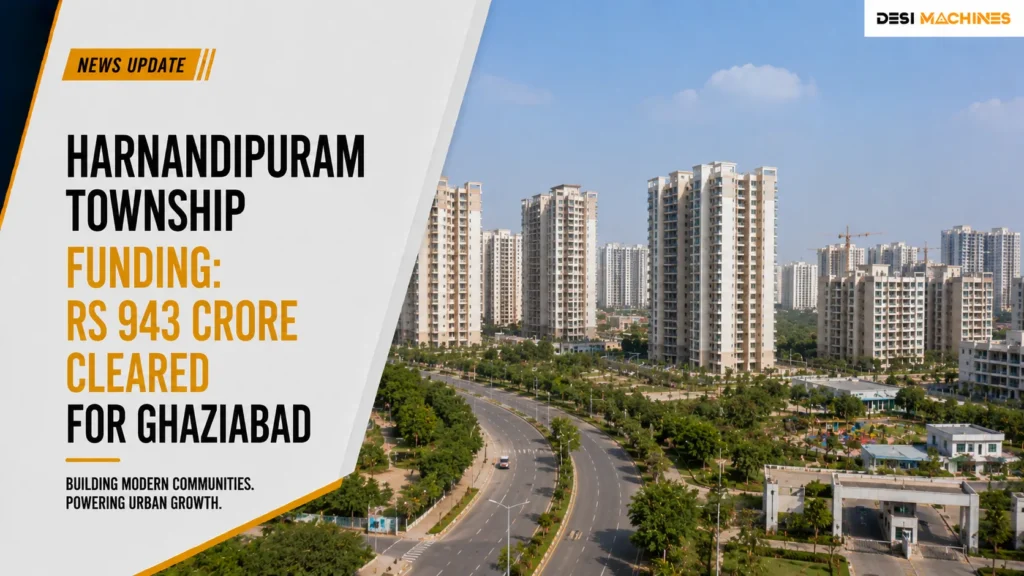
Uttar Pradesh has released the balance seed capital for Harnandipuram, the Ghaziabad Development Authority’s 501-hectare township on the Delhi-NCR edge. For fleet owners across west Uttar Pradesh, the headline number matters less than the sequence behind it: this is money in a development authority’s account, not a work order on the ground.
The quick facts
- Rs 943.37 crore released to the Ghaziabad Development Authority under the Chief Minister Urban Expansion / New City Promotion Scheme, through a government order dated 31 July 2026, for FY 2026-27.
- It is the balance instalment of the scheme’s seed capital, and it covers both land acquisition and infrastructure work. No split between the two has been published.
- Harnandipuram covers about 501 hectares across eight villages, among them Mathurapur, Bhovapur, Morta and Shahpur Nij Morta.
- Phase 1 is roughly 48 hectares. GDA vice-chairman Nand Kishore Kaal has said the detailed phase-1 layout goes to the next board meeting for final approval.
What the state actually released
The order clears the remaining seed capital the state owed the authority under its new-city scheme, and it is meant to carry both land purchase and the first trunk infrastructure: internal roads, water supply, sewerage, power, rainwater harvesting and green belts. The Pioneer and the Ghaziabad-based NCR Khabar both reported the order over the weekend, with NCR Khabar carrying the vice-chairman’s comment on the layout; Hindustan Times ran it the same day. This is a state development authority building the enabling works, not a private builder launching a project.
What does the Harnandipuram township funding mean for equipment buyers?
Read the order of operations before you read the crore figure. Seed capital comes first, then land acquisition, then a board-approved layout, then a phase-1 development tender, and only then does anyone mobilise. Machines sit at the far end of that queue. Nobody should be repositioning a fleet on this announcement.
Size it honestly, too. Phase 1 is about 48 hectares out of roughly 501, and a 48-hectare township phase is not a mega-earthmoving job. The realistic spread is a handful of 20-tonne class excavators on cut-and-fill and service trenches, backhoe loaders doing most of the water and sewer trenching (still the JCB-dominated class on NCR services work), soil compactors and small tandem rollers behind them, and a motor grader for internal road formation. Transit mixers and a batching plant arrive later, once kerbs and carriageways start.
The unpublished split is the live uncertainty. If most of the Rs 943.37 crore goes to buying land across eight villages, the civil-works spend actually released this year is a fraction of it. Land acquisition in west UP is slow and frequently contested, and that timeline, not the sanction, decides when plant is needed.
Our take: the useful signal here is not the money. Sanctioned funds sit idle in UP township schemes for years. The signal is that GDA is close to putting a phase-1 layout in front of its board, because an approved layout is what puts a tender on the street. Watch the board meeting, not the budget line. And given how stop-start phased township work is, this looks like a hire job for most contractors rather than a reason to buy.
What to watch
- The next GDA board meeting, and whether the phase-1 layout for the ~48 hectares clears final approval.
- The first phase-1 development tender, and whether earthwork and trunk services are packaged together or split into separate awards.
- How quickly land acquisition closes across the eight villages. That sets the mobilisation date, not the sanction date.
Planning for NCR township and trunk-services work? Compare machine classes and specs on DesiMachines before you commit, and check what your monthly outgo looks like on our equipment finance pages.
FAQ
Does the Rs 943.37 crore mean construction starts now?
No. It is a funding release to the development authority, not a construction award. The phase-1 layout still needs GDA board approval, and a development tender has to follow before any contractor mobilises.
Which machines does a township like this need first?
Earthwork and services come first: 20-tonne class excavators for cut-and-fill, backhoe loaders for water and sewer trenching, soil compactors and tandem rollers, and a motor grader for road formation. Paving plant and transit mixers follow later.
How much of Harnandipuram is being developed in phase 1?
About 48 hectares of the roughly 501-hectare scheme. The rest is planned in later phases, so demand will arrive in tranches rather than all at once.
Related on DesiMachines: Andhra Pradesh Highway Projects 2026: Rs 1,880 Crore Starts
Source: The Pioneer

 Excavator
294 models
Excavator
294 models  Backhoe Loader
51 models
Backhoe Loader
51 models  Crane
68 models
Crane
68 models  Concrete Mixer
79 models
Concrete Mixer
79 models  Wheel Loader
54 models
Wheel Loader
54 models  Compactor / Roller
45 models
Compactor / Roller
45 models  Motor Grader
42 models
Motor Grader
42 models  Concrete Pump
66 models
Concrete Pump
66 models  Skid Steer Loader
11 models
Skid Steer Loader
11 models  Telehandler
13 models
Telehandler
13 models