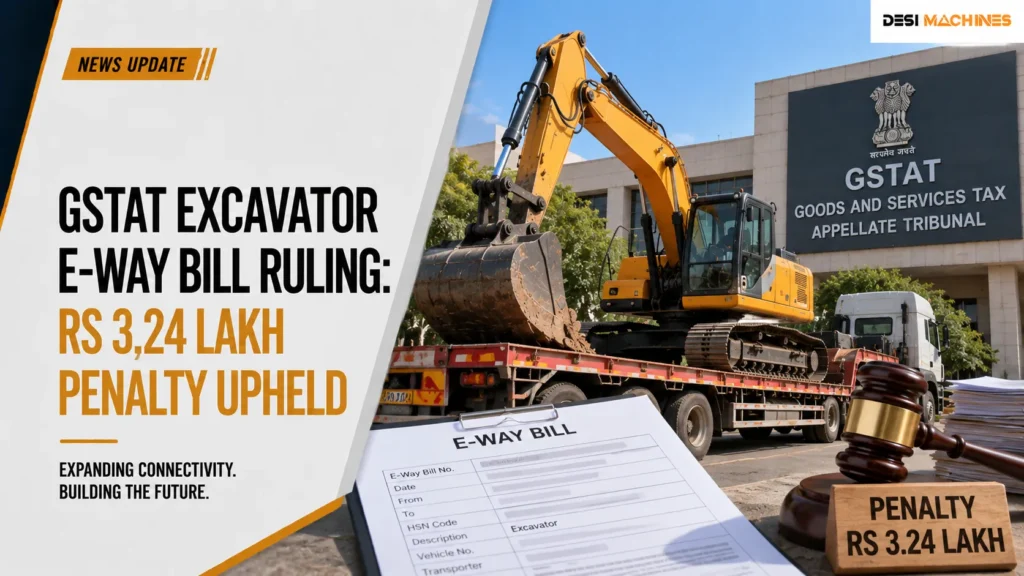
Move your own excavator back from a finished site without an e-way bill and the penalty can take roughly a third of what the machine is worth. That is the blunt read on a GST Appellate Tribunal order out of Lucknow that tax desks started reporting in the first week of September. The owner was not selling anything. Both ends of the trip sat under the same GSTIN. The penalty stood anyway.
The quick facts
- The GSTAT Lucknow bench upheld a Rs 3,24,000 penalty under Section 129(3) of the UP GST Act, split Rs 1,62,000 CGST and Rs 1,62,000 SGST. Appeal APL/52/LCK/2026, order dated 25 August 2026.
- The goods were an excavator valued at about Rs 9,00,000, moved in vehicle UP78GN8559 from a project site at Trans Ganga City, Unnao to the owner’s registered premises in Kanpur.
- The machine travelled on Delivery Challan No. 01 dated 18 July 2025 with no e-way bill, and was intercepted the same day. Consignor and consignee shared one GSTIN.
- The owner’s claim to a 20-kilometre exemption was rejected for want of evidence. The bench was Santosh Kumar Srivastava, Judicial Member, and Arvind Kumar, Technical Member.
What the tribunal actually held
Taxguru carried the order on 8 September, and the text is reproduced by Taxheal. The bench read Section 68 with Rule 138 to mean that prescribed documents, an e-way bill among them, are required for movement of goods even where the reason is something other than supply. Owning the machine, sending it back to your own yard and holding one GSTIN at both ends do not by themselves switch the requirement off. Exemptions exist, but the tribunal treated them as something the transporter has to establish. It also noted the appellant produced nothing on how the money earned for the excavator’s use at the site had been taxed: no operating hours, no hire charges, no GST record. That gap fed the finding on intent.
What it means for equipment owners
Start with the arithmetic, because it is the part that stings. Rs 3,24,000 against a machine carried at about Rs 9,00,000 is close to 36 per cent of the stated value of the asset. For one mid-size excavator on a routine return trip, that is a number most single-machine owners cannot absorb.
The exposure sits on the return leg, not the outbound one. Owners generally raise paperwork when a machine goes out to a job, because a hire contract is driving it and someone is being billed. Bringing it home feels like an internal shuffle: no invoice, no buyer, nothing sold. This order says the department does not see it that way, and that the challan alone is not cover.
Short-haul concessions are the second trap. A distance-based relaxation is a claim you have to prove with records, not a status the machine carries. Asserting it after the fact did not work here.
Hire fleets carry the heaviest risk, because they generate the most movements. A backhoe loader or a small wheel loader that hops between three sites in a month has six documented trips to get right, not one. Owners working across Uttar Pradesh should note this was a state-tax interception on an intra-state move, so it is enforcement close to home, not a border problem.
The quieter half of the order matters too. The bench went looking for proof of how the hire income had been treated, and the absence of it hurt the appellant. A machine moving on thin paperwork invites a second question about what it has been earning, and the rates involved are set out in our guide to GST on construction equipment.
Our take: read this as a documentation standard, not a new tax. One bench, one set of facts, and the outcome turned on missing evidence rather than any holding that own-machinery movement can never qualify for relief. An owner with dated records and a logged hire rate would have been arguing a different case. The cheap fix is raising the e-way bill on every leg, including the one nobody bills for.
What to watch
- Whether other GSTAT benches take the same line on return-leg movements of own machinery, or distinguish on facts.
- Whether field formations start pressing the consideration-for-use question at interception, not just the missing document.
- Any state clarification on what evidence actually discharges a short-distance delivery-challan movement.
Buying or hiring a machine this season? Compare excavator and loader classes by size, and check finance options before you commit to a purchase. Browse machines on DesiMachines and get quotes from verified sellers.
FAQ
Do I need an e-way bill to move my own machine between my own sites?
On the reasoning in this order, yes, unless you can establish that a notified exemption applies. The tribunal held the requirement covers movement for reasons other than supply, and that shared ownership or a common GSTIN does not remove it.
Is a delivery challan enough on its own?
It was not here. The machine carried a dated delivery challan and the penalty was still upheld, because the challan did not substitute for the e-way bill or prove the exemption claimed.
How large was the penalty compared with the machine?
Rs 3,24,000 was upheld on an excavator valued at about Rs 9,00,000, so roughly 36 per cent of the stated value, divided equally between CGST and SGST.
Related on DesiMachines: E-way bill for machinery: when you need one to move a machine
Source: Taxguru

 Excavator
294 models
Excavator
294 models  Backhoe Loader
51 models
Backhoe Loader
51 models  Crane
68 models
Crane
68 models  Concrete Mixer
79 models
Concrete Mixer
79 models  Wheel Loader
54 models
Wheel Loader
54 models  Compactor / Roller
45 models
Compactor / Roller
45 models  Motor Grader
42 models
Motor Grader
42 models  Dozer
41 models
Dozer
41 models  Concrete Pump
66 models
Concrete Pump
66 models  Skid Steer Loader
11 models
Skid Steer Loader
11 models  Telehandler
13 models
Telehandler
13 models