Excavator
316 models
 Backhoe Loader
54 models
 Crane
68 models
 Concrete Mixer
79 models
 Wheel Loader
71 models
 Compactor / Roller
45 models
 Motor Grader
42 models

 Concrete Pump
66 models
 Skid Steer Loader
11 models


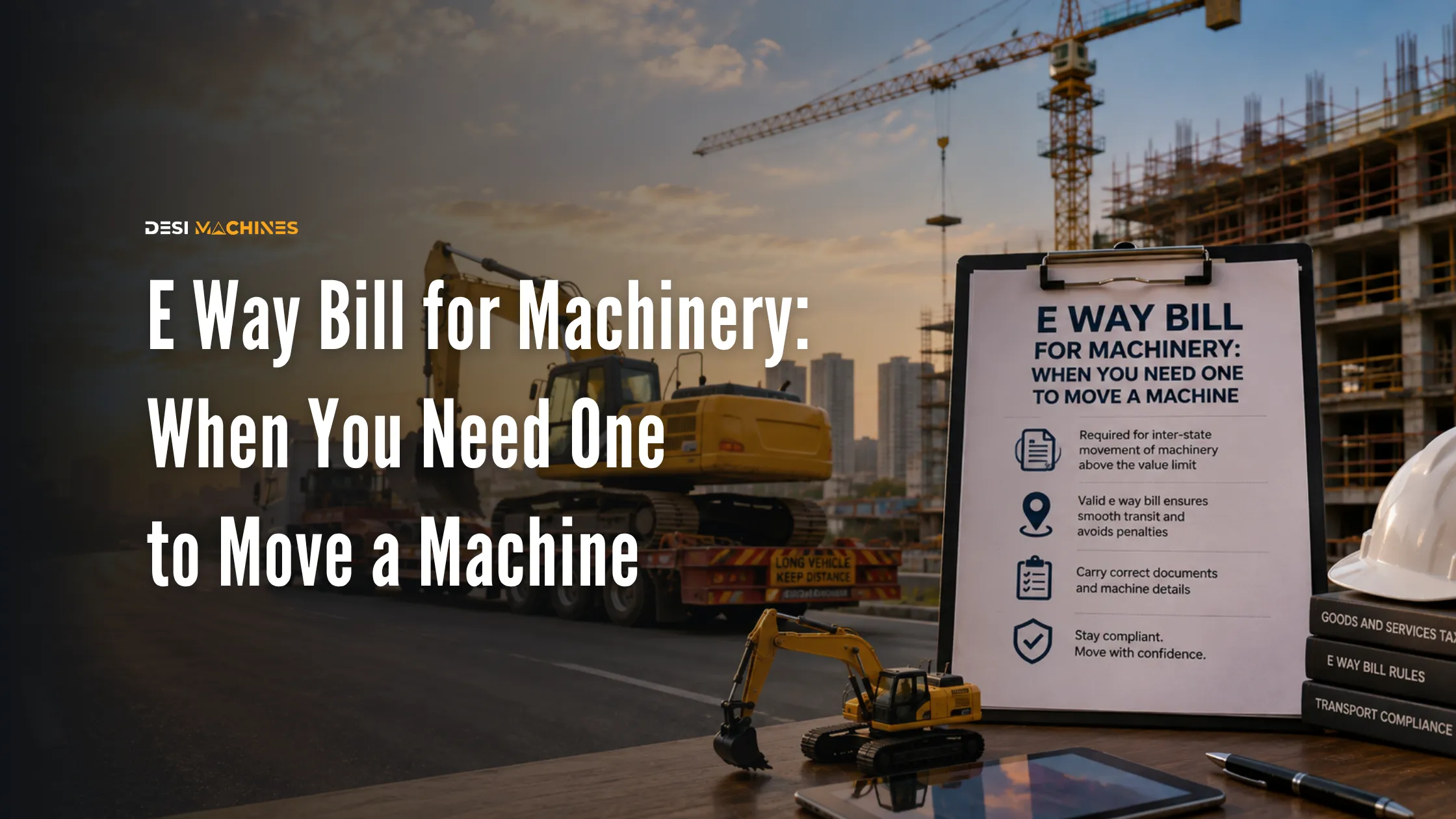
An e way bill for machinery is required where the consignment value exceeds ₹50,000 (the Rule 138 threshold as of November 2026), and the rule is not limited to sales. Moving a machine for reasons other than supply, which is what shifting it between your own sites or sending it for repair is, sits inside the same rule. Where there is no sale there is no invoice, so the movement travels on a delivery challan instead. Validity runs at roughly one day per 200 km.
Most owners meet this rule in the least convenient way: a machine is stopped, the trailer driver has an invoice or nothing at all, and the person asking wants a document that was supposed to be generated before the movement started.
The confusion is nearly always the same. People read the rule as a sales rule. It is not. It is a movement rule, and three of the four things a machine owner does with a machine are movements without a sale.
What triggers an e way bill for machinery
Rule 138 of the Central Goods and Services Tax Rules, 2017 opens by saying that every registered person who causes movement of goods of consignment value exceeding fifty thousand rupees must furnish information about the goods in Part A of the prescribed form, electronically, before the commencement of such movement.
It then lists three occasions:
| The move | Which trigger it falls under | Document with the machine |
|---|---|---|
| You sell the machine to a buyer | In relation to a supply | Tax invoice |
| You shift it between your own sites | For reasons other than supply | Delivery challan under Rule 55 |
| You send it to a workshop for repair | For reasons other than supply | Delivery challan under Rule 55 |
| You buy from an unregistered seller | Inward supply from an unregistered person | As applicable to that purchase |
The second and third rows are where owners get caught, because nothing is being sold and it does not feel like a GST event. The rule does not ask whether money changed hands. It asks whether goods moved.
The first row has its own trap when the machine is a used one, because the tax on the sale is worked out differently: see GST on the sale of an old machine. The second row has already been tested. In a GST Appellate Tribunal order reported in September 2026, an owner moved his own excavator back from a finished site, with both ends under the same GSTIN and a dated delivery challan on board but no e-way bill, and the penalty was upheld. The GST Appellate Tribunal excavator ruling sets out the case.
On value, Explanation 2 defines consignment value as the value determined under Section 15, declared in the invoice, bill of supply or delivery challan issued for that consignment, and it includes the central, state or union territory tax, integrated tax and cess charged in the document. For any working machine, that figure is going to clear the ₹50,000 threshold (as it stands in November 2026) comfortably, which means for practical purposes the threshold filters out spare parts and consumables, not machines.
The two-part form, and who fills which half
The form has two parts, and the split explains most of the friction between an owner and a transporter.
Part A carries the details of the goods and is furnished by the registered person causing the movement. That is you.
Part B carries the conveyance details. Where you transport in your own conveyance, a hired one, or a public conveyance by road, you furnish Part B and generate the e-way bill. Where you hand the machine to a transporter for carriage by road and the bill has not already been generated, the rule moves the obligation along: you furnish Part A, and the transporter generates the e-way bill on the basis of what you furnished.
Two consequences follow. If you fill Part A and assume the transporter will finish the job, confirm that they did: the machine moves on their number, but the movement is yours. And if the machine is transhipped to another vehicle mid-journey, Part B has to be updated, which is a transporter’s task that has to actually happen rather than be assumed.
There are separate routes for movement by rail, air or vessel, where the information in Part B may be furnished either before or after the movement commences, with the notable condition that railways will not deliver the goods unless the e-way bill is produced at delivery.
How long it lasts, and the eight-hour window
Validity is set by distance, not by a fixed number of days:
| Distance | Validity (other than over dimensional cargo) |
|---|---|
| Up to 200 km | One day |
| Every 200 km or part thereafter | One additional day |
Over dimensional cargo runs on its own, shorter distance bands. That matters here more than it does for most goods, because a large machine on a trailer is frequently over dimensional in its own right, which brings its own permit question, covered in the over-dimensional cargo permit.
The rule spells out both halves. Explanation 2 to sub-rule (10) treats cargo as over dimensional when it is carried as a single indivisible unit and exceeds the limits in rule 93 of the Central Motor Vehicles Rules, and its bill runs one day for the first 20 km and one more day for every 20 km or part after that. Most 20-tonne excavators qualify on width alone: the Tata Hitachi EX 200 Infra, about ₹56–62 lakh as of November 2026, is 2,890 mm wide over its tracks against a 2.6 metre limit. A 300 km site shift that gets two days as ordinary cargo gets 15 days as over dimensional cargo, so pick the right vehicle type in Part B; the e-way bill portal’s user manual lists ODC as a vehicle type alongside Regular.
Two reliefs are built in. Where goods cannot be moved within the validity period because of an exceptional circumstance, including transhipment, the transporter may extend the validity after updating the details. And the validity may be extended within eight hours of its expiry, a genuinely useful provision when a machine is stuck at a check post or a breakdown eats a day.
The rule itself says only “within eight hours from the time of its expiry”. The e-way bill portal’s user manual (version 1.7, June 2025) lets the current transporter extend from eight hours before expiry to eight hours after it, up to 360 days from the date the bill was generated, so the extension has to come from whoever holds Part B at the time.
One more line saves an argument at a state border: an e-way bill generated under this rule, or under the corresponding rule of any State or Union Territory, is valid in every State and Union Territory. You do not generate a fresh one per state. If the movement is a purchase from a dealer in another state, the same document sits inside a longer checklist: see buying heavy machinery across states for the invoice, permit and service-network questions that travel with it.
What is exempt, and what is not
The rule carries a long list of cases where no e-way bill is required. Most of it is irrelevant to a machine owner: goods moved by non-motorised conveyance, customs-bonded movements, empty cargo containers, transit cargo to Nepal or Bhutan, movement caused by a defence formation, specified exempt goods.
What is worth noticing is what the list does not contain. There is no exemption for construction machinery, none for capital goods, and none for a machine you already own moving to a site you already work on.
There is one entry with a peculiar relevance to this industry. High speed diesel, petrol, petroleum crude, natural gas and aviation turbine fuel are outside the rule. So the fuel is exempt and the machine that burns it is not.
The state-level catch
The central rule is the floor, not the whole picture. The exemptions include movement of goods within areas notified under the corresponding provision of the State or Union Territory GST Rules, and states have taken different positions on movement inside the state: different thresholds, and in some cases notified areas where no bill is needed at all.
So the ₹50,000 test (November 2026) is safe to rely on for inter-state movement, and is the starting point rather than the answer for movement within your own state. Confirm your state’s notification with your accountant before you build a practice around a number. The input credit question needs the same care: see GST input credit on a construction machine.
How to generate one for a site shift or a repair trip
Start with the delivery challan, because the e-way bill is built from it. Rule 55 lets you issue a challan instead of an invoice when goods move for reasons other than supply; it needs a serial number of up to sixteen characters, the date, your GSTIN, the consignee’s name and address, the HSN code and description of the machine, the quantity, the taxable value and a signature. Put the machine’s serial number in the description so the challan matches the machine on the trailer.
Then fill Part A on the e-way bill portal from that challan, as an outward movement with Delivery Challan as the document type. The portal’s user manual describes the “For Own Use” sub-type as the one for goods moved between a taxpayer’s own business places, and “Others” as the one where you specify the movement yourself, which is where a trip to an outside workshop usually fits. Ask your accountant which applies if the site is not a registered place of business. Part B takes the vehicle number, and the vehicle type ODC when the machine on the trailer is over dimensional. The return trip is a separate movement with its own challan and e-way bill, so agree in writing who will generate it, you or the workshop.
Getting it right on a hire movement
Putting a machine on hire is where the paperwork most often goes wrong, because two different things are happening. The service is the hire. The movement is the machine physically going to the customer’s site and coming back.
The machine itself is not being sold, so no goods invoice travels with it: owners move it on a delivery challan, both ways, and generate the e-way bill against that challan. Owners commonly document the outbound leg and forget the return, which is the leg that tends to be stopped, because a machine coming back on an empty-looking trailer attracts more questions than one going out.
Build the challan into the hire process rather than the transport process, and keep it with the hire documentation. What that documentation should contain in the first place is set out in the equipment rental agreement, and what the movement itself costs is in excavator transport cost.
Who arranges the trailer and who pays for each leg is a separate hire term, covered in the guide to equipment rental mobilisation and transport.
If a move has already gone wrong and the machine is standing detained, the amount at stake is set by section 129 of the CGST Act, and the current figures and the release route are in e-way bill penalty and detention.
In short, as of November 2026: since the Finance Act 2021, section 129 releases detained goods on a penalty of 200% of the tax payable where the owner comes forward, and of 50% of the value of the goods or 200% of the tax, whichever is higher, where the owner does not; the trailer itself is released on that penalty or ₹1 lakh, whichever is less. Small slips are handled differently. The CBIC’s Circular 64/38/2018 of 14 September 2018 says that where the machine travels with an e-way bill, an error in one or two characters of the vehicle number or of the document number draws a penalty of ₹500 under the CGST Act and ₹500 under the state GST Act, not a detention.
Generate the e-way bill for every machine movement
Treat every machine movement as a documented movement, including the ones where no money changes hands. Sale, site shift, workshop trip, hire out and hire back: five movements, one rule, and only the sale travels on a goods invoice.
The cheapest habit here is to generate the bill even when you think you are under the line. The rule expressly permits it, it costs nothing, and it removes the argument entirely. A machine detained at a check post costs a day of hire and a day of goodwill, and neither is recoverable: the same arithmetic as any other idle day, which we work through in the cost of equipment downtime.
If these movements are frequent enough to be a real cost, the question is whether the work justifies a machine stationed closer to it. Compare excavator models and prices and backhoe loaders, and connect with a dealer before committing.
Confirm the current price and variant with the dealer or OEM before you buy.
Rates, schemes, specifications and prices change, so confirm current terms with the OEM, dealer, bank or insurer before deciding. The position here is summarised from Rule 138 of the Central Goods and Services Tax Rules, 2017 as it stood at the time of writing; state notifications differ and tax positions turn on facts, so confirm yours with a qualified professional.