Excavator
294 models
Excavator
294 models  Backhoe Loader
51 models
Backhoe Loader
51 models  Crane
68 models
Crane
68 models  Concrete Mixer
79 models
Concrete Mixer
79 models  Wheel Loader
54 models
Wheel Loader
54 models  Compactor / Roller
45 models
Compactor / Roller
45 models  Motor Grader
42 models
Motor Grader
42 models  Dozer
41 models
Dozer
41 models  Concrete Pump
66 models
Concrete Pump
66 models  Skid Steer Loader
11 models
Skid Steer Loader
11 models  Telehandler
13 models
Telehandler
13 models 


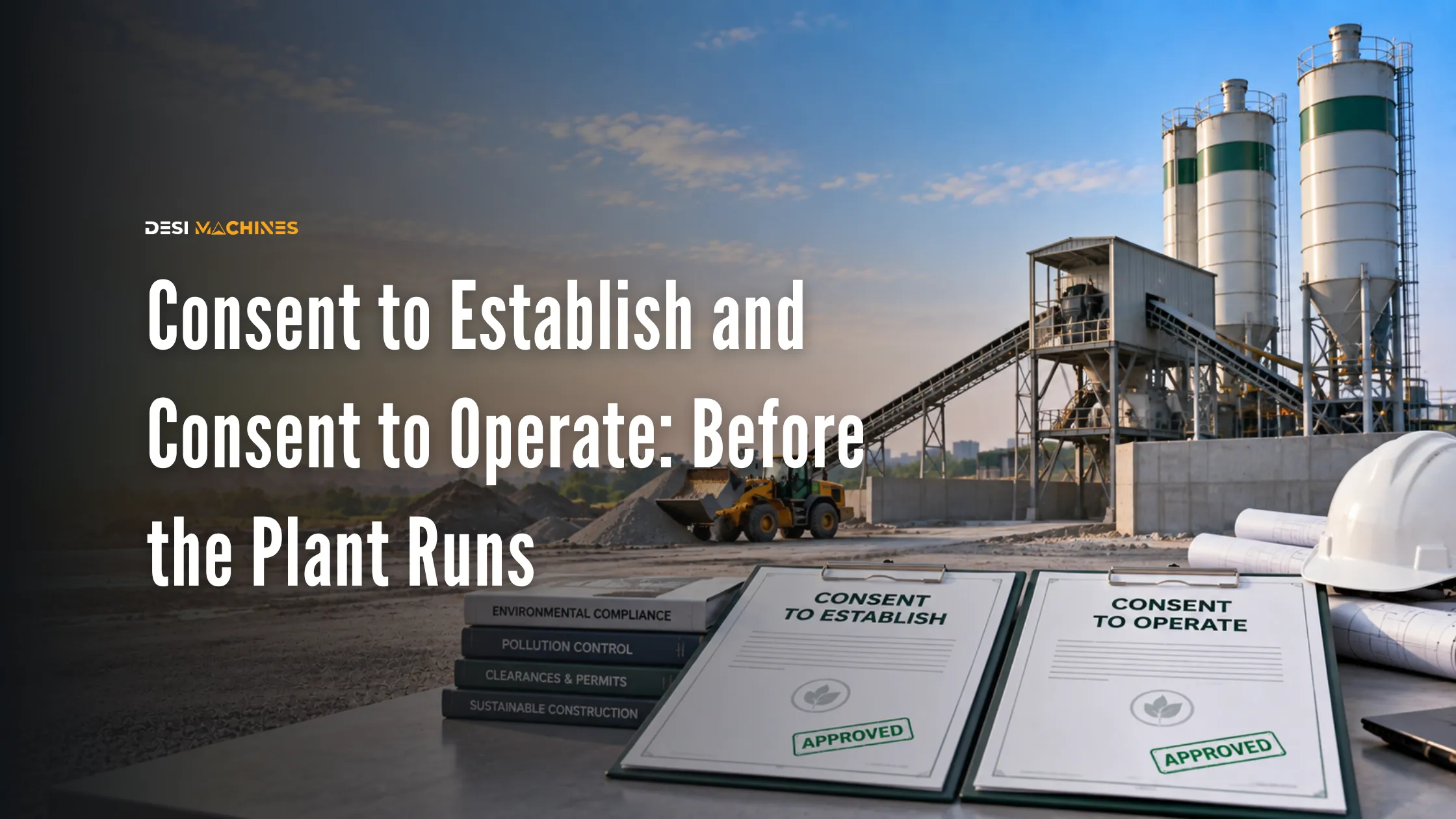
Consent to establish and consent to operate are the two approvals a State Pollution Control Board issues before a crusher, hot-mix or batching plant can be built and then run. They rest on section 25 of the Water Act, 1974 and section 21 of the Air Act, 1981, they are granted only for a stated period, and they carry conditions you have to keep meeting. The sequencing is the commercial point: consent comes before the spending, not after it.
What consent to establish and consent to operate actually are
If your business is machines on hire, this never comes up. The moment you put up a fixed plant — a stone crusher, a hot-mix plant, a ready-mix batching plant, a screening unit at a quarry — you move from being a machine owner to being an operator of an industrial plant, and a different rule book applies.
For a hot-mix plant in particular, the 2023 siting distances and a Tribunal order that stopped a plant running without consent to operate are set out in hot mix plant business.
Two central Acts sit behind it, both administered by your State Board.
Section 25 of the Water (Prevention and Control of Pollution) Act, 1974 says that no person shall, without the previous consent of the State Board, establish or take any steps to establish any industry, operation or process — or any treatment and disposal system, or any extension or addition to one — which is likely to discharge sewage or trade effluent into a stream, well, sewer or on land. It also covers bringing a new or altered outlet into use, and beginning a new discharge.
Section 21 of the Air (Prevention and Control of Pollution) Act, 1981 says that no person shall, without the previous consent of the State Board, establish or operate any industrial plant in an air pollution control area.
Read the verbs. The Water Act catches you at “take any steps to establish”. The Air Act catches you at both “establish” and “operate”. That is the whole architecture: one approval before the plant exists, another before it works.
Why the sequence is a money question, not a paperwork question
Owners routinely treat consent as something the office handles while the site gets on with it. The statute is written the other way round — the consent is previous consent, required before the steps are taken.
Work through what that means for capital. Land, civil foundations, the crusher itself, the conveyor, the electrical connection: on a plant of any size that is a large committed sum, and much of it is not recoverable if the site turns out to be unconsentable. A refusal has to be for reasons recorded in writing, but a well-reasoned refusal is still a refusal.
Then add the calendar. Under section 21(4) of the Air Act, the State Board is to pass a written order within four months of receiving the application, granting the consent subject to such conditions and for such period as it specifies, or refusing it. Four months is the outer statutory frame for that decision, and it should be sitting in your project schedule as a real line.
It should also be sitting in your finance plan. If the plant and the machines feeding it are on instalments, those instalments start on a delivery date, not on a consent date. A plant that is built, financed and waiting on an order is paying for itself out of nothing. That is the same arithmetic that decides whether the crusher economics work at all, and it is worth running before the first payment goes out.
What the board is deciding, and what it attaches
A consent is not a certificate that you passed. It is an order with conditions, and the conditions are where the ongoing cost lives.
| What the statute provides | What it means on your site |
|---|---|
| Consent granted for a specified period | Both Acts contemplate a stated period, not a permanent clearance. It expires and needs renewal. |
| Conditions on discharge (Water Act) | The order can fix the point of discharge and, for a new discharge, the nature, composition, temperature, volume or rate of the effluent. |
| Control equipment (Air Act) | Equipment of a specification the board approves must be installed and operated, and altered or replaced if the board directs. |
| Kept in good running condition | The control equipment has to be kept working at all times — an operating and maintenance cost, not a one-time purchase. |
| Chimney where necessary | Erected or re-erected to a specification the board approves. |
| Cancellation before expiry | The board may cancel a consent, or refuse further consent, where the conditions are not fulfilled — after a reasonable opportunity of being heard. |
That last row is the one to plan against. Consent is not a hurdle cleared once at the start of the project. It is a licence that can be withdrawn mid-life if the dust suppression is switched off to save money, and the hearing you get before that happens is worth far more if your maintenance records show the equipment was actually running.
What we are deliberately not quoting
You will find articles giving a fee figure, a validity in years, and a minimum distance from the nearest habitation. Be careful with all three.
Both Acts leave the application form, the particulars and the fees to be prescribed — that is, fixed by rules made at state level and revised from time to time. Each state has its own consent rules under these Acts, its own fee schedule tied to project cost or category, its own validity periods and its own siting conditions. Categorisation of the plant itself drives most of it, and that too is administered state by state.
So a number that is correct in Maharashtra is not evidence about Rajasthan, and a number that was correct two years ago is not evidence about today. The honest position is the one to work from: get the current fee schedule, validity and siting conditions for your own state and your own category, in writing, from the State Board before capital is committed. It is the same reason we decline to publish a single national figure for royalty on earthwork and minor minerals, which is set the same way.
Board consent is not the only clearance a large site needs. Where the built-up area crosses 20,000 square metres, prior environmental clearance for construction projects is a separate requirement that comes before the work, not alongside it.
A practical order of work
For an owner putting up a plant for the first time, the sequence that avoids stranded capital looks like this.
| Stage | What has to be true before you spend |
|---|---|
| Site selection | Category of the plant identified, and the state’s siting conditions checked for that category against the actual location. |
| Consent to establish | Applied for and granted before civil work and before the plant order is placed. |
| Build and install | Built to what the consent order says, including the control equipment specification it approves. |
| Consent to operate | Obtained before commissioning. The plant does not earn until this exists. |
| Renewal calendar | Expiry date diarised well ahead, with the renewal application timed against the board’s own decision period. |
Two of those stages are where owners lose money. Placing the plant order before the consent to establish converts an approval risk into a stranded asset. Letting a consent to operate expire converts a compliant plant into a non-compliant one overnight, without anything changing on site. The pollution consents also run alongside a separate fire file with its own certificate and its own blocking power, set out in our note on the fire clearance a construction site actually needs.
What to ask your State Board for, in writing
“Get it from your own board” is the right answer and a useless one on its own, because an owner walking into a State Board office still has to know what to come back with. These are the items that decide whether the project is viable, and they are the ones worth a written answer before any capital moves.
| What to ask for | Why it decides something |
|---|---|
| The category your plant falls in | Categorisation drives the fee, the validity period and most of the siting conditions, and it is administered state by state. Ask for the category of your specific plant and capacity, not of “a crusher” in general. |
| The current fee schedule for that category | Both Acts leave fees to be prescribed by state rules, and those rules are revised from time to time. A figure from a neighbouring state, or from two years ago, is not evidence about yours. |
| The validity period each consent will carry | Both Acts contemplate a stated period rather than a permanent clearance. The expiry date sets the renewal calendar, and a short first period changes the finance case on a plant bought on instalments. |
| The siting conditions that apply at your location | Distance from habitation, water bodies and roads is fixed at state level against the category. Check them against the actual plot, with its survey number, before the land is committed. |
| The control equipment specification the board will approve | The Air Act lets the board require equipment of a specification it approves, and require it to be altered or replaced later. That is a capital line at the start and a maintenance line for the life of the plant. |
| The discharge conditions likely to be attached | For a new discharge the order can fix the point of discharge and the nature, composition, temperature, volume and rate of the effluent. Those conditions size the treatment you have to build. |
| The lead time a renewal needs | The four-month frame under section 21(4) of the Air Act is for deciding an application. Ask separately how far ahead a renewal should be filed, because it is the gap between expiry and renewal that leaves a running plant uncovered. |
| All of it on paper | A refusal has to be for reasons recorded in writing. An encouraging conversation at the counter is not something you can hold anyone to once the foundations are poured. |
Take the answers in the board’s own words rather than paraphrased into your file note. When a condition is later argued about — and the ones on control equipment usually are — the wording the board used is what the argument turns on.
Which consent do you need before the plant runs?
Consent to establish clears the building of the plant; consent to operate clears the running of it. They come from the State Board under two separate Acts, they are granted for a stated period with conditions attached, and they can be withdrawn if those conditions stop being met. The fees, forms and siting distances are set by your state, so take them from your own board rather than from an article.
If the plant is the next step in the business, price the approval time into the plan the way you would price any other input. Look at what the finance structure on the plant and feeding machines costs you across the months before the plant earns, and compare live excavator models and prices for the quarry side on running cost rather than on sticker price alone. The economics of the feed sit in the excavation rate per cubic meter.
Consent requirements, fees, validity periods, categorisation and siting conditions are prescribed by state rules under the Water Act, 1974 and the Air Act, 1981 and are revised from time to time. Nothing here is legal advice. Confirm the current position for your category and your state in writing with your State Pollution Control Board or another official source before committing capital. DesiMachines is not liable for decisions taken on the basis of information that may have changed after publication.