
 Excavator
294 models
Excavator
294 models  Backhoe Loader
51 models
Backhoe Loader
51 models  Crane
68 models
Crane
68 models  Concrete Mixer
79 models
Concrete Mixer
79 models  Wheel Loader
54 models
Wheel Loader
54 models  Compactor / Roller
45 models
Compactor / Roller
45 models  Motor Grader
42 models
Motor Grader
42 models  Concrete Pump
66 models
Concrete Pump
66 models  Skid Steer Loader
11 models
Skid Steer Loader
11 models  Telehandler
13 models
Telehandler
13 models  Dozer
Dozer 


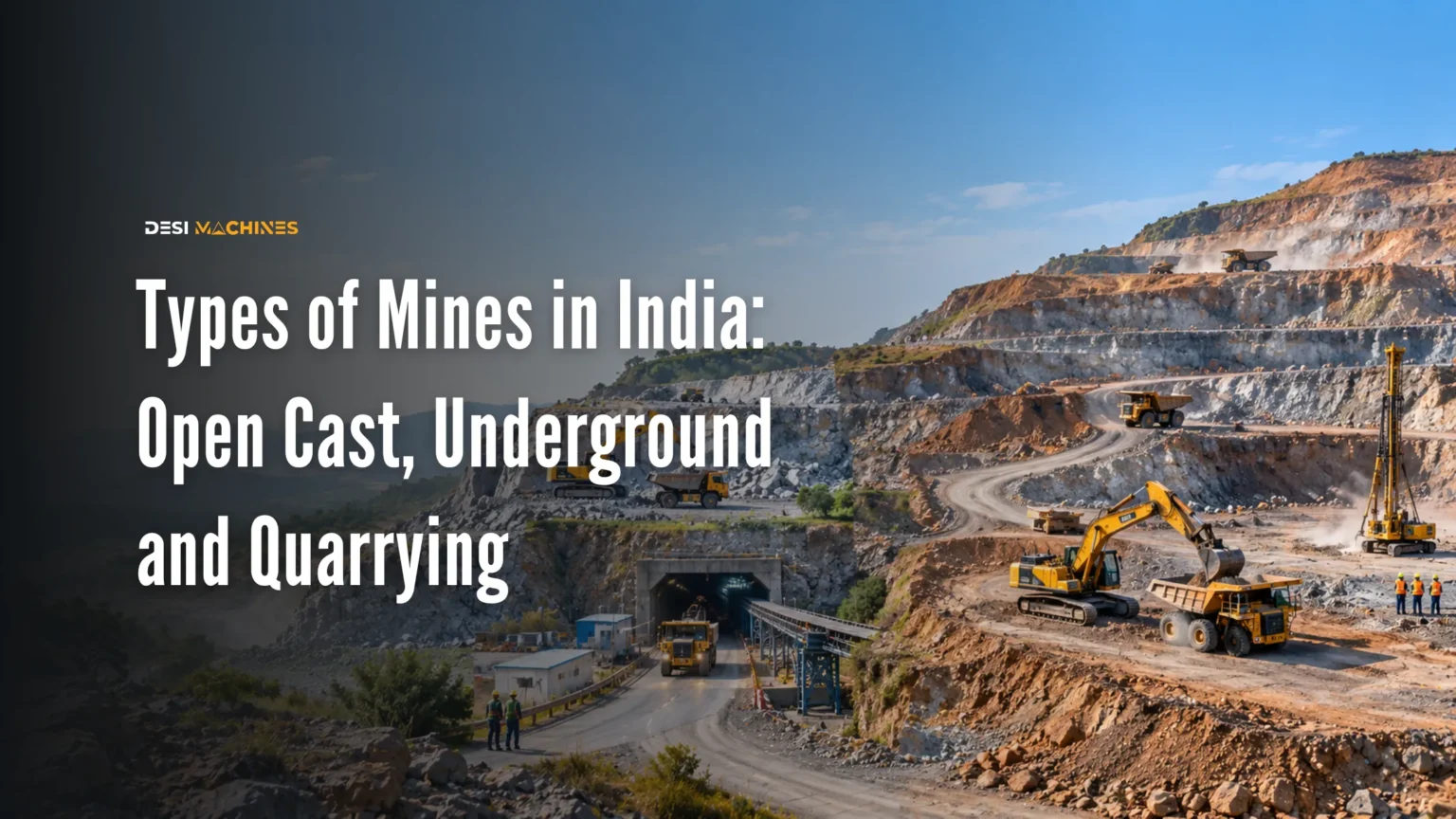
Open cast mining is mining done from the surface. The soil and rock lying over the mineral are stripped off in steps, the seam or ore body is laid bare in the open air, and everything is dug and loaded by machines working under the sky. It is one of three ways India takes material out of the ground. The other two are underground mining, where a vertical shaft or a sloping tunnel carries men and machines below the surface to reach a deep seam, and quarrying, where stone is blasted or cut out of a hillside for aggregate, building stone or cement.
Which of the three you are standing in front of decides nearly everything else about the site: the size of the machines, how many of them there are, who issues the licence, and what the safety law expects. This page takes the three in turn, in the order of how much material India actually moves with each one.
What is open cast mining?
Strip the ground lying over a mineral, then dig the mineral itself in daylight — that is open cast mining, also written open-cast or opencast. The material lying on top — soil, weathered rock, whatever is not worth selling — is called overburden. Stripping that overburden is usually the biggest single job on the site, and it is why a coal mine can run a fleet of heavy machines and still ship no coal for months at the start.
The pit is worked in benches. A bench is a flat step cut into the side of the pit, and the face of each step is sized so the excavator working it can reach the top of that face safely. Stack enough benches and the pit looks like a giant staircase cut into the ground, with a haul road spiralling down it for the tippers.
Hard rock is drilled and blasted first, then dug. Softer ground is dug straight. Either way the cycle is the same three moves, repeated all day: break it, load it, haul it out. A large tracked excavator or a dragline loads, tippers carry, a dozer keeps the face and the dump tidy, and a motor grader keeps the haul road smooth — a rough haul road costs more in tyres and fuel than most owners expect.
The method works when the mineral is shallow. Once the seam sits deep enough that you would be moving several tonnes of waste for every tonne of coal, the sum stops working and the mine has to go underground instead.
What is underground mining and when is it used?
Underground mining reaches a deep deposit through an opening instead of removing the ground above it. That opening is either a vertical shaft, a sloping incline driven down from the surface, or an adit driven horizontally into a hillside. Nothing above the deposit is stripped, so the farm, forest or town on the surface can stay where it is.
In Indian coal the common method is bord and pillar: the seam is cut into a grid of roadways, and squat pillars of coal are left standing between them to hold the roof up. Longwall mining, where a long face is cut in one pass under moving roof supports, is used in far fewer mines here. Metal mines have their own methods again.
Three things make underground work harder than the surface. The roof has to be supported everywhere men walk. The workings need forced ventilation, because coal seams give off methane. And every machine has to fit down the same opening the men use, which is why underground equipment is a different family altogether — low, narrow, often electric, and not the crawler excavators and tippers you see in a pit. We do not list underground machines on this site, and a guide that pretended otherwise would not help you.
The trade is cost against ground. Underground output per worker is lower and the cost per tonne is higher, but you are not buying, clearing and later restoring the entire surface above the deposit.
Is quarrying the same as mining?
A quarry is an open working too, so in engineering terms quarrying is surface mining. The difference is what comes out and which law governs it. A quarry produces stone: aggregate for concrete and roads, dimension stone like granite and marble, limestone for cement, and the crushed rock that becomes manufactured sand.
In Indian law most of this falls under minor minerals — building stone, ordinary sand, gravel, ordinary clay and the like. Minor minerals are administered by the state government under state rules, while major minerals such as coal, iron ore and bauxite are handled under central law. That single distinction is why a stone quarry lease is dealt with at the district and state level while a coal block is auctioned by the Ministry of Coal.
Quarries are also smaller operations. A hard-rock quarry feeding a crusher usually runs one or two excavators in the 20–25 tonne class (20,000–25,000 kg), a rock breaker for oversize boulders, a wheel loader — the payloader, as most sites call it — to feed the crusher hopper, and a handful of tippers. That is a fleet a single contractor can own, which is not true of a coal mine.
Which type of mine does India use most?
Open cast, by a distance. More than 95 out of every 100 tonnes of Indian coal now comes from surface mines, and the biggest iron ore and limestone operations are open workings as well. Underground mining holds a small share of national output, though the government has been trying to grow it: in the 14th round of commercial coal mine auctions, launched on 29 October 2025, blocks reserved for underground mining were offered with the revenue-share floor cut to 2% and the upfront amount waived, per the Ministry of Coal’s year-end review.
The three workings in cross-section
Read the diagram left to right and the difference is the ground above the mineral: the open cast mine removes it, the underground mine leaves it standing on pillars, and the quarry cuts into a hillside where there was little sitting on top to begin with.
| Working | What it mainly produces here | Who governs the licence | Scale of the machine fleet |
|---|---|---|---|
| Open cast mine | Coal, iron ore, bauxite, limestone | Central law; coal blocks auctioned by the Ministry of Coal | Very large — 50 tonne (50,000 kg) and heavier excavators, dozers, tipper fleets |
| Underground mine | Deep coal seams, zinc, lead, copper, gold | Central law, with mine safety under the Directorate General of Mines Safety | Specialised low-profile underground machines, not surface equipment |
| Quarry | Aggregate, building and dimension stone, limestone for cement, manufactured sand | Mostly state rules, as minor minerals | Small — one or two 20–25 tonne (20,000–25,000 kg) excavators, a loader, tippers |
If you are a contractor rather than a mine owner, the quarry row is the one that concerns you. Most machines bought for mineral work in India go to quarries and small stone workings, not to the big coal pits, because the coal pits are worked by the mine developer’s own fleet or by a large contractor.
Which machines work in each type of mine?
The surface fleet is the same family of machines used in construction, built heavier. Thicker steel, stronger undercarriages, bigger buckets, more cooling. The mining equipment guide covers that machine set in detail; what follows is which class of machine belongs to which working, with examples we list.
| Working | Class | Example on our site | Operating weight | Bucket or blade |
|---|---|---|---|---|
| Large coal or iron ore pit | Extra-large excavator, above 50 Ton | BEML BE1800D | 175 Ton (175,000 kg) | 10.5–12.0 m³ bucket |
| Large pit or overburden removal | Extra-large excavator | Tata Hitachi ZAXIS 890LCH | 84.3 Ton (84,300 kg) | 4.5–6.0 m³ bucket |
| Dozing and ripping at the face | Mining dozer | Komatsu D475A-5E0 | 108.4 Ton (108,390 kg) | 27.2 m³ blade |
| Medium mine or big quarry | Large excavator, 25–50 Ton | Tata Hitachi ZAXIS 370LCH Ultra | 35.7 Ton (35,700 kg) | 1.3–2.5 m³ bucket |
| Hard-rock quarry | Medium excavator, 15–25 Ton | SANY SY240C-9HD GraMa | 24.4 Ton (24,410 kg) | 1.4 m³ bucket |
Specifications above are as listed on each machine’s page on this site. Around those diggers sit the support machines: a wheel loader to feed the crusher or load tippers, a mining dozer to push overburden and keep the face clean, and a motor grader for the haul roads. Haul road upkeep is the job most quarries skip and then pay for in tyres.
Looking at a machine for mineral work? Browse the extra-large mining excavators we list, or the 15–25 tonne class that most quarries actually buy.
Who gives permission to open a mine or a quarry in India?
Mineral rights in India belong to the state, and you need a grant before a single bucket moves. Major minerals are handled under the Mines and Minerals (Development and Regulation) Act, 1957, with coal blocks and most mineral blocks now awarded by auction. Minor minerals — the quarry materials — are granted by the state government under its own minor mineral concession rules, which is why the process and the royalty rates differ from one state to the next.
Two more approvals sit on top of the lease. Safety in every mine is regulated under the Mines Act, 1952 and enforced by the Directorate General of Mines Safety, which is why a working mine has a mining plan, a qualified mine manager and rules about bench height and face distance that are not suggestions. Separately, pollution control board clearance is needed before the plant runs; our guide to consent to establish and consent to operate explains that pair, and it applies to the crusher next to your quarry as much as to a factory.
Buying a machine before the lease is signed is a common and expensive mistake. The lease decides the volume, the volume decides the machine size, and until the lease is in hand the sizing is guesswork.
How do you choose a machine for quarry or mine work?
Start with the material, not the machine. Hard rock that needs blasting wears out a digger differently from soft overburden, and the specifications that matter change with it.
Check four things. Bucket capacity against your tipper: three to five clean bucket passes should fill the body, and our guide to excavator bucket capacity sets out how to match them. Ground pressure, which is the weight the machine puts on each square centimetre of ground through its tracks — it decides whether the machine floats on a soft dump or sinks into it, and the ground pressure guide explains the numbers. Attachment plumbing, because a quarry machine spends real hours on a rock breaker, and breaker work eats consumables — the breaker chisel guide covers what wears and when to change it. And haul road provision, since the material still has to leave the site; the road construction equipment guide covers the machines that build and hold that road.
If the work is a single season or a trial pit, renting is the sober answer. Dozer rental in particular suits short overburden jobs, where buying a heavy dozer for one contract rarely pays back. Where a purchase does make sense, work the monthly cost out before you commit — our equipment finance page sets out how construction and mining machine loans are structured in India.
Ready to shortlist? See what we list in the 25–50 tonne excavator class, the workhorse size for Indian quarries and medium mines, and talk to us about what suits your material.
Read next: the mining equipment guide for the full machine set, with sizes and running costs.
Prices, specifications and features are indicative, vary by variant, location and date, and should always be confirmed with the official OEM or authorised dealer before any purchase decision. DesiMachines is not liable for decisions taken on the basis of information that may have changed after publication.
