Excavator
294 models
Excavator
294 models  Backhoe Loader
51 models
Backhoe Loader
51 models  Crane
68 models
Crane
68 models  Concrete Mixer
79 models
Concrete Mixer
79 models  Wheel Loader
54 models
Wheel Loader
54 models  Compactor / Roller
45 models
Compactor / Roller
45 models  Motor Grader
42 models
Motor Grader
42 models  Dozer
41 models
Dozer
41 models  Concrete Pump
66 models
Concrete Pump
66 models  Skid Steer Loader
11 models
Skid Steer Loader
11 models  Telehandler
13 models
Telehandler
13 models 


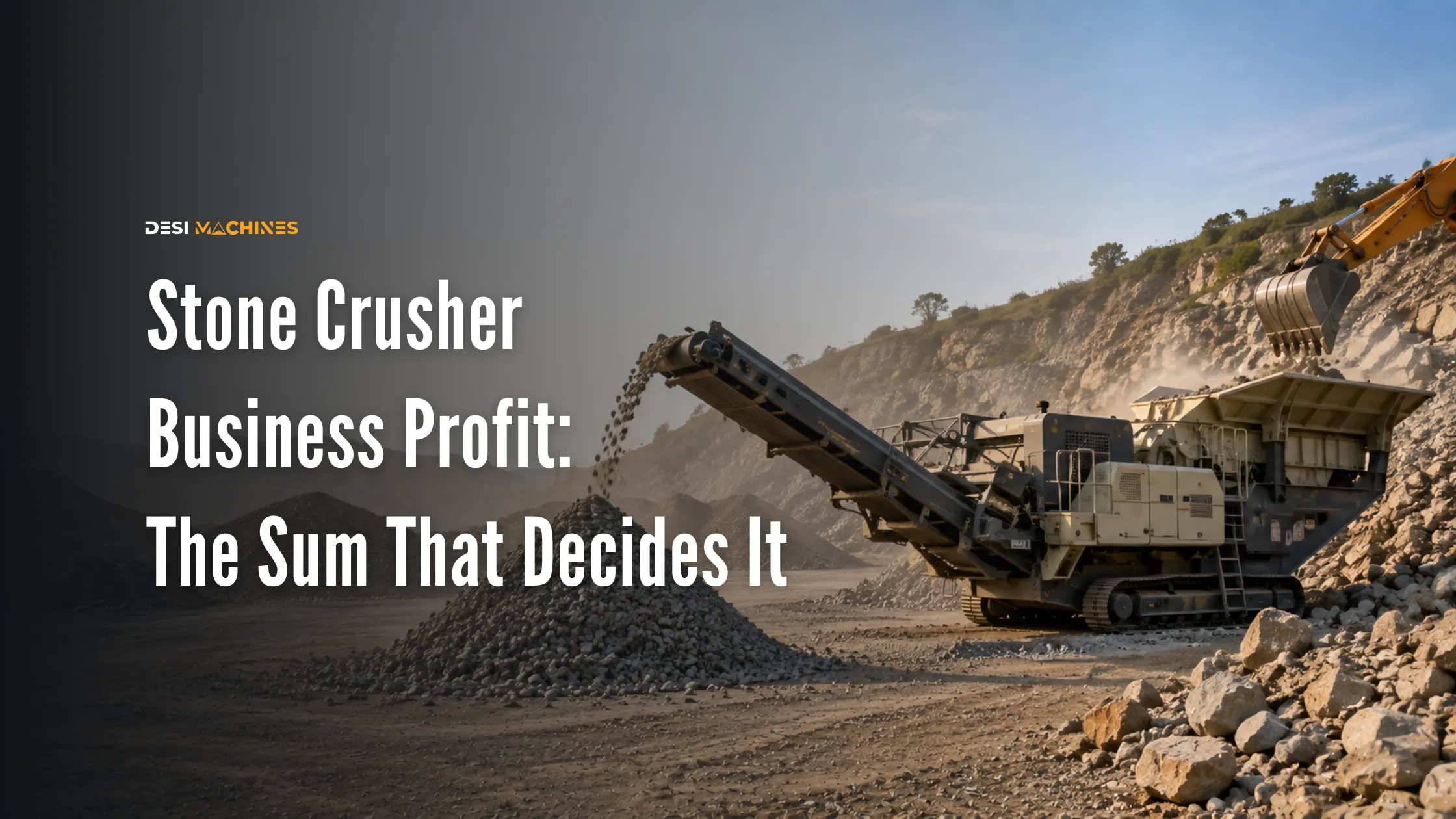
Stone crusher business profit is decided per tonne, not per month, and the two lines that move it most are what you pay for the raw stone and how far the finished aggregate has to travel. Crushing itself is the predictable part. This piece sets out the per-tonne sum, the royalty and lease question, the support fleet that does most of the real work, and the clearances to confirm before any of it matters.
Why nobody can quote you a stone crusher business profit figure
Search for stone crusher business profit and you will find monthly numbers presented with great confidence and no arithmetic behind them. Ignore them. The inputs that decide the answer are set district by district.
Royalty on stone is fixed by your state, because stone used for aggregate is a minor mineral and the state government sets and collects the rate. Electricity tariffs are set by your state regulator. The selling price of aggregate is set by how many plants are within economic haulage of the same project. Change district and every one of those moves.
The same problem shows up in every machine business we have costed. There is no national dumper business profit per month either, for exactly this reason, and the honest answer in both cases is a method rather than a number.
The per-tonne sum
Work in rupees per tonne of saleable product. Every line below is something you can establish locally in a week, and the sum tells you more than any published figure could.
| Line | Where the number comes from |
|---|---|
| A. Royalty or lease cost per tonne of raw stone | Your state’s notified rate, or the terms of the lease you are buying from |
| B. Quarry face cost per tonne | Breaker or excavator hours plus drilling, divided by tonnes won |
| C. Haulage in, quarry to plant | Tipper cost per trip, divided by payload, over the actual lead |
| D. Crushing and screening cost per tonne | Power units per tonne at your tariff, plus wear parts, plus plant labour |
| E. Loading and haulage out | Wheel loader time plus the delivered lead to your buyer |
| F. Total cost per tonne | A + B + C + D + E |
| G. Realisation per tonne | Your weighted selling price across the sizes you actually produce |
| H. Margin per tonne | G minus F |
| I. Monthly profit | H multiplied by tonnes actually despatched, not plant capacity |
Line I is where most plans break. Rated capacity assumes continuous feed, a full shift and a buyer for everything that comes off the belt. Real despatch is limited by whichever of those three runs out first.
The size mix decides your realisation
A crusher does not produce one product. It produces a distribution of sizes, and the market for each of them is different. The larger aggregate sizes and the manufactured sand usually move well; the intermediate sizes and the dust can sit in stock for months if there is no buyer nearby.
That matters because line G is a weighted average across everything you produce, not the price of your best-selling size. A plant that sells its premium fraction at a good rate and stockpiles the rest is earning far less per tonne of stone crushed than the headline price suggests. Set the crusher settings to the mix your local market actually buys, and count the unsold fractions as cost, not inventory.
Royalty is the line to settle first
The single largest variable in most plans is what you pay for the stone before you have crushed anything. It comes in one of two shapes: you hold the quarry lease and pay royalty on what you win, or you buy raw stone from someone who does and pay their price.
Because stone for aggregate is a minor mineral, the rate and the lease conditions are a state matter and the enforcement is local. That also explains why every article you read quotes a different figure and none of them agree — they are quoting different states, often from different years. The mechanics of how royalty is calculated, deducted and evidenced through transit passes are set out in our piece on royalty on earthwork, and the same machinery applies here.
Get your own state’s current notified rate from the district mining office before you build a plan around it. A rate copied from a neighbouring state can be wrong by a margin large enough to invert line H.
The support fleet does most of the work
Owners tend to plan the crushing line in detail and treat the machines around it as an afterthought. In practice the support fleet is where most of the running cost sits and where most of the flexibility lives.
| Machine | Job on an aggregate plant | Works elsewhere? |
|---|---|---|
| Excavator or breaker | Winning stone at the face, breaking oversize | Yes |
| Wheel loader | Feeding the hopper, loading out to trucks | Yes |
| Tippers | Stone in from the face, aggregate out to buyers | Yes |
| Crushing and screening line | The plant itself | No — tied to the site |
That last column is the whole risk picture in one line. Three of the four asset classes can be redeployed if the lease lapses, the consent is not renewed or the local market softens. The crushing line cannot.
For owners already running earthmoving machines, this points at a lower-risk way in: hire into the aggregate trade before buying into it. The per-hour and per-day economics of doing that are the same ones set out in what a machine actually earns and the equipment rental rate card.
Utilisation across the year, not the good month
Aggregate demand follows construction, and construction in most of India stops or slows through the monsoon. Quarry faces flood, haul roads break up, and the sites that buy your product are not pouring.
Build the plan on despatched tonnes across twelve months. A plant that runs well for eight months and barely at all for four is a normal plant, and the fixed costs — lease rent, plant labour you want to keep, loan instalments, minimum electricity demand charges — carry on through the quiet months. Those fixed costs divided by annual tonnage are the real overhead per tonne, and they are usually higher than the first plan assumes.
The licence itself deserves separate study before any of this is modelled, because it is decided on location rather than on paperwork. The stone crusher licence turns on safer-zone distances from highways, villages, schools and municipal limits, runs for a fixed term and is issued only after no-objection certificates from the pollution, forest and revenue departments.
Confirm the clearances before the arithmetic
A crusher plant sits under more than one authority. The quarry side runs through the state’s minor-mineral rules and the district administration. The plant side normally needs a consent to operate from the state pollution control board, along with siting requirements that commonly set minimum distances from habitation, water bodies and roads. Local body permissions and the electricity connection sit alongside those.
We are deliberately not listing thresholds, fees or distances here. They differ by state, they are revised, and a wrong figure on this subject is worse than no figure. Take your district mining office and your state pollution control board as the starting points, and get the current position for your site in writing before capital is committed.
The two approvals behind that sentence are worth understanding before a site is chosen: consent to establish clears the building of the plant and consent to operate clears the running of it, each granted only for a stated period and each carrying conditions the board can act on later.
What we are not quoting
You will not find a plant price in this piece. Crushing and screening lines are not part of the DesiMachines catalogue, there is no published Indian price list worth citing for them, and a number lifted from an aggregator would be a guess dressed as a fact. Get written quotations against a stated capacity and size mix from the plant suppliers themselves.
What we can be useful about is the fleet around the plant, because those are machines we do list and price, and they are the ones that decide whether the operation earns.
Settle royalty and haul distance before crusher profit
Stone crusher business profit is a per-tonne question with two dominant terms: what the stone costs you before crushing, and what the haul costs on either side. Settle your state’s royalty position and your distance to market first, then build lines A to I with your own figures. If the margin per tonne only works at full rated capacity, the plan does not work.
For most owners reading this, the better first move is the fleet rather than the plant. Compare current excavator models and prices and the wheel loader range, see what the earthwork side pays through our note on the excavation rate per cubic meter, and structure the funding with our equipment finance options.
Rates, schemes, specifications and prices change — confirm current terms with the OEM, dealer, bank or insurer before deciding. Royalty rates, consent conditions and siting rules are set by your state and district and are revised periodically; the figures and heads here describe how the economics are structured and are not a quotation for any site. Confirm the current position with your district mining office, state pollution control board or another official source before committing capital. DesiMachines is not liable for decisions taken on the basis of information that may have changed after publication.