Excavator
294 models
Excavator
294 models  Backhoe Loader
51 models
Backhoe Loader
51 models  Crane
68 models
Crane
68 models  Concrete Mixer
79 models
Concrete Mixer
79 models  Wheel Loader
54 models
Wheel Loader
54 models  Compactor / Roller
45 models
Compactor / Roller
45 models  Motor Grader
42 models
Motor Grader
42 models  Concrete Pump
66 models
Concrete Pump
66 models  Skid Steer Loader
11 models
Skid Steer Loader
11 models  Telehandler
13 models
Telehandler
13 models  Dozer
Dozer 


Being the lowest bidder and being the contractor are two different things, and the gap between them is where tender cancellation lives. A government employer can usually scrap a tender at any time before award, because the bidding document itself reserves that right, and courts have held repeatedly that the lowest bidder has no vested right to the contract. What the employer cannot do is act arbitrarily or in bad faith, and that narrow line is the only one worth arguing about.
The clause is already in the document you signed
Most contractors first read the cancellation clause after the cancellation. It is normally sitting in the instructions to bidders.
In a matter decided by the Jammu and Kashmir and Ladakh High Court on 21 August 2026, the employer relied on clauses 27 and 28 of its Standard Bidding Document, under which it had reserved the right to accept or reject any bid, and to cancel the bidding process and reject all bids, at any time prior to the award of contract, without thereby incurring any liability to the affected bidder or bidders, or any obligation to inform them of the grounds for that action.
Three limbs there matter to you. The power runs until award, not until bid opening. It carries no liability to you. And it comes with no duty to explain itself to you.
That is a contractual position you accepted when you bid, which is why an argument built purely on the effort you put in tends to go nowhere.
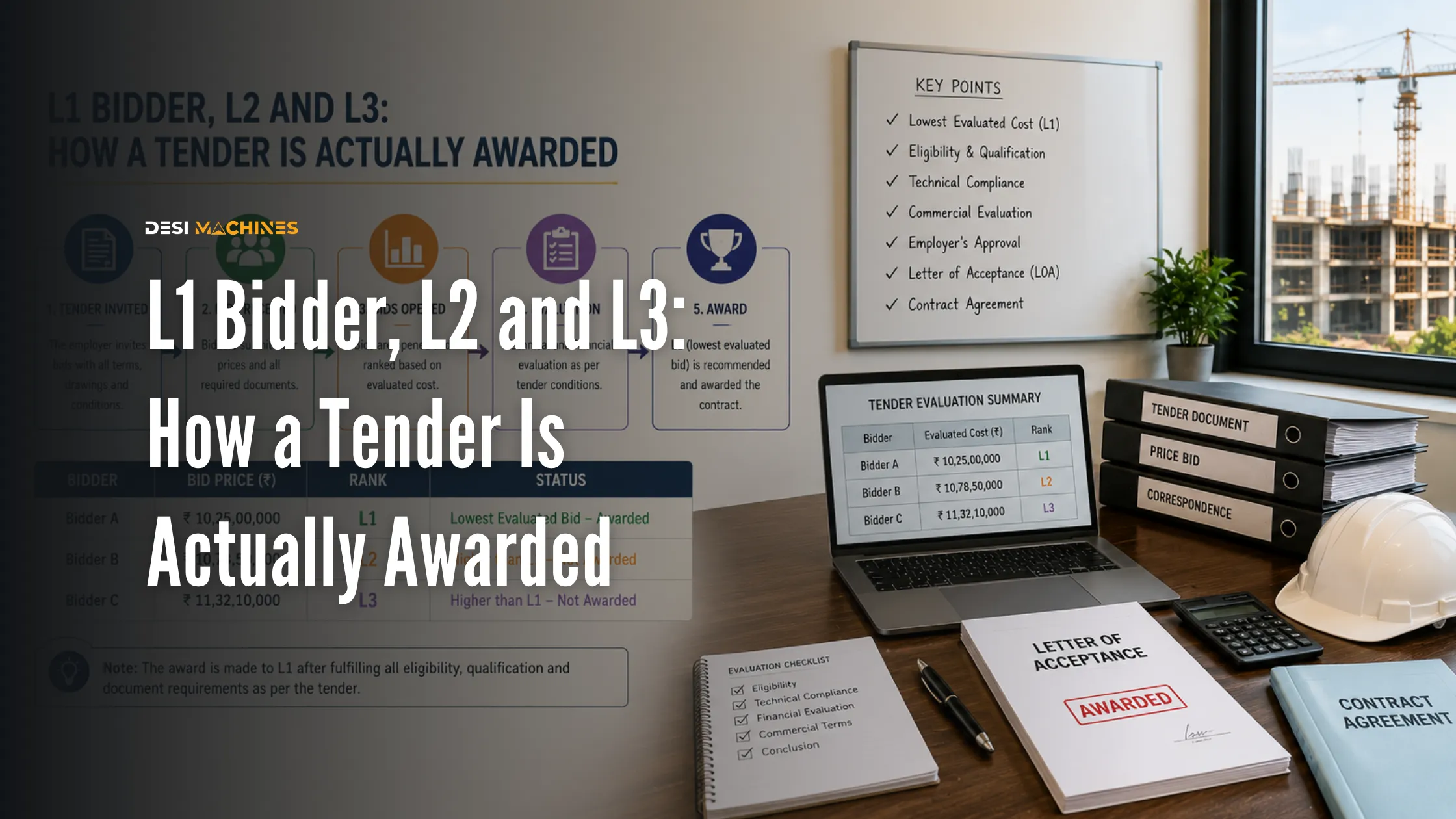
Why being L-1 is not a right
This is the part owners find hardest to accept, particularly after months of follow-up.
The High Court stated the principle as settled law fortified by an unbroken line of judicial precedents: the lowest bidder possesses no indefeasible or vested right to the award of a contract. The tendering authority remains the sole judge of its requirements and is fully empowered to reject the lowest bid, provided such a decision is grounded in cogent and justifiable reasons.
The same reasoning appears on the auction side. In Haryana Urban Development Authority v Orchid Infrastructure Developers P. Ltd, AIR 2017 SC 882, the Supreme Court held it settled law that the highest bidder has no vested right to have the auction concluded in his favour, and that the authority could validly retain the power to accept or reject the highest bid in the interest of public revenue.
So being declared L-1 puts you at the front of a queue that the buyer is still entitled to dissolve. Until a work order instructs you to start, you have a position, not a contract.
Where the discretion stops
The power is wide but it is not unlimited, and the limit is about conduct rather than outcome.
The court continued that this administrative discretion is not absolute, that the authority cannot act arbitrarily, irrationally, or with mala fide to extend an undue favour to any preferred bidder, and that individual commercial interest must ultimately yield to the paramount public interest.
On what a court is doing when it looks at this, Jagdish Mandal v State of Orissa, AIR Online 2006 SC 645, is the passage quoted most often. Judicial review of administrative action is intended to prevent arbitrariness, irrationality, unreasonableness, bias and mala fides. Its purpose is to check whether the choice or decision is made lawfully, and not to check whether it is sound. Evaluating tenders and awarding contracts are essentially commercial functions, and principles of equity and natural justice stay at a distance.
There is a further filter that surprises people. Even where some defect is found in the decision-making process, the court is to exercise its power under Article 226 with great caution and only in furtherance of public interest, intervening only where overwhelming public interest requires it. A technical flaw alone does not get your tender revived.
What a cogent reason for tender cancellation looks like
The J&K case is useful precisely because the reason was ordinary rather than dramatic.
A contract committee of chief engineers and financial control examined the earlier notice and found a difference of about ₹6.05 crore between two bids for the same work. On that footing it decided to scrap the earlier notice and go out again. The bidder who had become lowest after a disqualification argued this was arbitrary and mala fide. The petition was dismissed.
Read that as a costing lesson rather than a legal one. A spread that large between bidders invites the buyer to conclude the pricing exercise itself was unsound, and the tender gets re-run. An outlier bid is not only a thin-margin risk; it is a cancellation risk.
Corrigendum, cancellation and retender are three different events
| What arrives | What it does | What you do |
|---|---|---|
| Corrigendum | Changes a term, date, quantity or eligibility condition; the same tender continues | Re-check eligibility and whether your price still holds; the change may be the reason to withdraw |
| Cancellation | Ends the tender without an award | Claim the earnest money back against the tender reference in writing |
| Retender | A fresh notice for the same work, usually with revised conditions | Read it as a new tender, not a continuation; the conditions are frequently not the old ones |
The practical trap is treating a retender as a formality you have already qualified for. Fresh notices routinely carry a revised bid capacity or turnover requirement, and contractors who assumed continuity have found themselves ineligible for work they were previously lowest on.
What you can still recover
Your earnest money should come back. A cancellation before award is not a default on your side and is not a forfeiture ground, so pursue the refund against the tender reference straight away rather than after the retender concludes.
Your bid preparation cost usually does not come back, because the clause says so in terms. Solvency certificates, document fees, travel, and the time of whoever assembled the file are absorbed by you.
Check also whether your bid validity and any bid security were extended during the delay, because an extension you agreed to keeps your exposure alive longer than the tender that justified it.
The bottom line
Treat every tender as revocable until a work order arrives, and let that shape what you commit before it does. Do not move machines, sign hire agreements or turn down other work on the strength of being lowest.
Where a cancellation genuinely looks like favouritism, the case has to be built on the decision-making process and on documents such as the committee minutes, not on the unfairness of losing. That is a narrow, expensive road, and it is worth walking only when the evidence of bias is real. For most owners the better answer is a wider pipeline, so one scrapped notice is an inconvenience rather than a bad quarter. Keep a working shortlist from the live tenders and contract opportunities, and keep your equipment finance commitments matched to awarded work rather than expected work.
Rates, schemes, specifications and prices change — confirm current terms with the OEM, dealer, bank or insurer before deciding. Case law is summarised here for general understanding and is not legal advice on your tender.