Excavator
294 models
Excavator
294 models  Backhoe Loader
51 models
Backhoe Loader
51 models  Crane
68 models
Crane
68 models  Concrete Mixer
79 models
Concrete Mixer
79 models  Wheel Loader
54 models
Wheel Loader
54 models  Compactor / Roller
45 models
Compactor / Roller
45 models  Motor Grader
42 models
Motor Grader
42 models  Dozer
41 models
Dozer
41 models  Concrete Pump
66 models
Concrete Pump
66 models  Skid Steer Loader
11 models
Skid Steer Loader
11 models  Telehandler
13 models
Telehandler
13 models 


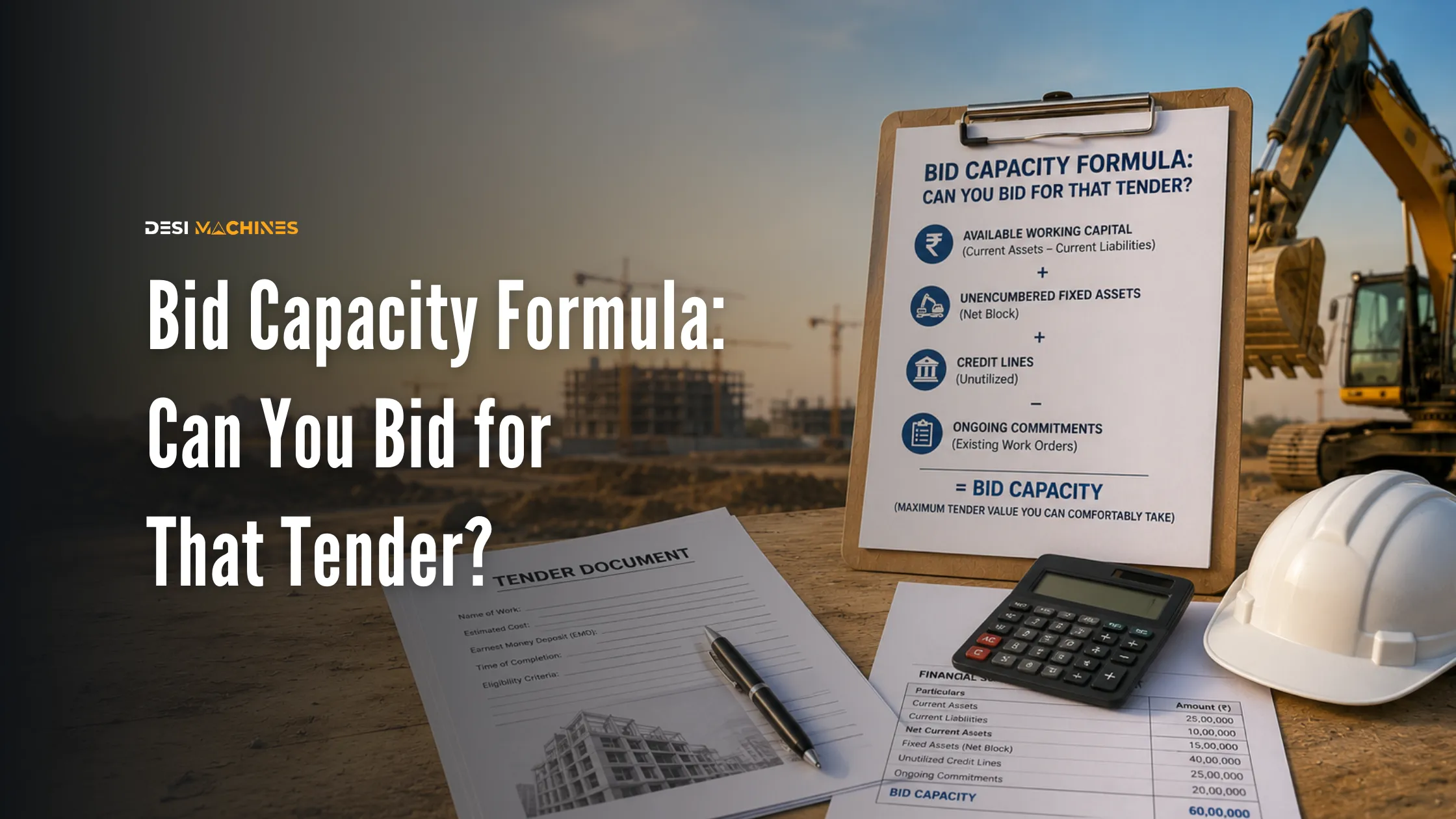
The bid capacity formula decides the largest tender value you are permitted to bid for, and it is applied before anyone reads your price. The common shape is (A x N x 2) minus B — where A is your best single year of paid work, N is the completion period of the tender, and B is what you already have running. Departments word it differently, and some discount B rather than subtracting it in full, which can move your ceiling by crores. Calculate from the clause in your own tender document, not from a formula found anywhere else.
You find a tender that suits your fleet. The value is comfortable, the work is close by, and the completion period looks realistic. You spend a week on the bid, pay the earnest money, and get rejected before the price envelope is even opened.
Often the reason is bid capacity. It is an eligibility wall rather than a pricing one, and it is arithmetic, so you can work out where you stand before you spend a rupee on the bid.
What the bid capacity formula is actually testing
The buyer is not asking whether you can do the work. They are asking whether you can do it on top of everything else you have already promised to do. A contractor with three jobs running and a fourth about to start is a delivery risk, however good the fourth bid looks.
So the test compares a measure of your demonstrated throughput against your existing load. Past performance sets the ceiling, current commitments eat into it, and what is left is your available capacity for this tender.
The three numbers: A, N and B
| Term | What it means | Where it comes from |
|---|---|---|
| A | The highest value of work executed and paid for in any one financial year of the qualifying period the tender names | Your audited accounts, certified by a chartered accountant |
| N | The number of years allowed to complete the work being tendered | Printed in the tender document |
| B | The value of ongoing works and awarded-but-not-started works to be completed in the next N years | Your own declaration, usually in a prescribed form |
Two details in that table do most of the damage.
A is a payments figure, not an order book figure. Work you executed but have not been paid for does not lift A in the year you did it. An owner sitting on unpaid running bills is being penalised twice — once on cash flow, and again on the eligibility ceiling for the next job. If that is your situation, the route for recovering delayed payment on government work is worth starting early, because it feeds the number that decides your next bid.
B includes work you have won but not yet started. A letter of award signed last month reduces the capacity you can show this month, even though no machine has moved.
A worked example
Take an owner with a small earthmoving fleet. In the qualifying period, the best single year of paid work was ₹4 crore. The tender in front of them has a completion period of 2 years. They currently have ₹3 crore of work running that falls inside those 2 years.
| Step | Working | Value |
|---|---|---|
| A x N x 2 | 4 x 2 x 2 | ₹16 crore |
| Less existing commitments (B) | minus 3 | ₹3 crore |
| Available bid capacity | 16 minus 3 | ₹13 crore |
So this owner can bid for tenders up to about ₹13 crore, and will be knocked out above that however sharp the price is.
Now change one thing. Suppose they close out ₹2 crore of the running work before the bid date. B falls to ₹1 crore and the capacity rises to ₹15 crore. Nothing about the fleet changed. The paperwork position did.
Why your tender’s version may not match this one
This is the part most write-ups skip, and it is the part that costs money.
There is no single national formula. The expression above is the one you will meet most often in Indian works tenders, but the multiplier is not universal, and some tender documents do not subtract B in full — they apply a factor to it first, which produces a noticeably higher capacity from identical accounts.
Run the same numbers through a version that discounts commitments rather than deducting them outright and the ₹13 crore answer moves upward by more than a crore. Same contractor, same year, different clause.
The practical rule is simple. Open the tender document, find the bid capacity or bidding capacity clause, and calculate using the expression printed there. Treat every formula you read elsewhere, including this one, as an explanation of the method rather than as your number.
Raising your capacity, in order of how fast it works
Close out finished work. The fastest lever. Every completed and settled contract that drops out of B lifts your ceiling immediately, and it costs nothing except the chasing.
Get paid faster. This raises A for the year in which the money lands. Concentrating billing into a strong year, rather than letting it drift across two weak ones, produces a higher single-year peak — and A is a peak, not an average.
Bid as a joint venture. Where the tender allows it, partners’ capacities are read together. It is the only route that adds capacity you do not already have, and it comes with shared liability, so read the tender’s JV conditions before treating it as an easy answer.
What does not work is optimism. The figures are certified from audited accounts and reconciled against what you filed, so the number is set long before the tender appears. If you are still building the track record, getting enlisted with the PWD in the right class and registering on GeM to hire machines to government buyers are the two routes that put billable, documented work on your books in the first place.
What to check before you spend money on a bid
Work through this before the earnest money leaves your account.
Calculate your available capacity from the tender’s own clause and compare it against the estimated contract value. If you are within a few percent of the ceiling, be careful — a single new award before the bid date can push you under it.
Check which financial years the tender treats as the qualifying period, because a formula applied to the wrong years gives the wrong answer.
Confirm what certification is wanted and whether your chartered accountant can produce it in time. A capacity you genuinely have but cannot evidence is worth nothing on bid day.
And read the rest of the eligibility wall in the same sitting. Capacity is one gate; the solvency certificate is another, and the performance bank guarantee you must furnish after winning is a third that decides whether the win is affordable at all. For a full walk-through of the sequence, the government tender bidding process sets out where each document lands.
Check your bid capacity before chasing a tender
Bid capacity is the cheapest eligibility check you can run, because it needs no fee, no certificate and no site visit — just your own accounts and the tender’s clause. Ten minutes with a calculator tells you whether the next week of bid work is worth doing.
Owners who bid inside their capacity and lose on price have lost a fair fight. Owners who bid above it never entered one. If growing the fleet is what would lift A next year, compare equipment finance options and lenders before the tender season rather than during it.
Rates, schemes, specifications and prices change — confirm current terms with the OEM, dealer, bank or insurer before deciding. The formula, qualifying period and certification requirements vary between departments and tenders; the clause in your tender document is the only version that binds you, and your chartered accountant should confirm the figures before you file them.
Rates, schemes and charges shown here are indicative and vary by bank, department, state and tender. Confirm the current terms with the dealer, OEM, bank or the tender authority before you commit.