Excavator
294 models
Excavator
294 models  Backhoe Loader
51 models
Backhoe Loader
51 models  Crane
68 models
Crane
68 models  Concrete Mixer
79 models
Concrete Mixer
79 models  Wheel Loader
54 models
Wheel Loader
54 models  Compactor / Roller
45 models
Compactor / Roller
45 models  Motor Grader
42 models
Motor Grader
42 models  Dozer
41 models
Dozer
41 models  Concrete Pump
66 models
Concrete Pump
66 models  Skid Steer Loader
11 models
Skid Steer Loader
11 models  Telehandler
13 models
Telehandler
13 models 


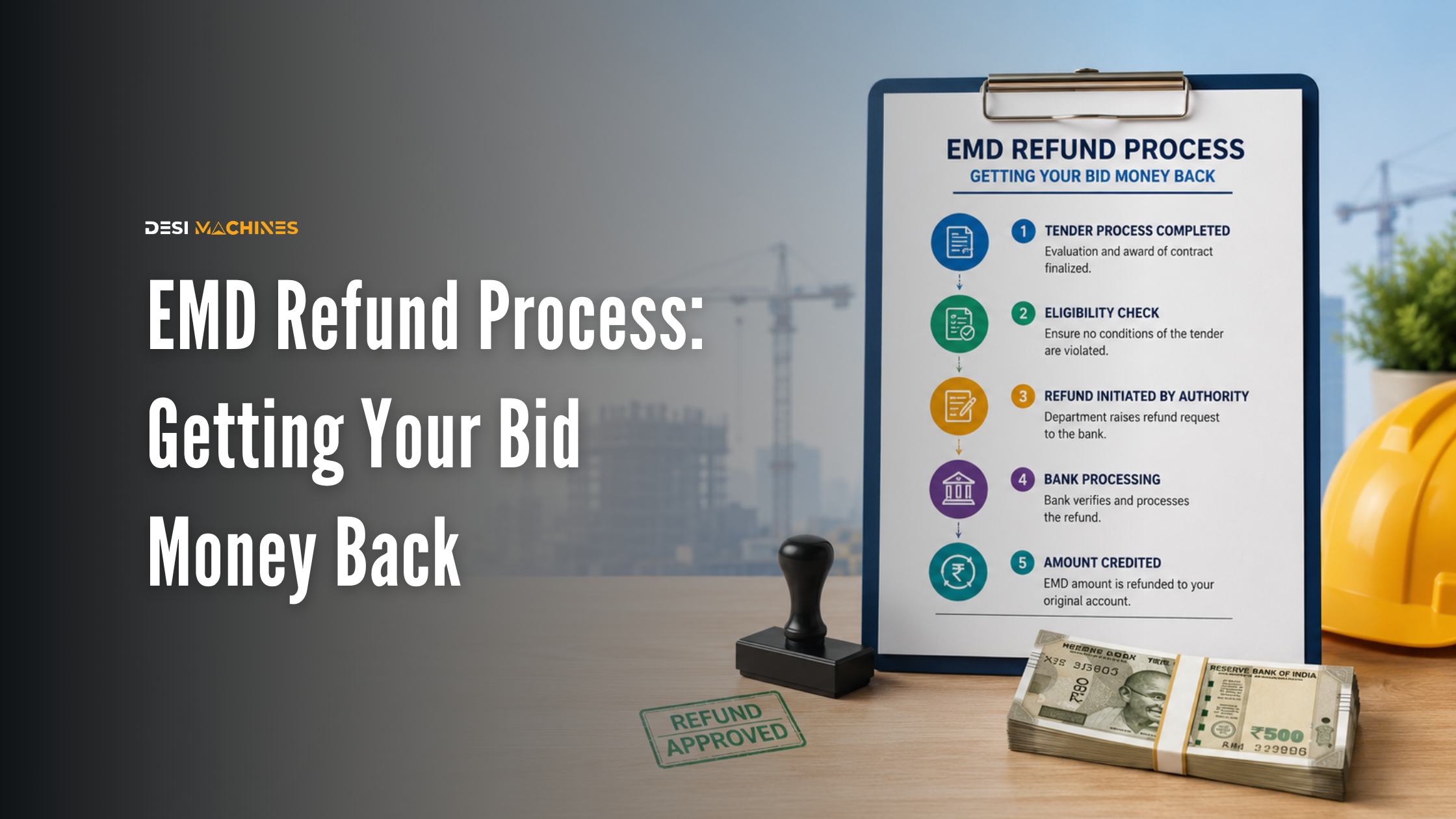
The emd refund process starts when the tender is decided, not when you ask. Earnest money is returned to bidders who did not win, and the winner’s is released after the performance security is furnished and the agreement signed. It is forfeited if you win and then walk away. Micro and small enterprises registered under Udyam are exempt from paying it at all. If a refund has not arrived, a written request quoting the tender reference and the clause moves it; phone calls do not.
Ask a contractor how much of their money is lying with departments right now and you will usually get a shrug and a rough figure. Not the retention, which everyone tracks. The earnest money, spread across bids that were decided months ago, in amounts too small individually to chase and large enough together to matter.
It goes missing for a dull reason. Earnest money is paid at the most stressful point of a bid, recorded nowhere in particular, and then the result arrives and attention moves to the next tender. Nobody ever decided to write it off.
What the emd refund process actually is
Earnest money deposit is bid security. You put it up so the department knows your offer is serious and that you will stand behind it if it is accepted. It is your money throughout, held by the department, and it carries no interest. What fixes the amount in the first place, and who is exempt from lodging it at all, is covered in our guide to EMD in tender.
Once bids are evaluated and the tender is decided, the deposits split two ways. Bidders who did not win get theirs released. The successful bidder’s stays put until the performance security is furnished and the agreement is signed, at which point the earnest money has done its job and is released or adjusted against the security. That handover from one instrument to the other is where the winner’s refund usually sits, and it is worth understanding alongside the performance bank guarantee that replaces it.
Three separate amounts leave your account around a bid, and merging them is what makes the outstanding figure impossible to track.
| Amount | What it is for | Does it come back? |
|---|---|---|
| Tender or document fee | The cost of participating in the tender | No, generally non-refundable |
| Earnest money deposit | Security that your bid is serious | Yes, unless forfeited |
| Performance security | Security that you will perform the contract | Yes, on completion per the contract |
Owners routinely write off the earnest money because the fee was non-refundable and the two got remembered as one loss. Keep them on separate lines from the day you bid.
When the refund is due, and when it is not
The trigger for release is the decision on the tender, not the date you noticed. For unsuccessful bidders the money becomes due once the award is made or the bid validity expires, whichever your conditions specify. That window is itself worth understanding before you quote — see how the bid validity period works and whether you have to agree to extend it. For the winner it becomes due once the performance security is in place.
We are deliberately not quoting a standard number of days here. The timeline is set by the conditions of your own tender and by the rules of the department, public sector undertaking or marketplace running it, and a figure taken from one department’s standard conditions and applied to yours would be a guess dressed up as advice. Open the bid document, find the clause, and read two things off it: the event the clock starts from and how long the department gives itself. Then put that date in your diary at the time of bidding, while the paperwork is still in front of you.
Where the money was paid from matters more than owners expect. An online payment made through an e-procurement portal or the government marketplace leaves a clean electronic trail back to the account it came from, and the reversal is a system step. A demand draft or banker’s cheque handed over physically has to be located, released and posted back, which is slower and easier to lose. If a tender allows either, the online route is worth taking for the refund alone. Registration on the marketplace is where most owners meet the process for the first time, and the GeM portal registration route is the cleanest place to learn it.
What forfeits earnest money
Forfeiture is not arbitrary. It attaches to a small set of things you do after the bids are opened, and every one of them is inside your control.
You withdraw or modify your bid while it is still within its validity period. You are declared successful and then fail to furnish the performance security. You are declared successful and refuse to sign the agreement. Some conditions add a materially false declaration to the list. The common thread is that the department relied on your offer and you removed it.
The deposit is usually the cheapest part of that outcome. Abandoning an award after being declared the lowest bidder is one of the standard grounds departments cite when they start proceedings for blacklisting a contractor, which shuts you out of that department’s work for years. If the numbers on a job stop working after you have bid, that is a problem to raise before the award, not after.
There is a related trap in being the runner-up. Being second does not put you in a queue, and your earnest money does not stay held on the chance that the winner fails. If the award is decided and you were not it, the money is due back to you. How the ranking actually works is covered in the note on the L1 bidder and tender award.
How to get a stuck refund released
The reason a refund stalls is almost never a dispute. It is that nobody in the department has been asked, in writing, by someone who can quote the tender number.
Write to the tender-inviting authority rather than calling the office. Put five things in the letter: the tender reference and title, your bid or bidder identification, the amount paid and the date it was paid, the mode of payment with the instrument or transaction reference, and the clause under which the refund is due. Ask for the release, and ask for the reason in writing if it is being withheld. Keep the acknowledgement.
That last request does the real work. A refund withheld against a live claim, a pending clarification or an outstanding recovery is a different problem, and you need to know which one you have before you can fix it. A refund that is simply sitting in a file moves as soon as somebody has a reference number to act on.
Track them together rather than one at a time. A simple sheet with one row per bid — tender reference, amount, date paid, result, date due, date received — turns an invisible loss into a list you can work through in an afternoon. Owners who keep it are usually surprised by the total the first time. Money sitting with a department is working capital you have already earned, and the same discipline that recovers it is what keeps a contractor payment delay from becoming permanent.
It is worth seeing what that sheet looks like once it has a few months on it. The figures below are illustrative — the amounts, dates and references are invented and the arithmetic is the point — but the shape is the one that turns up when an owner sits down and lists every bid from the last two quarters.
| Tender reference | EMD paid | Date paid | Result | Where it stands |
|---|---|---|---|---|
| PWD/2026/041 | ₹45,000 | 12 Feb 2026 | Not awarded to us | Received 6 Apr 2026 |
| MUN/2026/113 | ₹60,000 | 28 Feb 2026 | Not awarded to us | Due, never asked for |
| PSU/2026/007 | ₹1,25,000 | 15 Mar 2026 | Won, agreement signed | Adjusted against performance security |
| PWD/2026/098 | ₹45,000 | 02 Apr 2026 | Not awarded to us | Due, never asked for |
| MKT/2026/256 | ₹30,000 | 19 Apr 2026 | Bid validity expired | Due, never asked for |
Five bids, ₹3,05,000 paid out. One came back, one did its job and turned into the performance security, and ₹1,35,000 across three tenders is simply due and has never been asked for. No department refused it and no dispute exists. That is the number the shrug at the start of this piece is hiding, and it is the working capital that pays for a month of diesel or an instalment on a machine.
Two things fall out of the sheet that do not fall out of memory. The first is that the losses are individually small — ₹30,000 to ₹60,000, each one too minor to chase on its own, which is exactly why none of them was chased. The second is that they are all the same letter. One afternoon, three letters to three tender-inviting authorities quoting the references in column one, and the list is worked through.
The better answer: not paying it in the first place
Two routes remove the problem instead of managing it.
Micro and small enterprises registered under Udyam are exempt from earnest money under the Public Procurement Policy for Micro and Small Enterprises, Order 2012 — the same policy that gives registered MSEs tender sets free of cost. The exemption has to be claimed correctly, by declaring the Udyam registration with the bid. A bidder who does not is treated as an ordinary bidder for that tender, and the exemption is not applied afterwards.
Many tenders now also accept a bid security declaration in place of a cash deposit. It is an undertaking that you will not withdraw or modify your bid inside its validity and will accept the award if it is made, with the consequence of breaching it being suspension from that buyer’s tenders for a stated period rather than loss of money. Whether your tender allows it is written in the bid document. Where it is allowed, it keeps your cash in your account and removes the refund question entirely.
Both routes need to be read off your own tender before you bid. Neither is retrospective. The wider set of pre-bid paperwork, and how to get it in place once instead of per tender, is covered in how to bid for government construction tenders and the note on the solvency certificate for tenders.
If bidding is going to be a regular part of how you keep machines working, the live tenders and equipment opportunities are the place to see what is actually being advertised, and what each one asks for before you commit money to it.
Three habits that keep your earnest money safe
Earnest money is the easiest money a contractor loses, because losing it requires no decision. It is returned once the tender is decided, forfeited only if you win and then walk away, and avoidable entirely if you are a registered micro or small enterprise or your tender accepts a bid security declaration.
Do three things. Read the refund clause before you bid and diarise the date. Keep the fee and the deposit on separate lines so the outstanding figure stays visible. And when one is late, write to the authority quoting the tender reference and the clause, and ask for the reason if it is withheld.
If the deposits and guarantees a tender demands are what stand between you and the work, the equipment finance options for machine owners are worth reviewing alongside your bidding plan, because bid security and working capital come out of the same pocket.
Rates, schemes, timelines and tender conditions change and vary between departments — confirm the current terms with the tender-inviting authority, the department or your bank before you bid or before you write off a deposit.