Excavator
294 models
Excavator
294 models  Backhoe Loader
51 models
Backhoe Loader
51 models  Crane
68 models
Crane
68 models  Concrete Mixer
79 models
Concrete Mixer
79 models  Wheel Loader
54 models
Wheel Loader
54 models  Compactor / Roller
45 models
Compactor / Roller
45 models  Motor Grader
42 models
Motor Grader
42 models  Dozer
41 models
Dozer
41 models  Concrete Pump
66 models
Concrete Pump
66 models  Skid Steer Loader
11 models
Skid Steer Loader
11 models  Telehandler
13 models
Telehandler
13 models 


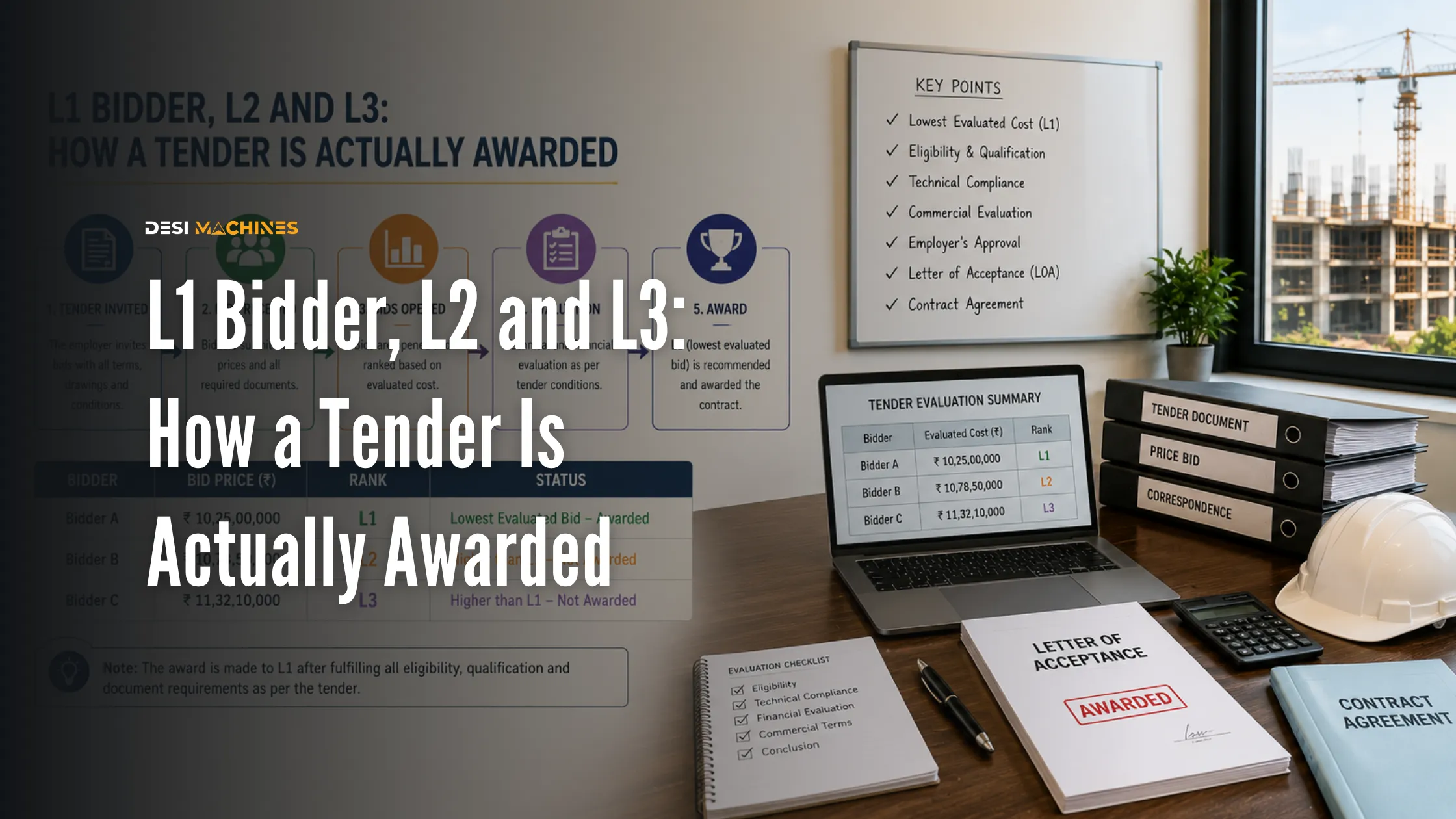
The L1 bidder is the one whose evaluated price is lowest among the bids that first cleared the technical stage, not necessarily the one who typed the smallest number. L stands for lowest and the number is the rank, so L2 and L3 are the second and third lowest. Corrections, tax treatment and loadings are applied before ranking, so L1, L2 and L3 are decided after the buyer has done arithmetic on your quote. Being L1 is also not the same as being awarded: the rate still has to be found reasonable, and where price discovery runs by reverse auction, the ranking only settles when the clock stops.
Most owners bidding for hire work learn the ranking the hard way: by watching a job go to someone whose quote looked higher on the day the financial bids opened.
The gap between “I quoted lowest” and “I got the work” is filled with steps that are all written down in the tender document, and almost never read before the bid is submitted.
What L1, L2 and L3 mean
After the financial bids are opened, the buyer arranges the qualifying bids from lowest to highest and labels them. The lowest is L1, the next L2, then L3. The letter stands for lowest and the number is simply the position.
Two things about that list matter more than the labels.
The first is who is on it. Only bids that cleared technical evaluation get ranked. A bidder who quoted the lowest figure in the room but whose experience certificate or machine schedule did not satisfy the conditions is not L1. That bid is out, and the ranking happens without it. The two-part submission set out in the bidding guide is what decides whether your price is ever seen at all.
The second is what the ranking is done on.
Evaluated price, not the number you typed
Ranking uses the evaluated price: your quote after the buyer has applied whatever the tender allows it to apply.
| Adjustment | What it does to your quote |
|---|---|
| Arithmetic correction | Rate times quantity is recomputed. Where words and figures differ, the tender says which prevails, often the rate in words. |
| Tax treatment | Bids are brought to a common basis so that a quote stated inclusive is comparable with one stated exclusive. |
| Loading for deviations | If you took a deviation from the payment or delivery terms and it was permitted, the buyer may load a cost onto your price for comparison. |
| Unbalanced items | Rates that are very high on early items and very low on later ones draw scrutiny, and can cost you the bid even when the total is lowest. |
This is why two bidders can enter the same total and finish at different ranks. It is also why a conditional bid is dangerous: conditions that the tender does not permit can get the bid rejected outright rather than merely loaded.
Can the buyer negotiate with the L1 bidder?
This is the most-asked question of the lot, and the honest answer is that it depends on the buyer’s own rules.
The principle applied across public procurement is that negotiation, where it is allowed at all, is conducted with L1 only. The reason is straightforward. If a buyer could go down the list and invite better numbers after the prices were public, no sealed bid would mean anything and every bidder would quote high in the expectation of a second round.
So negotiation tends to be treated as exceptional rather than routine, reserved for situations such as a single bid or a rate that looks out of line with the estimate, and it usually needs approval from a level above the tendering officer.
What follows for you is practical. Do not price your bid on the assumption that there will be a negotiation stage where you can improve. Bid the number you can actually execute at. If you are called for negotiation as L1, treat it as a request to justify your rate: bring the rate analysis, not just a willingness to drop.
What the central works manual says about L1, negotiation and re-tender
For works bought by central ministries that have no manual of their own, the rules sit in chapter 5 of the Ministry of Finance’s Manual for Procurement of Works 2022. CPWD, MES, BRO and the Railways keep their own manuals and the states their own codes, so treat it as the reference point, not the rule in your tender.
| Question | What the manual says | Para |
|---|---|---|
| Will there be a negotiation? | Normally none. It is a rare exception, for work placed on nomination, single or limited sources, a recorded suspicion of a cartel, or an urgent need where only the bare minimum is negotiated and the rest re-tendered | 5.6.6(i) |
| With whom? | Only the lowest acceptable bidder, L1. Never with anyone who did not tender or whose bid was rejected | 5.6.6(i) |
| Who decides? | The tender accepting authority, on the tender committee’s recommendation, with the reasons recorded | 5.6.6(ii) |
| Is a counter-offer a negotiation? | A counter-offer to L1 is. A counter-offer to L2, L3 at the rate L1 accepted, where the quantity is split, is not | 5.6.6(iii) |
| What if L1 walks away? | If the lowest evaluated bidder withdraws, fails to sign or fails to furnish the security, the department re-tenders | 5.6.8(i)(f) |
| Only one bid came in? | A single offer can still be awarded if the price is reasonable; lack of competition is not judged by the number of bidders alone | 5.6.7 |
| L1 far below the estimate? | The department may ask for a price analysis and reject an abnormally low bid, but the manual advises against a fixed percentage cut-off | 5.6.4 |
| Is the rate reasonable? | Every award recommendation must declare that the recommended rates are reasonable | 5.6.3 |
Two of those rows answer the questions owners ask most. Negotiation, where it happens at all, stops at L1 and does not move down the list. And when L1 backs out, the manual’s answer is a fresh tender, not a call to L2. The one place it lets a buyer offer L1’s rate to L2 and L3 is where the quantity is split between bidders, the same counter-offer that fills parallel contracts in a rate contract tender. When a single bid is all that came in, the single bid tender explainer walks through the three tests in 5.6.7, and what a re-tender means for your deposit is covered under tender cancellation.
When price discovery runs as a reverse auction
On the government marketplace and on several e-procurement platforms, the sealed financial bid is followed by a live auction in which bidders reduce their offers within a time window. The lowest standing offer when the clock stops becomes L1.
Three things decide whether that room is profitable for you.
The decrement. Each new bid must improve on the standing lowest by at least a set amount. Know it before you enter, because it sets how fast the price can fall.
Your floor. Work out, before the auction opens, the rate below which the job stops paying: machine EMI, operator, diesel, maintenance, transport to site, and the idle days between fronts. Write that number down. The whole design of an auction is to make you find out where your floor is by passing it.
The extension rule. A bid placed near the end usually extends the clock, so the auction rarely stops when you expect it to. The GeM version, and the clause that decides when its L-1 actually gets the order, is set out in the reverse auction in GeM explainer.
If you have not costed a machine hour properly, an auction is the most expensive place to discover it. The equipment rental rate card sets out what a day rate has to cover before it earns anything.
Clearing the auction is not the end of the eligibility check either. A joint venture of two transport firms came out of a reverse auction as L-1 on a coal haulage contract and still lost the award, because the committee went back over whose past work it had claimed. How that experience is counted, and at what share, is worked through in the explainer on the joint venture route into a tender.
Being L2 is not a queue
Owners often treat L2 as next in line. It is not a position with rights attached.
If L1 withdraws or fails to furnish the security or sign the agreement, the buyer forfeits that earnest money and then chooses: approach the next ranked bidder, or retender. Which route it takes depends on its rules, the price gap and how urgent the work is. Under the central works manual the choice is made for it: para 5.6.8 says re-tender. Walking away after an award is also one of the standard triggers for blacklisting, so the cost is rarely just the deposit.
If you are approached as L2, you are being asked whether you will do the work, usually at the L1 rate. That is a fresh commercial decision. Run it through the same arithmetic you used the first time, because the rate that made sense for someone else’s fleet may not make sense for yours.
The fees, and which one comes back
Two payments get confused constantly.
The tender fee is the cost of participating: a document or processing charge, generally non-refundable, and it does not come back because you lost.
The earnest money deposit is security. It is returned to unsuccessful bidders and is forfeited if you win and then fail to take the work up. Small enterprises are often exempt from it, which the bidding guide covers, and registration on the government marketplace is where many owners meet both for the first time. Getting it back out of the department afterwards is its own exercise, set out in the note on the EMD refund process.
Once you win, the money moves again, into the security the contract asks you to furnish, usually a performance bank guarantee, which carries its own cost and its own release problems.
The instruction to actually begin comes separately, and it carries the dates you will be held to, and what to check in the work order before you mobilise is worth reading while the award is still fresh.
Being lowest is not always decisive either. Under Make in India purchase preference, a Class-I local supplier can be invited to match your price and take part of the order.
Why qualifying cleanly matters more than being L1
L1 is a rank produced by arithmetic on your quote, awarded only if the rate stands up as reasonable, and it is available only to bids that cleared the technical stage first. The bidders who win consistently are the ones who qualify cleanly, quote a number they can execute, and know their floor before an auction starts.
Check what your capacity actually allows before you chase a large job. The bid capacity formula explainer covers that ceiling, and current work is listed on the tender opportunities page.
Rates, schemes, specifications and prices change — confirm current terms with the OEM, dealer, bank or insurer before deciding. Evaluation rules, negotiation powers and auction settings differ between buyers and between tenders; confirm them in the tender document that applies to you.