Excavator
294 models
Excavator
294 models  Backhoe Loader
51 models
Backhoe Loader
51 models  Crane
68 models
Crane
68 models  Concrete Mixer
79 models
Concrete Mixer
79 models  Wheel Loader
54 models
Wheel Loader
54 models  Compactor / Roller
45 models
Compactor / Roller
45 models  Motor Grader
42 models
Motor Grader
42 models  Concrete Pump
66 models
Concrete Pump
66 models  Skid Steer Loader
11 models
Skid Steer Loader
11 models  Telehandler
13 models
Telehandler
13 models  Dozer
Dozer 


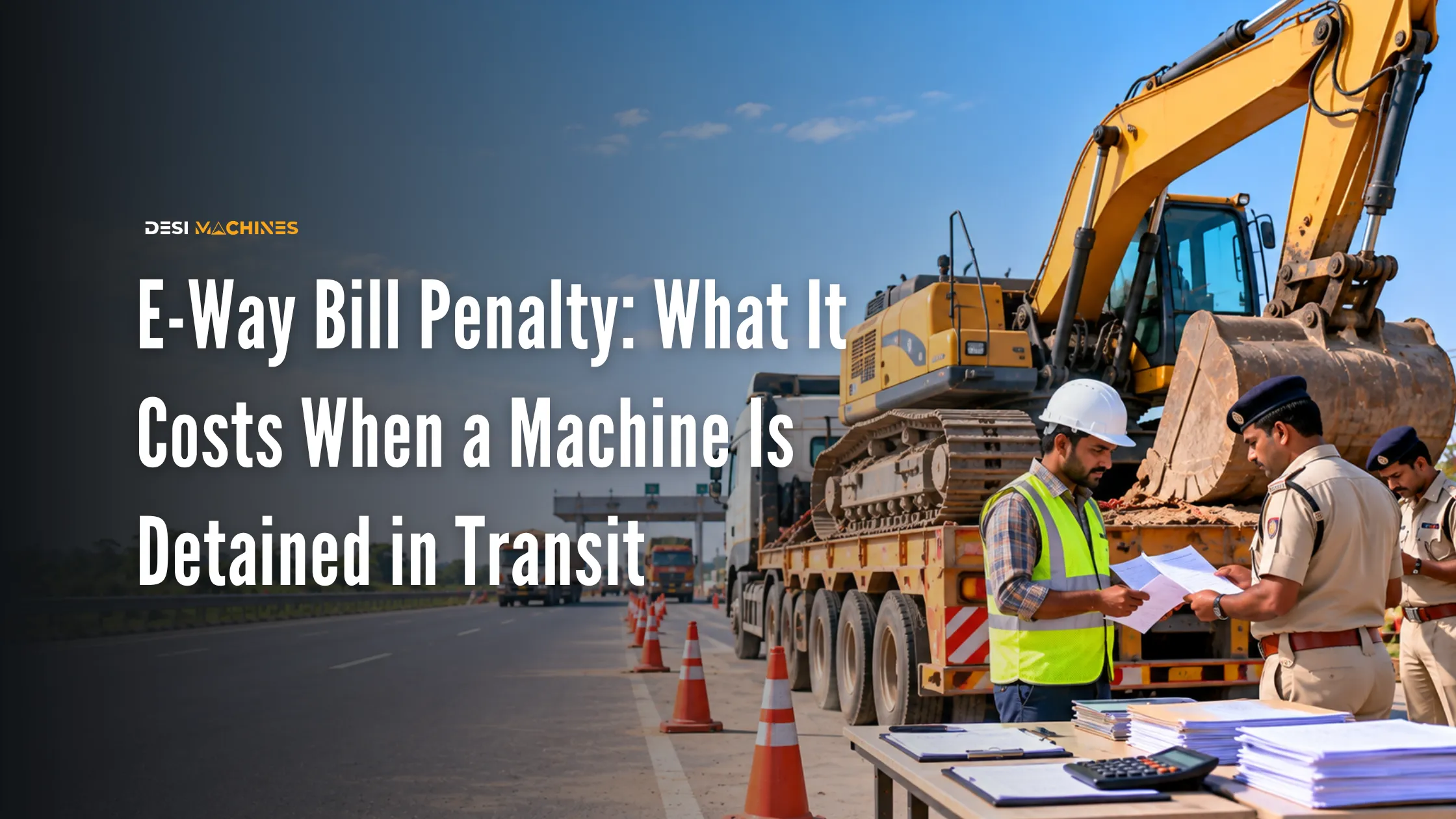
A low-bed carrying your excavator is stopped at a check post and the paperwork does not match. The e way bill penalty that follows is set by section 129 of the CGST Act, and since 1 January 2022 it is 200 per cent of the tax payable on the goods where the owner comes forward, not the 100 per cent most people still quote. If the owner stays away it becomes 50 per cent of the value of the goods or 200 per cent of the tax, whichever is higher. The trailer, separately, can be released for the penalty or one lakh rupees, whichever is less.
What the e way bill penalty actually is
Section 129 is headed “detention, seizure and release of goods and conveyances in transit”. It applies where any person transports or stores goods in transit in contravention of the Act or the rules made under it, which is where a missing, expired or incorrect e-way bill lands. The goods and the conveyance carrying them both become liable to detention or seizure, and the section then sets out what it takes to get them back.
| Situation | What must be paid to release the goods |
|---|---|
| Owner comes forward, taxable goods | Applicable tax, plus penalty of 200% of the tax payable on the goods |
| Owner comes forward, exempted goods | 2% of the value of the goods or 25,000 rupees, whichever is less |
| Owner does not come forward, taxable goods | Applicable tax, plus 50% of the value of the goods or 200% of the tax payable, whichever is higher, reduced by tax already paid |
| Owner does not come forward, exempted goods | 5% of the value of the goods or 25,000 rupees, whichever is less |
| Conveyance (the trailer or truck) | Penalty under section 129(3), or 1,00,000 rupees, whichever is less |
| Instead of paying now | Security equivalent to the amount payable, in the prescribed form |
The change from 100 per cent to 200 per cent came through the Finance Act 2021 and took effect on 1 January 2022. The Gujarat High Court set the pre-amendment and post-amendment provisions side by side in M/s Panchhi Traders v. State of Gujarat (Special Civil Application 9250 of 2020, decided 11 December 2025), noting that the words “applicable tax” in clauses (a) and (b) were replaced with “tax payable”, that the earlier 100 per cent penalty under clause (a) was raised to 200 per cent, and that the earlier 50 per cent under clause (b) was also replaced with a 200 per cent measure. Any advice still quoting 100 per cent is reading a repealed version.
The second change nobody priced in
The same amendment delinked section 129 from section 130. Before it, failure to pay under section 129 fed directly into confiscation proceedings under section 130. The Memorandum explaining the Finance Bill 2021 stated the intent plainly at serial numbers 10 and 11: section 129 was being amended to delink detention, seizure and release of goods in transit from the confiscation proceedings under section 130, and section 130 was being amended to make the same separation from the other direction.
That separation matters when a machine is sitting in a yard. Confiscation under section 130 is a distinct proceeding on distinct grounds, which include supplying or receiving goods in contravention of the Act with intent to evade tax, not accounting for goods, or using a conveyance to carry goods in contravention. Intent to evade is the thread running through them. A transporter served with a confiscation notice straight after a detention, without the section 129 procedure having been completed, is entitled to ask under which of those grounds he is being proceeded against.
The forms that arrive, in order
The detention process runs on the MOV series of forms issued under the circular dated 13 April 2018. Knowing the order tells you where you are in the process and how much time is left.
| Form | Stage |
|---|---|
| MOV-01 | Statement of the owner, driver or person in charge is recorded |
| MOV-02 | Physical verification and inspection of goods, documents and conveyance |
| MOV-03 | Extension of the inspection period beyond three working days |
| MOV-04 | Physical verification report |
| MOV-05 | Release order, on payment of tax and penalty |
| MOV-06 | Detention order where discrepancies are found |
| MOV-07 | Notice specifying tax and penalty payable under section 129(3) |
| MOV-08 | Bond and security for provisional release |
| MOV-09 | Final speaking order determining penalty |
| MOV-10 and MOV-11 | Confiscation notice and confiscation order |
MOV-06 and MOV-07 are where a machine owner’s decisions actually get made. That is the point at which the department has put its case in writing and before the final order exists. If the defect is clerical, the reply to MOV-07 is where that has to be said, with the invoice, the paid tax and the consignment details attached. Section 129(4) guarantees an opportunity of being heard before anything is determined under sub-section (3); taking it is the difference between a record and a regret.
The clocks, and the one-lakh door
Three periods run in this provision and they are easy to confuse. The officer must issue the notice within seven days of the detention or seizure. He must pass the order within seven days from the date of service of that notice. And you then have fifteen days from receipt of the copy of that order to pay, failing which the goods or the conveyance become liable to be sold or disposed of to recover the penalty. Where the goods are perishable or hazardous or likely to depreciate with time, the officer may shorten that window.
For a machine owner the most useful line in the whole section is the proviso to sub-section (6): the conveyance shall be released on payment by the transporter of the penalty under sub-section (3), or one lakh rupees, whichever is less. A low-bed trailer is an earning asset, and every day it stands in a departmental yard is a day of idle cost on top of the tax dispute. That cap lets the vehicle come out for a bounded sum while the argument over the consignment continues separately.
Paying under section 129(1) is not an admission you can undo lightly, though. Sub-section (5) says that on payment of the amount referred to in sub-section (1), all proceedings in respect of the notice are deemed to be concluded. That is the trade: paying ends the matter and ends the dispute with it.
What this means before the machine moves
The economics are lopsided, which is the practical point. A correctly generated e-way bill costs nothing but attention. A penalty at 200 per cent of the tax on a machine consignment, plus the idle days of a detained trailer and the transporter’s demurrage, runs into real money on a single move.
Most detentions on machine movements come from a small set of avoidable defects: an expired bill on a move that took longer than planned, a vehicle number that does not match the one actually carrying the load after a breakdown or a change of trailer, part-B left unfilled, or a shifting of own machinery between sites treated as needing no document at all. When and how the bill is generated for a machine movement is covered in our note on the e-way bill for machinery, and the permit side of an oversize move in over-dimensional cargo permits.
Build the risk into the move, not into the argument afterwards. What a machine move actually costs, before any penalty, is set out in excavator transport cost in India. Where the consignment is work rather than a machine sale, the tax position on the underlying contract is a separate question, covered in GST on a works contract.
The bottom line
Quote the current numbers, not the old ones: 200 per cent of tax where the owner comes forward, the higher of 50 per cent of value or 200 per cent of tax where he does not, and one lakh as the ceiling to get the vehicle out. Answer the MOV-07 notice rather than paying reflexively, because payment concludes the proceedings and the dispute together. And remember the clocks run on the department too: seven days to the notice, seven more to the order, fifteen to pay.
The cheapest version of this is never having the conversation. If a machine move is part of how you earn, price the compliance in alongside the trailer, and compare excavator models and prices with the full cost of running one rather than the sticker alone.
Statutory references are to the Central Goods and Services Tax Act, 2017 as amended; tax provisions, circulars and procedures change, and the facts of an individual detention decide the outcome. Confirm current provisions and your own position with a qualified professional or the official source before deciding. DesiMachines is not liable for decisions taken on the basis of information that may have changed after publication.