Excavator
294 models
Excavator
294 models  Backhoe Loader
51 models
Backhoe Loader
51 models  Crane
68 models
Crane
68 models  Concrete Mixer
79 models
Concrete Mixer
79 models  Wheel Loader
54 models
Wheel Loader
54 models  Compactor / Roller
45 models
Compactor / Roller
45 models  Motor Grader
42 models
Motor Grader
42 models  Concrete Pump
66 models
Concrete Pump
66 models  Skid Steer Loader
11 models
Skid Steer Loader
11 models  Telehandler
13 models
Telehandler
13 models  Dozer
Dozer 


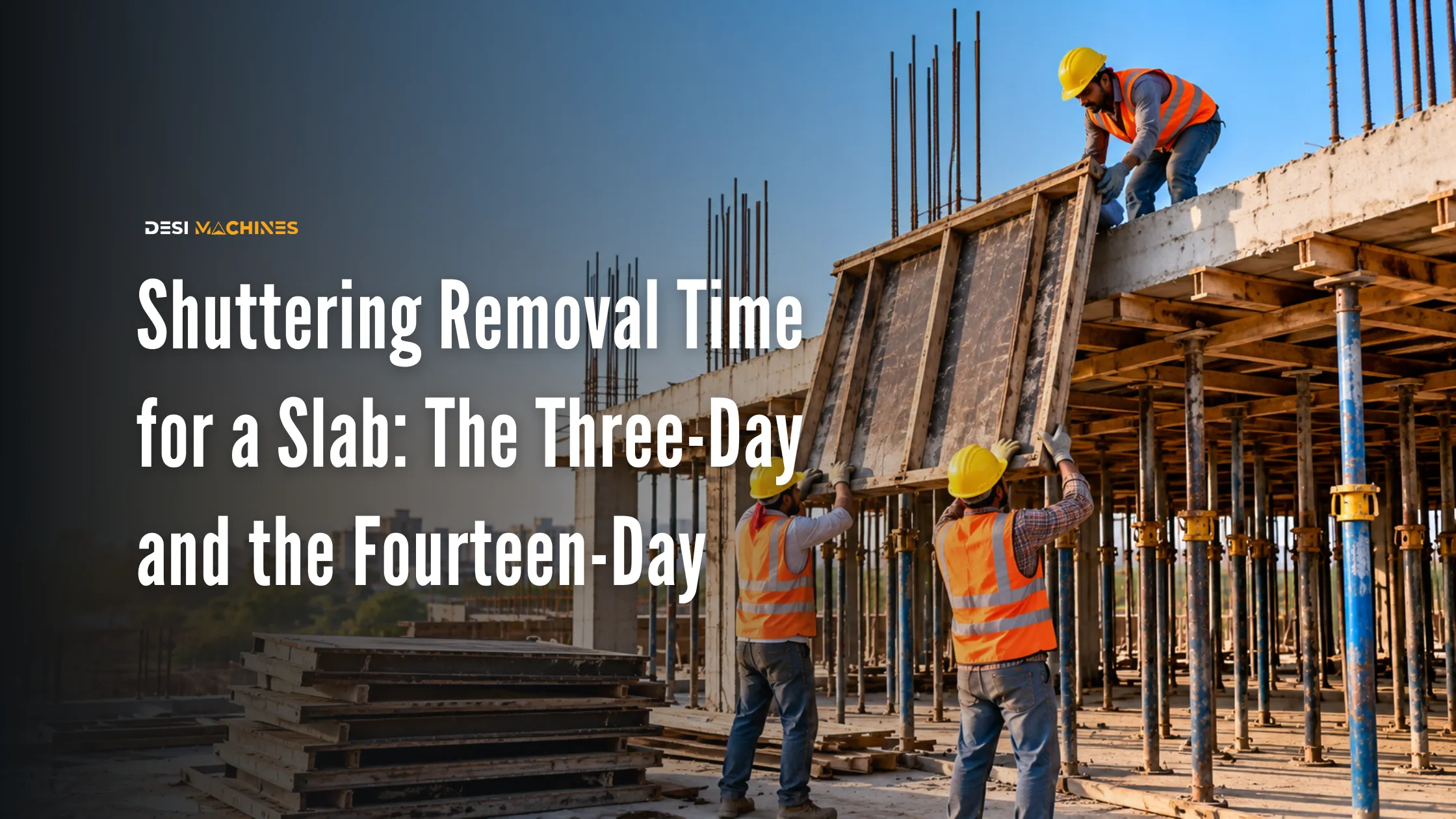
A slab is struck twice, not once, and that is where sites go wrong. Under IS 456:2000 the shuttering removal time for slab soffit plates is three days, with the props refixed immediately as the plates come out. The props themselves stay far longer: seven days for a slab spanning up to 4.5 m and 14 days for a slab spanning over 4.5 m. The familiar “14 days for a slab” is the prop figure, not the plate figure, and treating the whole assembly as one item is what puts a young slab on the floor.
The IS 456 shuttering removal time for slab and beam work
The clause is 11.3.1 of IS 456:2000, the Bureau of Indian Standards code of practice for plain and reinforced concrete. It lists the periods below as deemed to satisfy the general rule in 11.3.
| What is being struck | Minimum period |
|---|---|
| Vertical formwork to columns, walls and beams | 16 to 24 hours |
| Soffit formwork to slabs (props refixed immediately) | 3 days |
| Soffit formwork to beams (props refixed immediately) | 7 days |
| Props to slabs, spanning up to 4.5 m | 7 days |
| Props to slabs, spanning over 4.5 m | 14 days |
| Props to beams and arches, spanning up to 6 m | 14 days |
| Props to beams and arches, spanning over 6 m | 21 days |
Two rows do most of the work on an ordinary building. The slab soffit at three days, and the prop under it at 7 or 14 days depending on whether the span crosses 4.5 m. Measure the span before you argue about the date.
The full text, including clause 11.3 and the curing clauses beside it, is in the copy of IS 456:2000 published under the Right to Information.
Refixed immediately means immediately
The phrase in brackets against the slab and beam rows is not a footnote. The code says props are to be refixed immediately after removal of the formwork, which describes a specific operation: the plates and sheets come out from between the props, panel by panel, and every prop goes straight back under the slab it was holding.
What it does not describe is the practice most sites actually follow, which is to drop the whole table of props and plates together on day three, clear the floor, and re-prop later if someone asks. At three days a slab has nothing like the strength it needs to span unaided. It is being asked to carry its own weight, plus whatever is stacked on it, on concrete that is roughly a third of the way to its design strength.
Clause 11.3.2 sets the standard for what stays. It gives no count and no spacing, deliberately. It says the number of props left under, their sizes and their disposition shall be such as to be able to safely carry the full dead load of the slab, beam or arch, together with any live load likely to occur during curing or further construction. That last phrase is the one to read twice on a site where the next floor’s steel and shuttering are stacked on the slab you just struck.
The rule under the table is a strength rule
Clause 11.3 itself sets no days at all. It says forms shall not be released until the concrete has achieved a strength of at least twice the stress to which the concrete may be subjected at the time of removal of formwork. The days in 11.3.1 are a convenience, a deemed-to-satisfy default for normal circumstances.
The code is also specific about which strength counts. It says the strength referred to shall be that of concrete using the same cement, aggregates and admixture, in the same proportions, and cured under conditions of temperature and moisture similar to those existing on the work. A cube that has sat in a curing tank at controlled temperature does not qualify. If your case for striking early rests on cube results, the cubes have to have lived the same week your slab did.
This matters commercially, because formwork is usually the constraint on cycle time. Shuttering sets are expensive, and every extra day they stay under one floor is a day they are not earning under the next. That pressure is real and it is exactly why the code put a strength rule above the calendar rather than below it. If you are pricing the item, the striking cycle drives the number of sets you need to buy or hire, and the rate analysis for a non-scheduled item should carry that hire period honestly.
Where the table stops applying
Clause 11.3.1 opens with three conditions, and if your site fails any of them the numbers in the table are not yours to use. Ambient temperature must not fall below 15 degrees Celsius. The cement must be ordinary Portland cement. Adequate curing must be being done.
The last sentence of the clause says that for other cements and lower temperature, the stripping time recommended above may be suitably modified. Read in context that means extended, and it covers a large share of Indian work. A north Indian winter pour in December or January falls below 15 degrees on most nights. More to the point, most bags arriving on site today are PPC or slag cement rather than OPC, and those gain strength more slowly at early ages. On a PPC slab, the three-day and 14-day figures are floors under conditions you are not actually meeting.
Adequate curing is the third condition and it is not a formality either. The striking table assumes the slab has been kept wet, because concrete that dried out is concrete that stopped gaining strength. The periods and methods the code requires are set out in our note on the curing period for a slab, and the two clauses run at the same time rather than one after the other: the curing clock starts at placing, so by the time the plates come off at three days, three of your seven or 10 curing days are already spent.
One shape gets the opposite treatment. Clause 11.3.3 says that where the element has re-entrant angles, the formwork shall be removed as soon as possible after the concrete has set, to avoid shrinkage cracking caused by the restraint the form itself imposes. That is a case for striking early, not late.
Before you strike, tell someone
There is a procedural clause that rarely gets quoted and is worth knowing if you work for a government department or a large contractor. Clause 13.6.1 says that before any important operation, such as concreting or stripping of the formwork, adequate notice shall be given to the construction supervisor.
On a departmental job that notice is what puts the striking date into the record. If a slab is struck without it and something goes wrong afterwards, the absence of notice becomes part of the finding. It costs nothing to write the date and the span into the site order book before the props come out, and it is the cheapest protection available on a clause that is otherwise argued from memory.
For pavement and road slabs the governing specification is the road contract rather than IS 456 alone, and the sequence differs; the case is covered in our note on CC road construction.
The bottom line
Strike a slab twice. Plates at three days with every prop going straight back under; props at seven days up to a 4.5 m span and 14 days beyond it. Check the three conditions before you use those numbers at all, and if you are on PPC, in a cold month, or curing badly, extend them. If you want to go earlier than the table, the route is site-cured cube results and the engineer-in-charge’s agreement, not a busy programme.
Plan the pour that comes before the strike. Compare concrete equipment models and prices or a concrete pump and connect with a dealer for the cycle your programme actually needs.
Code references are to IS 456:2000 as published; standards, specifications and site conditions change, and your own contract specification may be stricter than the code minimum. Confirm current requirements with the engineer-in-charge, the department or the official source before deciding. DesiMachines is not liable for decisions taken on the basis of information that may have changed after publication.