Excavator
294 models
Excavator
294 models  Backhoe Loader
51 models
Backhoe Loader
51 models  Crane
68 models
Crane
68 models  Concrete Mixer
79 models
Concrete Mixer
79 models  Wheel Loader
54 models
Wheel Loader
54 models  Compactor / Roller
45 models
Compactor / Roller
45 models  Motor Grader
42 models
Motor Grader
42 models  Dozer
41 models
Dozer
41 models  Concrete Pump
66 models
Concrete Pump
66 models  Skid Steer Loader
11 models
Skid Steer Loader
11 models  Telehandler
13 models
Telehandler
13 models 


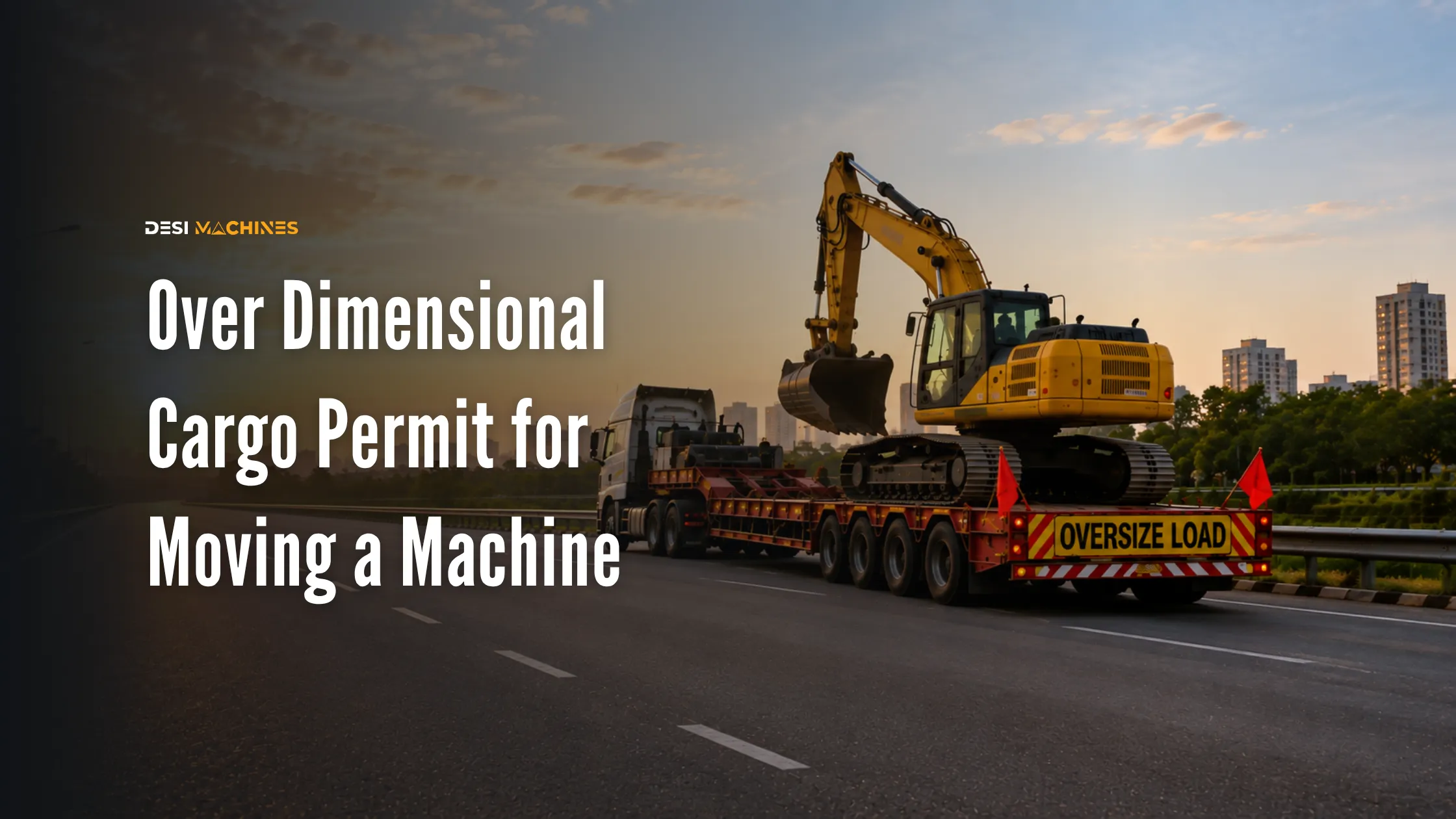
You need an over dimensional cargo permit when the vehicle carrying your machine crosses the dimensions the Central Motor Vehicles Rules allow. Rule 93 caps overall width at 2.6 metres for an ordinary motor vehicle but allows a construction equipment vehicle up to 3 metres in travel mode, provided the width beyond 2.6 metres carries yellow and black zebra stripes front and rear and red lamps for night movement. Height is capped at 3.8 metres. Once your machine is loaded onto a trailer, it is the combination that is measured — which is where most owners cross the line without realising it.
Ask an owner how wide their machine is and you will usually get the number from the brochure. Ask how wide it is sitting on a trailer, with the bed height added underneath, and the answer is a pause.
That pause is the whole problem. The limits in the Rules apply to the vehicle as it stands on the road, not to the machine as it stands in your yard.
The dimensions the Rules actually allow
Rule 93 of the Central Motor Vehicles Rules, 1989 sets overall dimensions. The figures worth knowing before you plan a move are these.
| Dimension | Limit | Applies to |
|---|---|---|
| Overall width | 2.6 m | Motor vehicle generally |
| Overall width | 3 m | Construction equipment vehicle, in travel mode, with marking conditions |
| Overall width | 3 m | Modular hydraulic trailer |
| Overall height | 3.8 m | Vehicle other than a double-decked transport vehicle |
| Overall length | 12 m | Transport vehicle with a rigid frame and two or more axles |
| Overall length | 18 m | Articulated or tractor-trailer combination built for loads of exceptional length |
Two points in that table are easy to miss and both work in your favour if you know them.
The 3 metre allowance for a construction equipment vehicle is a real concession — a machine travelling under its own power gets more width than an ordinary vehicle. It is conditional, though. The portion of the width that exceeds 2.6 metres has to be painted with yellow and black zebra stripes on the front and rear, and the vehicle has to be suitably marked for night-time driving or parking with red lamps at the front and rear. The Rules also say those stripes are not required on attachments.
The 18 metre length for a combination specially constructed to carry loads of exceptional length is the provision most low-bed movements rely on.
Where owners cross the line without meaning to
A machine that is comfortably legal driving itself down a district road can become over dimensional the moment it is loaded.
Height is the usual culprit. Add the trailer bed height under a machine that already stands tall, and 3.8 metres arrives quickly — which is also the number that decides whether you clear an overbridge or a low span of cabling on the route.
Width follows the same logic. The concession described above belongs to the construction equipment vehicle in travel mode. Sitting as a load on a trailer, what is measured is the carrying vehicle with the load on it.
And length comes in through the back door, when a long boom or an extended arm overhangs the bed.
The practical rule is simple: measure the loaded combination, not the machine. Our note on choosing a trailer for excavator transport covers how bed type changes the loaded height, and the piece on excavator transport cost covers what the move itself is built from.
Who arranges the over dimensional cargo permit
Route approval for oversize movement is administered by the transport authority of the state the vehicle is running in. The transporter normally arranges it, because the vehicle, its registration and its driver are theirs, and it is their driver who answers at the check post.
That convention is not a reason to leave it unsaid. Put four things in the transport work order.
Who obtains the approvals for every state on the route, and by when. Who pays for them, and for escort vehicles if the route needs one. Who bears detention if the vehicle is held up, and at what rate per day. What happens to the schedule if an approval is refused or delayed.
Detention is the clause owners regret leaving out. A loaded trailer stopped at a border for two days costs money at both ends — the transporter’s standing time, and your machine earning nothing while a front waits for it.
Since the procedure, the fees and the documents differ between states, confirm the position for your specific route with the transport authority concerned before the machine is loaded. There is no single national counter for this.
What to check before the machine is loaded
Run through five things while the trailer is still empty.
The loaded dimensions, measured rather than assumed — width, height from the road surface, and total length including any overhang.
The trailer’s registration certificate. The weight the vehicle is permitted to carry is on that document, and as our transport cost piece explains, it is that figure and not your machine’s brochure weight that binds at a check post.
The markings and lamps, where the machine is travelling under its own power and using the wider allowance.
The route — overbridges, low cables, weak culverts and any stretch where a night movement restriction applies.
The paperwork travelling with the driver, including the approvals for each state and the documents for the machine itself. Owners moving a machine between states should also read our note on road tax on construction equipment, because a border crossing raises that question at the same counter.
Measure the loaded machine against the permit limits
The limits are published and specific: 2.6 metres wide as a rule, 3 metres for a construction equipment vehicle in travel mode with stripes and lamps, 3.8 metres high, and length depending on the type of combination. Cross them and the movement needs approval from the transport authority for the route.
Measure the loaded combination, get the approvals named in the transport order with a detention rate attached, and start an inter-state move earlier than feels necessary. If you are buying a machine that will be moved often, factor the transport class into the decision — you can compare excavator models and prices and used machines before you commit to something that needs a permit every time it changes site.
Rates, schemes, specifications and prices change — confirm current terms with the OEM, dealer, bank or insurer before deciding. Dimensions above are from the Central Motor Vehicles Rules, 1989 as amended; permit procedure, fees and escort requirements are administered by state transport authorities and must be confirmed for your route before the move.