Excavator
294 models
Excavator
294 models  Backhoe Loader
51 models
Backhoe Loader
51 models  Crane
68 models
Crane
68 models  Concrete Mixer
79 models
Concrete Mixer
79 models  Wheel Loader
54 models
Wheel Loader
54 models  Compactor / Roller
45 models
Compactor / Roller
45 models  Motor Grader
42 models
Motor Grader
42 models  Dozer
41 models
Dozer
41 models  Concrete Pump
66 models
Concrete Pump
66 models  Skid Steer Loader
11 models
Skid Steer Loader
11 models  Telehandler
13 models
Telehandler
13 models 


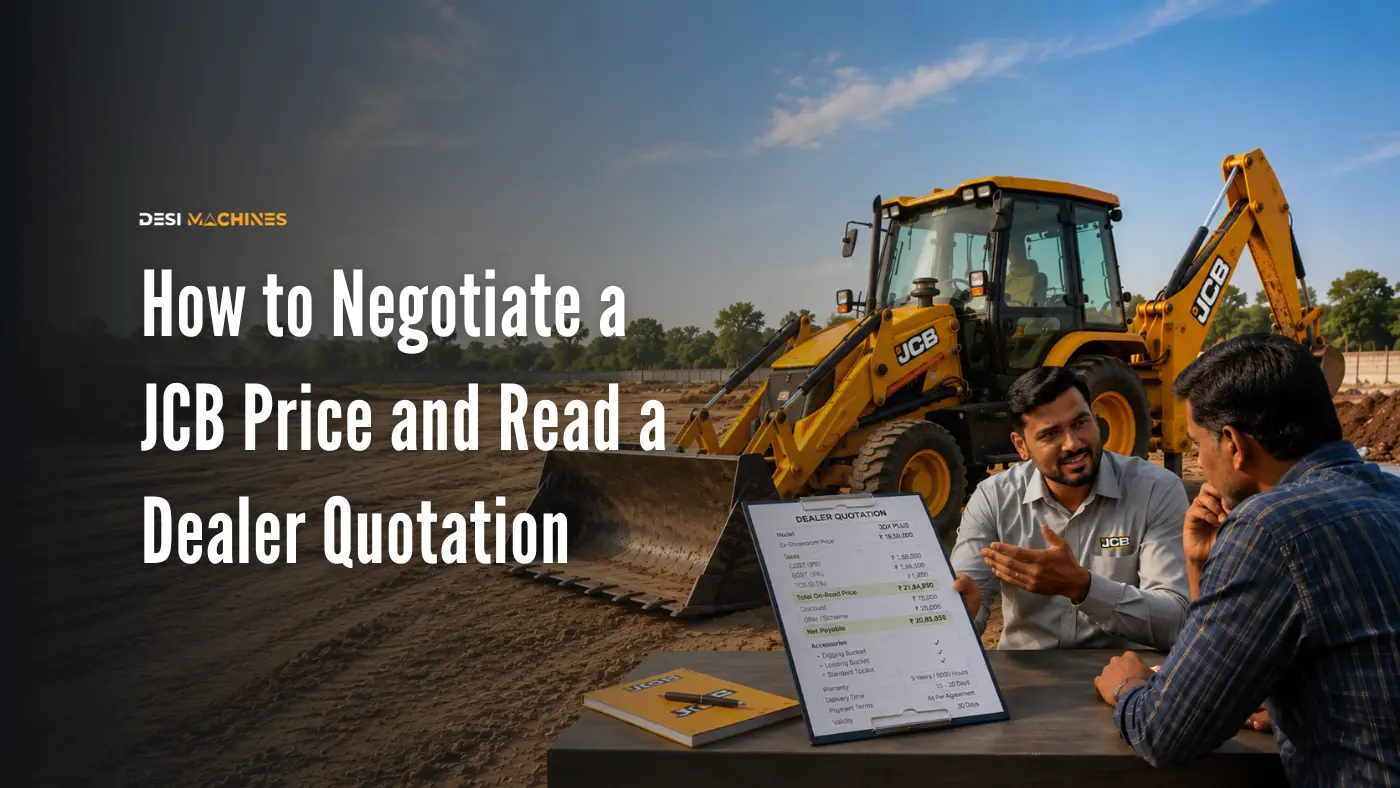
Here is how to negotiate JCB price (or any machine price) without leaving money on the table: stop haggling over one lump-sum number and read the dealer quotation line by line. The base machine price barely moves — an indicative 3–8% as of July 2026 — but the add-ons (transport, handling, extended warranty, accessories, exchange value) are where the real saving hides. Settle the on-road price as a cash figure first, negotiate the loan separately, and time the deal near a quarter-end. Confirm every concession in writing with our team before you pay.
Most first-time buyers negotiate a machine the way they’d negotiate a phone — argue over the final price, feel good about a small cut, and sign. Dealers are comfortable with that, because the number you fixate on is rarely where their margin sits. Learning how to negotiate a JCB price (or an excavator, crane or loader price) is really about learning to read the quotation, so you argue over the lines that actually move. This guide walks through that quotation, line by line.
Why the sticker price is the wrong thing to fight over
The base or ex-showroom price of a popular machine — a JCB 3DX, a Tata Hitachi excavator — is fairly standardised across dealers, and the dealer’s own margin on it is thinner than buyers assume. So a hard fight on the base number usually wins an indicative 3–8% as of July 2026, and no more. The quotation, though, has half a dozen other lines, and those are where a good negotiator quietly saves far more. Get the itemised quotation first; if a dealer gives you a single lump sum “on-road” figure, ask for the break-up before you say anything about price.
How to negotiate JCB price: read the quotation line by line
Here is what a typical machine quotation contains, and where each line can move:
| Line item | Negotiable? | What to do |
|---|---|---|
| Ex-showroom / base price | A little | Fight for 3–8%; don’t expect the big win here. |
| GST (at applicable rate) | No | Fixed by law — but confirm the current rate so it isn’t padded. |
| Handling / logistics / transport | Yes | Ask for it to be reduced or waived, especially for a nearby delivery. |
| Extended warranty / AMC | Yes | Useful, but priced high — negotiate it in free or discounted. |
| Accessories / attachments | Yes | Ask for the ones you need free instead of a price cut. |
| Exchange value (old machine) | Yes | The softest line of all — a better exchange quote saves you real money. |
| Insurance | Sometimes | You can often insure it yourself cheaper — get an outside quote to compare. |
Notice how many lines say “yes”. A dealer who won’t move ₹20,000 on the base price will happily throw in a service package, waive transport, or improve your exchange value by more than that — because those cost them less than a headline price cut, and because those numbers aren’t public. That is the whole game: trade the base-price fight for concessions on the soft lines.
What a JCB quotation format actually looks like
Most buyers have never seen a machine quotation laid out in full, which is exactly why a padded
one is hard to spot. Here is the standard format, with an indicative
JCB 3DX (catalogue band ₹30-32
lakh) used to show where the numbers sit. Ask for your quote in this shape and every line has to
justify itself.
| # | Line on the quotation | Indicative figure | Your move |
|---|---|---|---|
| 1 | Model and exact variant (with specification sheet) | JCB 3DX, stated in full | Check it matches what you asked for |
| 2 | Ex-showroom price | ₹30-32 lakh | Fight for 3-8%, no more |
| 3 | GST | At the applicable rate | Fixed — but confirm the rate isn’t padded |
| 4 | Registration / RTO, where applicable | At actuals | Ask for the receipt, not a round number |
| 5 | Handling, logistics and transport to site | ₹25,000-75,000 | Ask for it waived |
| 6 | First-year insurance | 1-2% of value | Get an outside quote and compare |
| 7 | Extended warranty / AMC (optional) | Quoted separately | Negotiate it in free |
| 8 | Accessories and attachments (optional) | Itemised, each priced | Take these instead of a price cut |
| 9 | Less: exchange value of your old machine | Shown as a deduction | The softest line on the page |
| 10 | Less: scheme or corporate discount | Stated explicitly | Make them write it in, not promise it |
| 11 | Total on-road price | The only number that matters | Settle this as cash before finance |
| 12 | Quotation validity date and dealer stamp | Usually 7-30 days | Undated quotes are not quotes |
Two lines do most of the work. Line 11 is the only figure worth comparing between dealers — a
low ex-showroom price with a fat line 5 and a thin line 9 is a worse deal than the reverse. And
line 12 is what stops a “today only” price from being a pressure tactic: a dated, stamped
quotation you can carry to the next dealer is the single most useful document in the negotiation.
If a dealer will not put the break-up in writing in this format, that itself is the answer.
Separate the machine deal from the finance deal
The most common trap is the “low EMI” pitch. A dealer offers an easy monthly figure, and the buyer relaxes — without checking that the low EMI came from a longer tenure or a quietly higher price. Always fix the on-road machine price first, as a cash number, and only then negotiate the loan as a separate deal: the interest rate, the processing fee, and the margin money (down payment). Compare the total amount you will repay, never just the monthly figure.
Before you sit down, it helps to know what a fair loan looks like. Our guide to loan vs lease vs cash for equipment and the equipment finance options page let you walk in knowing the going rate, so a dealer’s finance desk can’t set the terms for you.
Time the purchase for a bigger discount
The same machine costs less at some moments than others. Dealers work to targets, so month-end, and especially quarter-end (June, September, December, March), is when discounts loosen. The end of a model year, or the run-up to an emission-norm change, can mean good deals on outgoing stock. And a machine sitting unsold in the yard is always easier to negotiate than one in short supply. If your work can wait a few weeks, buying into a quarter-end can be worth more than any amount of arguing.
Do your homework before you walk in
Negotiation is really preparation. Know the honest market range for the exact variant you want, know what a fair finance rate is, and know the value of your exchange machine. The more you already know, the less the quotation can hide. Comparing the same machine across variants and rivals on our machine comparison pages, and checking live listings for the JCB 3DX Plus or other models before you visit, gives you the reference numbers a dealer assumes you don’t have. First-timers should also read the full first machine buyer’s roadmap so nothing in the process is a surprise.
Where to find savings when negotiating a JCB price
To negotiate a JCB price — or any machine price — well, don’t fight the sticker. Get the itemised quotation, win a fair 3–8% on the base, then take the real savings from the soft lines: transport, warranty, accessories and exchange value. Settle the machine price before the loan, compare total repayment not EMI, and buy near a quarter-end. Every concession you win means nothing until it is written on the quotation, so get it in writing and confirm the final on-road figure with our team before you pay.
Ready to line up your numbers? Compare live machines and variants and check the finance options, then get an offer from a position of knowing your figures.
Prices, taxes, discounts, schemes and specifications are indicative, change constantly, and vary by variant, location and date. The figures here are indicative as of July 2026 — always confirm the current price, tax rate and terms with our team before any purchase decision. DesiMachines is not liable for decisions taken on the basis of information that may have changed after publication.