Excavator
294 models
Excavator
294 models  Backhoe Loader
51 models
Backhoe Loader
51 models  Crane
68 models
Crane
68 models  Concrete Mixer
79 models
Concrete Mixer
79 models  Wheel Loader
54 models
Wheel Loader
54 models  Compactor / Roller
45 models
Compactor / Roller
45 models  Motor Grader
42 models
Motor Grader
42 models  Concrete Pump
66 models
Concrete Pump
66 models  Skid Steer Loader
11 models
Skid Steer Loader
11 models  Telehandler
13 models
Telehandler
13 models  Dozer
Dozer 


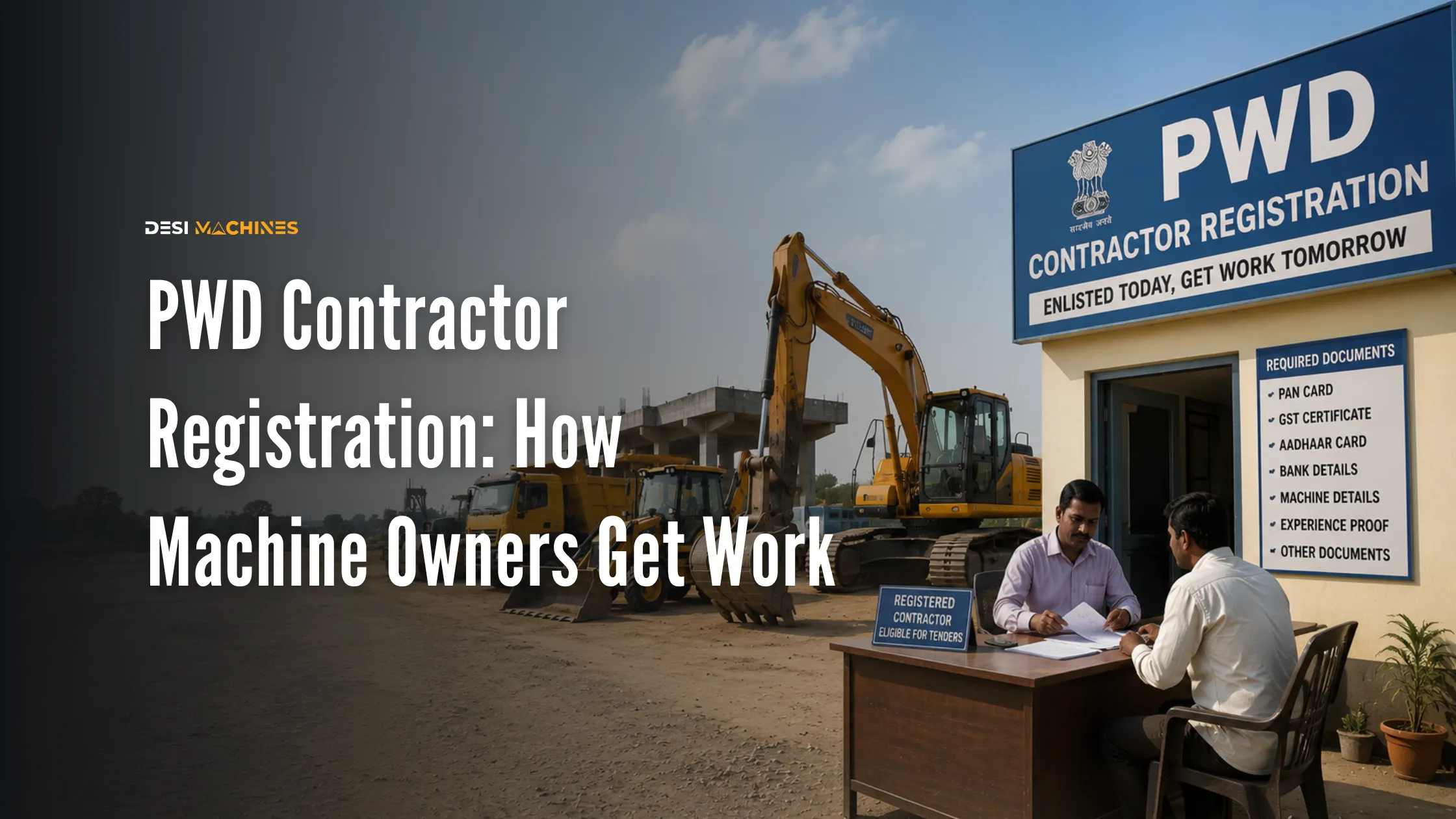
In short: PWD contractor registration is not a licence you buy, it is an enlistment in a category and a class, and the class carries a tendering limit that decides the size of work you can bid for. Under the Rules for Enlistment of Contractors in CPWD 2026, in force from 1 January 2026, enlistment runs for five years, the whole file moves through the CEMS portal, and a newly enlisted contractor must finish ERP training within 90 days or stay locked out of tendering. If you only want to put your machine on a government site on hire, you probably do not need enlistment at all.
Ask around any contractor market and you will hear the same shorthand: get the licence, then the work comes. It is a misleading way to describe what actually happens, and it sends a lot of machine owners into a process that was not built for them.
There is no single “PWD licence”. Enlistment is departmental. The Central Public Works Department runs its own, every state PWD runs its own, and municipal bodies, irrigation departments and PSUs each keep their own lists. What follows is built on CPWD’s current rule book, because it is the one published in full and the one most state departments broadly follow. Treat it as the shape of the process, then read the rules of the department you are actually applying to. A separate regime governs electrical work, where the licence comes from a state licensing board instead: see electrical contractor licence.
What the term PWD contractor actually means
The phrase gets used as though it were a job title, and it is not one. A PWD contractor is a firm — a proprietor, a partnership or a company — that currently sits on one Public Works Department’s approved list, in a named category and a named class, with a tendering limit and an expiry date attached to it. It is a status held with a particular department, not a qualification you earn once and carry about. Nobody is a PWD contractor in the abstract: a firm is enlisted with CPWD, or with a state PWD, or with a municipal body, and each of those is a separate list kept under its own rule book.
Three things follow, and between them they answer most of what people mean when they ask what the term stands for. It is not a personal licence — it attaches to the firm and to its constitution, which is why changing a partnership can put it at risk. It is not permanent — it runs for a fixed term and can be reviewed, demoted or withdrawn inside that term. And it is not portable — being enlisted with one department gives you nothing with the next, so a firm that works across departments carries several enlistments at once.
It is also a claim that can be checked rather than taken on trust, because the enlisting department publishes who is on its list and in which class.
This is also why the class limits quoted around the internet so seldom match what an applicant is actually told. The grading is not standard across departments — what one department calls a class need not line up with another’s — and the rule book that fixes those limits is written for one department only. The 2026 CPWD rules say as much in terms: they are prepared for the use of CPWD, they may be used by other government departments, PSUs, private bodies and other institutions at their own discretion only, and CPWD disclaims responsibility for any ambiguity, dispute or financial loss arising from another body following them. A limit read off CPWD’s rule book is evidence about CPWD, and not about the department you are applying to.
What PWD contractor registration actually gets you
Enlistment puts your firm on a department’s approved list. It does not hand you work and it does not shortlist you for anything. What it does is let you into the tender process for jobs sized to your class.
Three fields on the enlistment order carry all the meaning:
| Field on the order | What it decides |
|---|---|
| Category | The kind of work you are enlisted for. CPWD’s 2026 rules cover Buildings and Roads, and Horticulture, as separate categories. |
| Class | Your standing within that category. A higher class means bigger jobs, and a class can be revised down as well as up. |
| Tendering limit | The value of work you may tender for. CPWD’s rules let an enlisted firm tender within its tendering limit as per Rule 3.5, subject to the eligibility conditions in each tender notice. |
That last line is the one people miss. Enlistment gets you through the door; the notice inviting tender can still ask for turnover, similar completed work or plant holding that you do not have. Being enlisted and being eligible are two different tests, and you have to pass both. The way a specific tender applies those conditions is covered in how to bid for government construction tenders.
The rule book to work from, and its date
CPWD’s current rules are the Rules for Enlistment of Contractors in CPWD, 2026, approved by the Director General, CPWD and in force with effect from 1 January 2026, issued under office memorandum No. DG/Enlist.Rules-2026/Misc./01 dated 31 December 2025. They replace the 2024 edition. The same memorandum records that enlistments expiring between 1 January 2025 and 31 March 2026 were deemed extended up to 31 March 2026.
Two practical notes from the department’s own text. Where the Hindi and English versions of a provision differ, the English version prevails. And CPWD publishes the rules for its own use, with a written caution that other departments, PSUs and private bodies use them at their own discretion. So a state PWD may follow the same structure and still differ on the numbers that matter to you.
The full rule book runs to about ninety pages and sits on the CPWD website as a downloadable PDF of the enlistment rules. Read the class and eligibility tables there rather than trusting a summary, including this one.
How the enlistment process runs, step by step
The file is online end to end. CPWD moved enlistment onto its CEMS portal and the 2026 rules were written to work with it, which changes the process in one important way: there is no counter to visit and no file to follow up in person.
1. Decide the category and the class you are eligible for. This is the step worth spending time on. Class criteria turn on experience and financial standing, and applying for a class you cannot support wastes the cycle. Use the eligibility check on the CPWD enlistment portal, and read the class tables in the rules PDF before you commit.
2. Get the identity and tax record straight. The enlistment paperwork is built around PAN, a GST registration number, Aadhaar with only the last four digits carried on the record, and a photograph and signature of the individual, partner, director or sole proprietor. If your firm’s constitution has changed, or the GST registration sits in a different name from the applicant, fix that before you apply rather than during.
3. Apply on the portal against a live enlistment notification. Fresh enlistment and revalidation are opened by separate notifications, so the window matters. The rules themselves say further notification regarding applications for fresh enlistment and revalidation is issued separately.
4. Download the enlistment order from the portal. When it is approved, nothing arrives in the post. CPWD’s rules state that the applicant shall download communication letters and enlistment orders from the CEMS or ERP portal, and that they will not be sent by speed post.
5. Finish the ERP training within 90 days. This is the rule that costs new contractors a season. A newly enlisted contractor or their authorised representative must take compulsory ERP training within ninety days of the date of issue of the enlistment order, and until the training certificate is uploaded they are not allowed to participate in the tendering process. Training runs through CPWD regional training institutes, the NCA at Ghaziabad, or the ERP unit at headquarters.
Note what that sequence means for planning. The enlistment order is a starting gun, not a finish line, and the ninety-day clock starts the day it is issued, whether or not you have looked at the portal since.
What we are deliberately not quoting
You will find plenty of articles listing class-wise monetary limits, application fees and solvency figures for PWD enlistment. We are leaving those out on purpose.
Those tables change with each edition of the rules, they differ between CPWD and every state department, and a figure carried over from an older edition is worse than no figure at all when you are budgeting an application. The current limits for your category and class are published in the rules PDF and in the eligibility check on the CPWD enlistment portal. Read them from the source on the day you apply, and confirm the fee on the payment screen rather than from any article.
Five years, then a review you should plan for
CPWD enlistment is valid for five years from the date of issue of the order, or from the date the order itself specifies. Inside those five years it is not untouchable. The enlisting authority can review the enlistment at any time and, where it considers it necessary, can restrict it, demote the contractor to a lower class, or take other disciplinary action under the rules.
Anyone can check where you stand. Enlistment orders are authenticated from the CPWD website under Contractors, then List of Contractors, then List of CPWD Enlisted Contractors, and the department will not entertain a request to verify a hard copy physically. Your record on that list is the thing a prospective partner will look at, so treat performance on small early jobs as the thing that protects the class you fought for.
Do you need enlistment at all, or just the work?
Here is the question most machine owners should answer before filling anything in. Enlistment makes you the contractor. You bid the job, you carry the programme, the labour, the measurement, the retention and the payment risk. If your business is one backhoe and an operator, that is a different business from the one you are running today.
There are two lighter routes to the same government rupee.
Hire the machine to an enlisted contractor. The contractor holds the class, the tender and the risk; you supply capacity against a log sheet and bill monthly. The rate conversation is the whole negotiation, and you can size it against the going numbers in the equipment rental rate card.
Sell machine hire as a service on the Government e Marketplace. Departments buy hiring services on GeM in units like a vehicle-day, which suits an owner renting out capacity. Registration is free and the old caution money deposit is gone, though three years of income tax returns and a GSTIN do the real gatekeeping. That route is set out in GeM portal registration for contractors.
Not every big client keeps a list at all. NBCC, the housing and redevelopment enterprise under the Ministry of Housing and Urban Affairs, tenders its construction out but runs no contractor register and no class ladder — eligibility is set on each notice instead. If you have been hunting for an application form there, what NBCC contractor registration actually involves explains why you will not find one.
Whichever route you take, government money moves on its own calendar. Running bills, retention and the statutory interest you are owed on a delay are worth understanding before the first invoice, and they are covered in contractor payment delay on government work. Live departmental work packages are listed on the construction tenders and opportunities page, which is a cheap way to see what your class would actually let you bid for before you apply for it.
The bottom line
PWD contractor registration is a five-year enlistment in a category and a class, run through the CEMS portal, with a tendering limit that sets the ceiling on what you can bid and a ninety-day ERP training rule that decides when you can start. It is the right move if you intend to take work in your own name. If you intend to rent out a machine, enlist your machine with a contractor who already holds the class, or take the GeM route, and put the effort into utilisation instead.
State PWD enlistment is one ladder among several. The defence side runs its own: MES contractor registration puts you in a class with an upper tendering limit on a five-year cycle, and BRO contractor registration trades a standing security deposit for an earnest money exemption. The evidence file overlaps heavily with this one.
If the plan is to buy the second machine on the back of departmental work, price the loan before you price the bid. Compare equipment finance options and lenders and look at what is live across backhoe loaders and excavators before you commit to a tendering limit you have to fund.
Enlistment rules, classes, limits, fees and validity change between editions and differ across CPWD, state PWDs and other departments. The provisions described here are from the Rules for Enlistment of Contractors in CPWD 2026, in force from 1 January 2026. Confirm current rules, eligibility and fees with the department or on its official portal before you apply. Prices, rates and figures elsewhere on this page are indicative, vary by variant, location and date, and should be confirmed with the OEM, dealer, bank or insurer before any decision. DesiMachines is not liable for decisions taken on the basis of information that may have changed after publication.