Excavator
294 models
Excavator
294 models  Backhoe Loader
51 models
Backhoe Loader
51 models  Crane
68 models
Crane
68 models  Concrete Mixer
79 models
Concrete Mixer
79 models  Wheel Loader
54 models
Wheel Loader
54 models  Compactor / Roller
45 models
Compactor / Roller
45 models  Motor Grader
42 models
Motor Grader
42 models  Concrete Pump
66 models
Concrete Pump
66 models  Skid Steer Loader
11 models
Skid Steer Loader
11 models  Telehandler
13 models
Telehandler
13 models 



In short: GeM portal registration for contractors and machine owners is free. The caution money deposit that used to be collected at registration has been discontinued, and existing deposits are refundable through the portal. You pay GeM nothing until your order value in a financial year crosses Rs 20 lakh, when a one-time Annual Milestone Charge of Rs 10,000 plus taxes applies. The two things that actually stop small owners are three years of verified income tax returns, needed to bid, and a GSTIN, without which you cannot accept an order above Rs 2.5 lakh.
Most owners hear about the Government e Marketplace the same way: a friend with two tippers says he is getting departmental work off a portal, no tender document, no physical file. Then they open the site, see a wall of registration steps, and close it again.
The registration itself is not the hard part. The hard part is that two of the requirements sit in your accountant’s office, not on the portal, and nobody tells you that until you are halfway through the form.
What GeM will buy from you, and what it will not
GeM describes itself as the National Public Procurement Portal, an end-to-end marketplace for central and state ministries, departments, public sector undertakings, autonomous institutions and local bodies to buy common-use goods and services. Two words there matter to a machine owner: goods and services.
You are almost never selling a machine on GeM. You are selling a service, and GeM’s service categories are built around a unit of hire rather than a lump sum. The live service categories run on shapes like per vehicle-day hiring, per-kilometre goods transport, and repair and maintenance of plant and equipment. That structure suits an owner who rents out capacity and bills against a log sheet.
What it does not suit is a works contract. If a department wants a road built or a canal desilted as a measured item of work, that goes out as a tender through the e-procurement route, not as a marketplace order. Those still run on the process described in how to bid for government construction tenders. Knowing which of the two you are chasing saves you registering on the wrong system.
What GeM portal registration for contractors actually costs
This is where most of the information floating around is out of date. GeM used to collect caution money, a one-time refundable deposit taken at seller registration and pegged to declared annual turnover. Its own note on the subject confirms the requirement has been discontinued for sellers and service providers, and that anyone who already paid can withdraw it from the seller dashboard, with credit to a PFMS-verified bank account inside 24 hours.
What remains is charged on business done, not on joining:
| Charge | When it applies | Amount |
|---|---|---|
| Registration | On signing up as a seller or service provider | Nil |
| Caution money | Formerly at registration, by turnover slab | Discontinued (was Rs 2,000 / Rs 10,000 / Rs 25,000) |
| Annual Milestone Charge | Once your order value in a financial year reaches Rs 20 lakh | Rs 10,000 + taxes, once that year |
| Transaction charge | Individual order of Rs 10 lakh or less | Nil |
| Transaction charge | Order above Rs 10 lakh and below Rs 10 crore | 0.30% of order value |
| Transaction charge | Order of Rs 10 crore and above | Flat Rs 3,00,000 |
These figures are from GeM’s Revenue Policy version 1.6, effective 26 August 2025. Two details in it are worth holding on to. Orders awarded to you before you cross the Rs 20 lakh mark carry no transaction charge at all, so a first year of small departmental hires can genuinely cost you nothing. And the charge falls due early: within 15 days of the contract being awarded, or before you raise your first invoice, or on or before the first delivery date, whichever comes first. Miss it and the account is suspended until you pay.
For a machine owner the practical reading is that GeM is cheap on small work and takes a thin slice on large work. At 0.30%, a Rs 40 lakh hire contract costs you about Rs 12,000 in transaction charge. Set against what a middleman takes on the same job, that is not the number that decides anything.
The documents to have open before you start
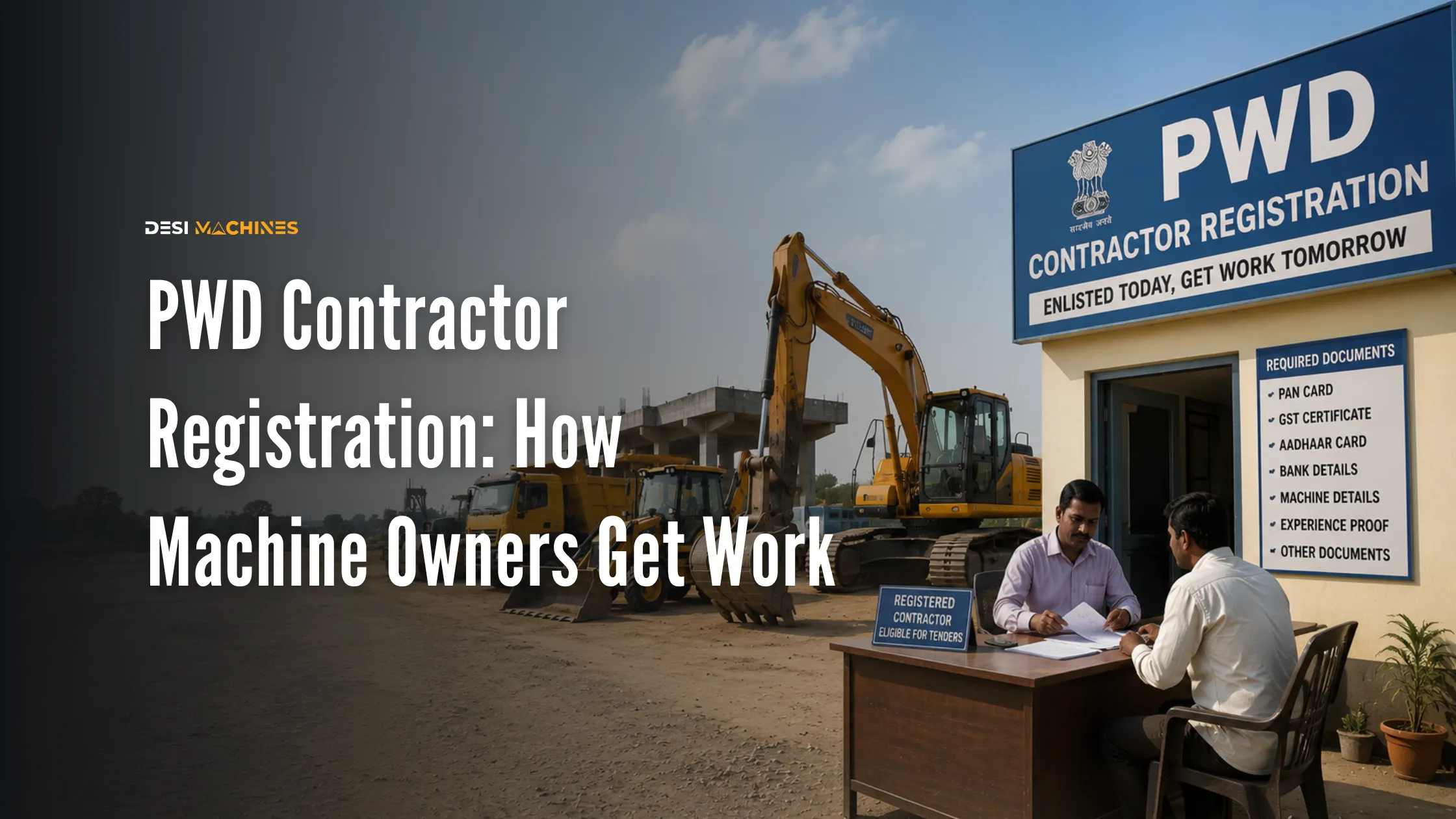
GeM’s pre-requisites sheet for seller registration, which the portal publishes for download, is blunt about who may register: an authorised person only, meaning a director, a key person or the proprietor. Your details are then validated against your income tax filings, so registering in a manager’s name and hoping it passes does not work.
Keep these ready:
| Item | Detail |
|---|---|
| Identity | Aadhaar number or virtual ID, with the linked mobile; or your personal PAN, whose fourth letter must be P |
| Constitution | Proprietorship, firm (partnership or LLP), company, trust or society, or government entity |
| Business PAN | Fourth letter must match the constitution: P proprietorship, F firm, C company, T trust or society, G government entity |
| Incorporation | Date of incorporation or registration; CIN as well if you are a private or public limited company |
| Income tax | ITR form and acknowledgment for the last three years |
| Bank | Account number and IFSC of the account that will receive GeM payments |
| Addresses | Registered office address, plus a billing address carrying your GSTIN |
| If MSE or start-up | Your MSME registration number and its linked mobile, or the DIPP number for a recognised start-up |
One note on that last row. GeM’s sheet is dated December 2019 and still asks for a UAM number, the old Udyog Aadhaar Memorandum. Udyam registration replaced UAM, so keep your Udyam number and the mobile linked to it at hand and confirm the current field on the portal as you fill it.
The two requirements that stop most small owners
Everything above is paperwork you either have or can get in a week. These two are different, because they depend on decisions you took in earlier years.
The first is income tax returns. GeM requires verified ITR details for the last three years to participate in a bid or reverse auction, for all entities, unless the business was incorporated less than 24 months ago or is exempt from filing. The details are checked against what you actually filed. An owner who has been running three tippers on an informal basis and filing thin returns will find that the returns, not the machines, are what keep him out of the bidding. If you only intend to list and accept direct purchase orders without bidding, the ITR requirement does not apply, which is a reasonable way to start while you get the filings in order.
The second is GST. Without a GSTIN on your billing address you cannot accept any order beyond Rs 2.5 lakh. One excavator on monthly hire with a department clears that ceiling in a single bill, so on machine work this is not a threshold you sit under for long.
What the MSE tag is worth when you bid
If you are registered as a micro or small enterprise, that status does real work at the bid evaluation stage rather than at registration. Where purchase preference for MSEs applies to a bid, the buyer can split the order among a maximum of five MSE sellers, and MSE offers within 15% of the lowest bid are given the option to match that price and take a share.
Read that as a margin of error. A single-machine owner competing against a fleet operator can be 12% higher on rate and still end up with part of the order. It is the strongest reason to complete the Udyam registration before you start bidding rather than after your first loss.
Pricing the hire once you are in
A GeM service order is priced per unit of hire, which means your rate has to carry diesel, the operator, maintenance, the EMI and your margin inside a per-day or per-hour number. Working backwards from prevailing market rates is a reasonable starting point, and the ranges in our equipment rental rate card give you something to sanity-check against before you commit a figure to a bid you cannot withdraw.
Build the payment cycle into that number as well. Government orders on GeM are cleaner than departmental running bills, but they are still government money, and the cash flow discipline in handling a contractor payment delay applies the moment a bill is queried. If you are still assembling the machine itself, the schemes covered in government subsidies for buying construction equipment and the setup steps in starting an equipment rental business come before any of this.
The bottom line
GeM has removed the money barrier to entry. Registration is free, caution money is gone, and a small owner can run an entire first year of departmental hires without paying the portal anything. What it has not removed is the compliance barrier, and that is where the real work sits: three clean years of returns if you want to bid, a GSTIN before your first serious order, and a Udyam registration to get the price-match protection. Those take an accountant and a few weeks, not money.
Get the filings straight, register as an authorised person, and start with small direct orders while the ITR history builds. Live government and public sector work is listed under construction equipment tenders and opportunities, and if you are still choosing the machine to put against that work, compare the current range of excavators and backhoe loaders and talk to a dealer before you commit to an EMI.
Registration rules, charges and thresholds on GeM are revised from time to time. The figures here are drawn from GeM’s published seller documents, including its Revenue Policy v1.6 dated 26 August 2025 and its seller registration pre-requisites sheet, and were current as at August 2026. Confirm the position on the official GeM seller resources page before you budget or bid.
Rates, schemes, specifications and prices change — confirm current terms with the OEM, dealer, bank or insurer before deciding. DesiMachines is not liable for decisions taken on the basis of information that may have changed after publication.