Excavator
294 models
Excavator
294 models  Backhoe Loader
51 models
Backhoe Loader
51 models  Crane
68 models
Crane
68 models  Concrete Mixer
79 models
Concrete Mixer
79 models  Wheel Loader
54 models
Wheel Loader
54 models  Compactor / Roller
45 models
Compactor / Roller
45 models  Motor Grader
42 models
Motor Grader
42 models  Concrete Pump
66 models
Concrete Pump
66 models  Skid Steer Loader
11 models
Skid Steer Loader
11 models  Telehandler
13 models
Telehandler
13 models  Dozer
Dozer 


A joint venture for tender work is how two small firms clear an experience clause neither could clear alone, and Indian courts have backed the principle since 1995. The catch is arithmetic. Your past work may count at full value or at a fraction of it depending on how you earned it, and a firm that has been reconstituted can lose the right to claim a job it actually did. Tender conditions and values change, so confirm the clauses in the document you are bidding on before you commit.
They were the lowest bidder, and they still lost the job.
Two partnership firms from Rajasthan and Chhattisgarh formed a joint venture in September 2019 and bid for a coal transportation contract worth about Rs 15.52 crore with a subsidiary of Coal India. They cleared the technical stage, got into the reverse auction, and came out as L-1. Then the evaluation committee looked again at the experience documents and rejected the bid. The Bombay High Court at Nagpur upheld that rejection in March 2020.
That case, Rajasthan Transport & HCT (JV) v Western Coalfields Ltd, Writ Petition No. 8537 of 2019, decided on 2 March 2020, is the clearest published account of how joint venture bidding actually works in Indian public procurement, and what it costs when you get it wrong. It is worth reading before you shake hands with anyone.
Why a joint venture for tender work exists at all
Most works tenders of any size carry two conditions a newer owner cannot meet: a minimum average annual turnover, and proof of having completed similar work of a certain value. Our walk-through of how to bid for government construction tenders sets out the usual ways around that wall, which are to aim at machine-hire tenders, at smaller municipal and panchayat work, or to subcontract under someone who has already qualified.
Bidding jointly is the fourth route, and it is the only one that lets you bid in your own name against a large tender straight away. Two owners pool what they have: one brings the completed work, the other brings machines, capacity or turnover, and they bid as a single entity.
The law supports this. In New Horizons Ltd v Union of India, (1995) 1 SCC 478, the Supreme Court held that where a joint venture is the tenderer, the experience of its constituents must be treated as the experience of the joint venture, notwithstanding that the bidding entity itself had no such record. That principle is quoted and applied in tender litigation to this day, and it is the reason departments accept joint bids at all.
The arithmetic nobody explains: your share is your experience
Here is where owners get caught. Accepting joint bids does not mean accepting every partner’s full track record. The tender document decides how much of it counts.
The coal transport tender in the Bombay case set its eligibility in clause 6(a). The bidder had to have, in its own name or as its proportionate share as a member of a JV or consortium, experience of having successfully executed works of a similar nature valuing 65 per cent of the annualised estimated cost of the work put to tender. A separate sub-clause then did the real damage: experience earned by a bidder as an individual or proprietary firm was to be considered at 100 per cent valuation, but experience earned as a partner in a joint venture was to be counted only in proportion to that bidder’s actual share.
| How you earned the past work | How much counts | What it means when you bid |
|---|---|---|
| As an individual or proprietary firm | 100% | The full certified value carries into your eligibility |
| As a partner in an earlier joint venture | Your actual share | A job done inside a 40% JV counts at 40% of its value |
| By a person who has since left your firm | Nothing | The firm cannot claim work it did not itself execute |
Run that against a real plan before you rely on it. If a tender wants similar work of Rs 6 crore and your only qualifying job was done inside a joint venture where you held a third, you are bringing Rs 2 crore of eligibility to the table, not Rs 6 crore. Your partner has to cover the rest, and if the document also splits turnover by share, the same discount applies there too. This sits alongside the separate ceiling on how much you may bid for at all, which our note on the bid capacity formula works through.
The trap that actually sank the bid: a reconstituted firm
The Rajasthan firm had genuinely done the work. A certificate from Bharat Aluminium confirmed coal loading and transportation worth Rs 14,38,01,978 in the financial year April 2017 to March 2018, which on its face was comfortably enough.
The problem was whose work it had been. That work was executed by a sole proprietary firm belonging to one individual. In December 2018 the firm was reconstituted as a partnership of the surviving partners, without him. It was that reconstituted firm which then bid as a joint venture, and it asked for his experience to be counted as its own. The court refused. An argument built on the Partnership Act did not save it, and the rejection was held to be a proper exercise of the department’s judgement rather than anything arbitrary.
For a machine owner the lesson is narrow and expensive. Experience attaches to the entity that performed the work, not to the name over the gate or to the family. If a partner has retired, died or been bought out since the job you intend to rely on, or if you have converted a proprietorship into a partnership or a company, your qualifying history may not have travelled with you. That is a question to settle with your auditor well before a bid, because the technical evaluation committee will ask it at the worst possible moment.
Lock the partner before prequalification
There is a second restriction that owners walk into. Where a tender runs a prequalification stage, the joint venture that prequalified is generally the joint venture that has to bid.
The Karnataka High Court considered exactly this in Kirloskar Brothers Ltd v Bangalore Water Supply and Sewerage Board, decided on 15 March 2000. The tender conditions there stated that prequalified tenderers and members of prequalified joint ventures or consortia could not form a new consortium with members prequalified under a different application, and that joint ventures and consortia must respond as prequalified. A bidder who dropped its original partner after prequalification and joined another was outside the condition.
So choose the partner before you prequalify, and write down what you have agreed while both of you still want the job: who leads, who signs, who supplies which machines, how the money splits, and who carries the liability if the work goes wrong. Departments generally want the lead member identified and the members jointly and severally liable, which in plain terms means the department can come after either of you for the whole of it. Settle that between yourselves on paper before the bid, not afterwards.
Being L-1 is not the same as winning
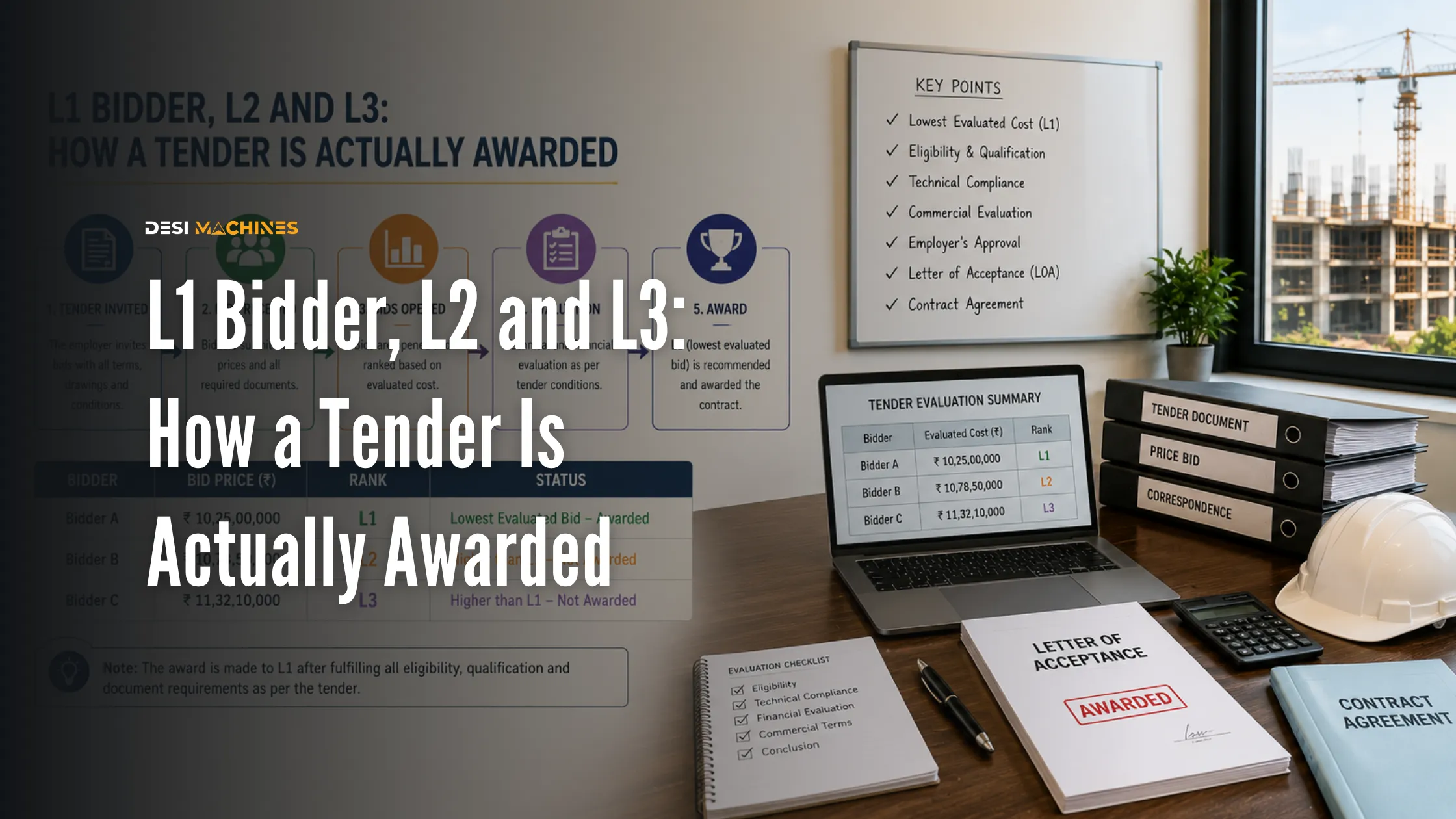
The detail most worth remembering from the coal case is the sequence. The joint venture passed the technical stage, was allowed into the reverse auction, and finished as the lowest bidder. The rejection came afterwards, on a re-examination of the eligibility documents. Standing first on price bought them nothing, which is the same point our piece on how an L1 bidder is actually awarded work makes from the other direction.
There was one piece of relief. The department had also forfeited the earnest money of Rs 17,70,300. The court set that aside and directed a refund within four weeks, holding that putting forward an arguable claim about whose experience counted was not the submission of wrong information within the meaning of the forfeiture clause. A rejected bid does not automatically mean a forfeited deposit, and the clause the department relies on matters: our guide to the EMD refund process covers how that money normally comes back.
Before any of this, make sure the rest of your file is current. A joint bid still needs each member’s financial standing documented, and the solvency certificate is usually where that starts.
The bottom line
Bidding jointly is a legitimate and court-backed way for a smaller owner to reach work that would otherwise be out of range. Treat it as a documentation exercise rather than a handshake. Check how the tender counts each member’s experience and turnover, check that the entity claiming a past job is the entity that did it, fix the composition before prequalification, and put the lead, the shares and the liability in writing.
The other half of the calculation is whether you can actually perform the job once you win it. If the answer needs another machine, our excavator range and our equipment finance options are where to work out what the next job can carry.
Rates, schemes, specifications and prices change — confirm current terms with the OEM, dealer, bank or insurer before deciding.