Excavator
316 models
 Backhoe Loader
54 models
 Crane
68 models
 Concrete Mixer
79 models
 Wheel Loader
71 models
 Compactor / Roller
45 models
 Motor Grader
42 models

 Concrete Pump
66 models
 Skid Steer Loader
11 models



Liquidated damages in construction contracts are a figure the contract fixes in advance for late completion, commonly a small percentage of the contract value per week of delay, with an overall ceiling. Under Section 74 of the Indian Contract Act, 1872, that named figure is the maximum recoverable, not an automatic entitlement: the client is entitled to reasonable compensation not exceeding the amount named. The lever that actually protects you is the extension of time application, filed in writing while the delay is happening. On CPWD’s General Conditions of Contract 2023, that means within fourteen days of the event, and the delay clause caps compensation at 10% of the accepted tendered value.
Every works contract has a completion date, and almost no site meets it. Drawings arrive late, the front is not handed over, a service line turns up where none was shown, or payment stalls and your own machines walk off to a job that pays.
Then the final bill is drawn and a deduction appears. By that stage the argument is much harder than it needed to be, because the clause was doing its work quietly for months while nobody wrote anything down.
What liquidated damages in construction contracts actually are
A delay clause names a sum. The usual shape is a percentage of the contract value for each week or part of a week you run past the completion date, subject to a maximum, often expressed as a ceiling on the total that can be recovered under the clause.
The point of naming a sum in advance is to save the client from having to prove what your delay cost. Proving that is genuinely difficult, so the contract fixes the number instead.
Two things follow from that, and owners regularly get both wrong. The first is that the clause is a contract term, so the figures in it are whatever the two of you signed. There is no single national rate (central guidance and CPWD’s own form already differ, as the worked example below shows), and the version in your tender may not match the version in the last one. The second is that a named figure is not the same thing as a debt that automatically falls due.
What the law says about the number
Section 74 of the Indian Contract Act, 1872 governs this. Where a sum is named in the contract as payable on breach, the party complaining of the breach is entitled to receive reasonable compensation not exceeding the amount so named, and this applies whether or not actual damage or loss is proved.
Read that twice, because both halves matter to you.
The first half is protective. The named sum operates as a ceiling. A client cannot treat the delay clause as a price list and simply help itself to the full figure regardless of what the delay actually did. What is recoverable is reasonable compensation, and the ceiling caps it.
The second half cuts the other way. The client does not have to arrive with proof of loss before it can recover anything at all. Arguing that the department suffered no loss because the road opened anyway is not, on its own, a complete answer.
The Supreme Court has drawn the line between those two halves. In ONGC v Saw Pipes (2003) 5 SCC 705, decided on 17 April 2003 over a late supply of pipes, it set aside an arbitral award that had made ONGC refund the agreed damages it had deducted from the supplier’s bills: time was of the essence, the contract called the sum a genuine pre-estimate, ONGC had said when it extended the time that it would still recover the damages, and in some contracts loss is impossible to assess or prove. In Kailash Nath Associates v Delhi Development Authority (2015) 4 SCC 136, decided on 9 January 2015 over the forfeit of an auction bidder’s earnest money, the court restated section 74 in seven points: where actual loss can be proved, the proof is not dispensed with, and the named sum can be awarded without it only where loss is difficult or impossible to prove and the sum is a genuine pre-estimate. It allowed the bidder’s appeal and restored the order refunding the deposit with interest, noting that where no loss is suffered “the law does not provide for a windfall”.
For a works contractor that cuts both ways. A no-loss argument is strongest where the department’s own record shows it lost nothing, and weakest on a public project where the cost of delay is real but hard to put a number on. CPWD’s own delay clause builds the point in: it sets its rate as a maximum, to be applied on the damage the delay caused.
Section 55 of the same Act adds a point that is worth knowing at handover. What you still owe once the work is accepted runs on a separate clock, the defect liability period. Where the completion time was of the essence and the client accepts your performance late, it cannot claim compensation for the delay unless it gave you notice, at the time of acceptance, that it intended to. A client that takes over the work, says nothing, and produces a deduction at final bill stage has given you something to raise.
Central guidance tells departments the same thing from their side. The Department of Expenditure’s Manual for Procurement of Works 2025 (para 7.4.6) says that when time is extended subject to recovery of liquidated damages, the contractor must be warned of it in writing when the extension is granted, and that an extension letter which only says it is “without prejudice” to the client’s rights does not amount to exercising the option to recover them. Read every extension letter you receive for that sentence.
How the deduction is worked out
The arithmetic itself is simple; it is the inputs that get fought over. Take a works contract of ₹50 Lakh with a delay clause of 0.5% of the contract value per week, capped at 10% (an illustration set in November 2026).
| Input | Example figure | Where it is contested |
|---|---|---|
| Contract value the rate applies to | ₹50,00,000 | Original value, or value including deviations? The clause decides. |
| Rate per week | 0.5% | Whether part of a week counts as a full week. |
| Weeks of delay counted | 6 | The real fight — every week covered by an extension comes out. |
| Deduction before the cap | ₹1,50,000 | 0.5% × 6 weeks × ₹50 Lakh. |
| Ceiling under the clause | ₹5,00,000 | 10% of contract value; the deduction sits below it. |
The contract value and the six weeks are an illustration of the method, but the rate is not invented. The Manual for Procurement of Works 2025 (para 7.4.7) tells central procuring entities to levy 0.5% of the contract value per week of delay, or 1% a week on repair works costing up to ₹20 lakh (2025 threshold), with a ceiling of 5% that rises to 10% only for inordinate delay; on this example the 2025 ceiling would be ₹2,50,000, not ₹5,00,000. CPWD’s General Conditions of Contract 2023 work differently: clause 2 lets the authority named in Schedule F levy up to 1% of the accepted tendered value a month, computed per day and based on the damage the delay caused, with a 10% ceiling, so under that 2023 clause the same six weeks would cost at most about ₹70,000 (taking a month as 30 days). Percentages and ceilings vary between departments and between contracts of the same department, so take them from your own clause.
Notice which line does the damage. Nobody argues about multiplication. The entire result turns on how many weeks of delay are laid at your door, and that is decided by the extension of time record.
Extension of time is the real defence
An extension of time moves the completion date. Move the date and the delay period shrinks, and with it the deduction, which is why the extension application is worth more to you than any argument made afterwards.
Works contracts normally require the application to be made within a stated number of days of the hindrance arising, not at the end of the job. Miss that window and you are asking for an indulgence rather than claiming an entitlement.
CPWD’s General Conditions of Contract 2023 put a number on that window. Clause 5.4 requires the request in writing within fourteen days of the event causing the delay, on the form at Appendix XVI, which asks you to list each hindrance with the dates it occurred and how long it is likely to last; clause 5.4.1 then gives the authority 21 days to reply. Extra work earns time too: under clause 12.1, deviations that add cost extend the completion time, if you ask, in the proportion the added cost bears to the tendered value plus 25% of that time, and clause 2 leaves those extensions out of the delay it charges for.
What supports an application is contemporaneous record. Site instructions and their dates. The hindrance register. Letters recording that the front was not available, that the drawing was awaited, that the client’s material did not arrive. Joint measurement of what was actually possible in the period. Photographs with dates.
None of this is exotic paperwork. It is the same file discipline that decides whether you get paid for a star rate on an extra item, and the same discipline that decides a payment delay claim on government work. One file serves all three.
Winning the extension protects your completion date, and on CPWD’s form it protects your escalation as well. Clause 10CC of the General Conditions of Contract 2023, where Schedule F makes it applicable, pays escalation for work done in the stipulated period and in any justified extension under clause 5 granted without action under clause 2. Where the delay is yours and compensation is levied, the price escalation clause stops paying for work done in the extended period, and the Works Manual 2025 (para 7.4.8) tells departments to add a denial clause to such an extension, so price rises in that period are yours as well. Other forms word this differently, so read your own; when the delay is yours, an overrun costs you twice unless you priced that risk into the bid.
Where the delay was caused by an event outside anyone’s control, the extension application usually runs alongside a claim under the contract’s own force majeure clause; what that clause does, and what it does not give you, is covered in force majeure in construction contracts.
When your own machine is the cause of the delay
The extension clause protects you only against delay that is not yours, and a machine that breaks down or arrives late is yours. Clause 5.2 of CPWD’s General Conditions of Contract 2023 lists the events that earn an extension without damages either way: force majeure, abnormally bad weather, serious loss or damage by fire, civil commotion, local commotion of workmen, strikes or lockouts, delay by other contractors engaged by the Engineer-in-Charge, and any other cause like these that is beyond the contractor’s control. Clause 5.3 adds hindrances caused by the department. A broken-down excavator, a tipper fleet that did not turn up or a crane mobilised late is on neither list.
Delay of that kind falls under clause 5.5: the Engineer-in-Charge may still extend the time, but you stay liable for compensation for the extended period. The Works Manual 2025 (para 7.4.5) calls it inexcusable delay, the contractor’s own fault, and says that where such delay runs beyond a quarter of the completion period (three months on a 12-month contract) it may be treated as inordinate: a record of poor performance that can count against you in later bids, with the ceiling on liquidated damages raised from 5% to 10%. Clause 18 of the GCC adds that you provide at your own cost the machinery, tools and plant set out in Schedule F, which has a slot for the mandatory machines on the job; if you do not, the Engineer-in-Charge may provide them at your expense and deduct the cost from money due to you.
So the machine decision is also a delay decision, and the arithmetic depends on the size of the contract. At CPWD’s maximum of 1% a month, each day of delay can cost a thirtieth of 1% of the accepted tendered value: about ₹1,667 a day on a ₹50 lakh job and ₹33,333 a day on a ₹10 crore job (illustrations, November 2026). A 20-tonne excavator on wet hire runs about ₹1,400–2,200 an hour (indicative, July 2026), or ₹11,200–17,600 for an eight-hour day. On a large contract a replacement machine for a breakdown on the critical path pays for itself the same day. On a small one the deduction alone does not justify it, and the reasons to hire anyway are the poor-performance record and the escalation you lose in the extended period. A breakdown on work with float in the programme moves nothing and needs no cover.
Settle the cover before you mobilise rather than on the day the machine stops. Machines on rent through Desi Machines are quoted job by job by owners and rental companies, which suits a short standby or replacement hire; owning a second excavator makes sense only when your order book keeps it working. Either way, keep a machine log alongside the hindrance register. The register proves the department’s hindrances; the log, with dates, hours and breakdowns, proves your own fleet was on site and working. That answers the argument that the delay was concurrent, which the Works Manual asks departments to settle by plotting each overlapping delay on the critical path.
Where the money is actually taken from
Most contracts let the client recover the sum from any money due to you. In practice that means a deduction from a running bill, from retention, or against the performance bank guarantee you furnished at the start.
That recovery route changes your position completely. If the money has already been withheld, you are the one who has to make a claim to get it back. If it has not, you can dispute the deduction before it happens. Read the recovery clause when you read the delay clause: they belong together.
If the money has already been taken and you dispute it, the contract’s disputes clause sets the route. On CPWD’s General Conditions of Contract 2023 that is clause 25: the dispute can go to a Conciliator under clause 25.1, and clause 25.2 opens arbitration on the construction contract if conciliation fails, though either party may also seek an arbitrator without conciliating first. Either way, the extension record you kept is the evidence that decides it.
Before you sign the next one
Check four things in the tender conditions, and price the risk into your rate if they are harsh.
Find the rate and the ceiling, and confirm which contract value the percentage applies to. Find the extension of time clause and note the number of days you get to apply. Find the recovery clause and see what the client may deduct from. Then check whether the contract makes time of the essence, because that phrase changes what the client can do when you run late.
If you are hiring your machines to a main contractor rather than holding the works contract yourself, look for the same clause in your hire order. Delay damages can be passed down the chain that way, and a machine standing idle on a stalled front can end up carrying a penalty for a delay that was never yours. The guide to equipment rental rates covers how to price standing time so that risk is not free.
Start the liquidated damages argument before the last bill
The clause names a ceiling, the law allows only reasonable compensation up to it, and the number of weeks is decided by paperwork you either created at the time or did not. Owners lose this argument at the final bill because they tried to start it at the final bill.
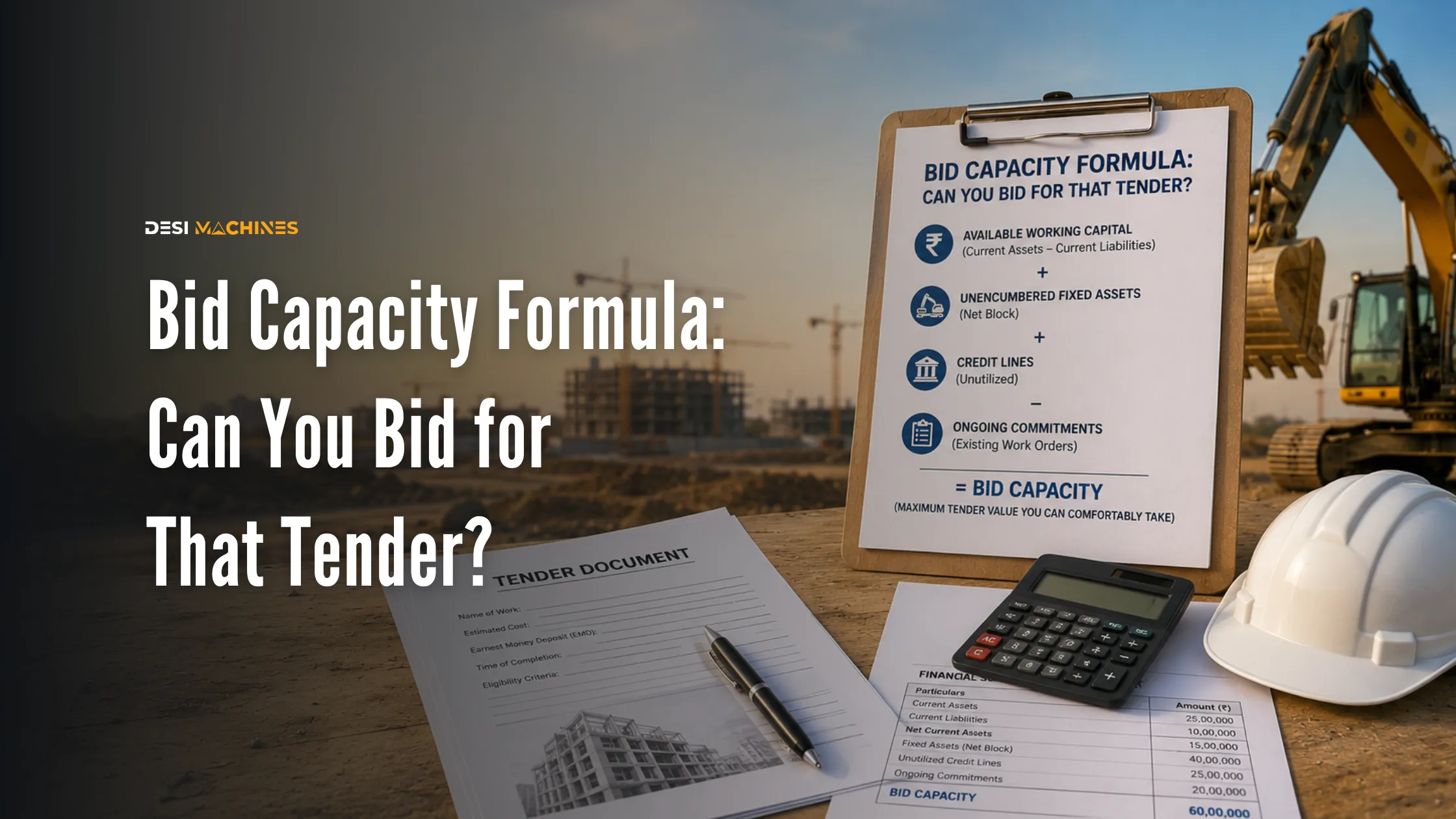
Write the extension application when the hindrance happens, keep the site record, and read the recovery clause before you sign. If you are bidding for work where these clauses bite, the guides to bidding for government construction tenders and bid capacity cover what to check before you commit, and current work is on the live tender opportunities page.
One question a deduction like this always raises: does tax ride on the amount cut from your bill? That turns on whether the damages are payment for a supply at all, and CBIC settled its own position in 2022; the reasoning and the cash-flow effect are set out in GST on liquidated damages.
Rates, schemes, specifications and prices change, so confirm current terms with the OEM, dealer, bank or insurer before deciding. Contract clauses differ between departments and between contracts; the worked example above is illustrative, the CPWD and Works Manual figures are as published in their 2023 and 2025 editions (checked in November 2026), and the terms that bind you are the ones in your own signed agreement.