Excavator
294 models
Excavator
294 models  Backhoe Loader
51 models
Backhoe Loader
51 models  Crane
68 models
Crane
68 models  Concrete Mixer
79 models
Concrete Mixer
79 models  Wheel Loader
54 models
Wheel Loader
54 models  Compactor / Roller
45 models
Compactor / Roller
45 models  Motor Grader
42 models
Motor Grader
42 models  Concrete Pump
66 models
Concrete Pump
66 models  Skid Steer Loader
11 models
Skid Steer Loader
11 models  Telehandler
13 models
Telehandler
13 models  Dozer
Dozer 


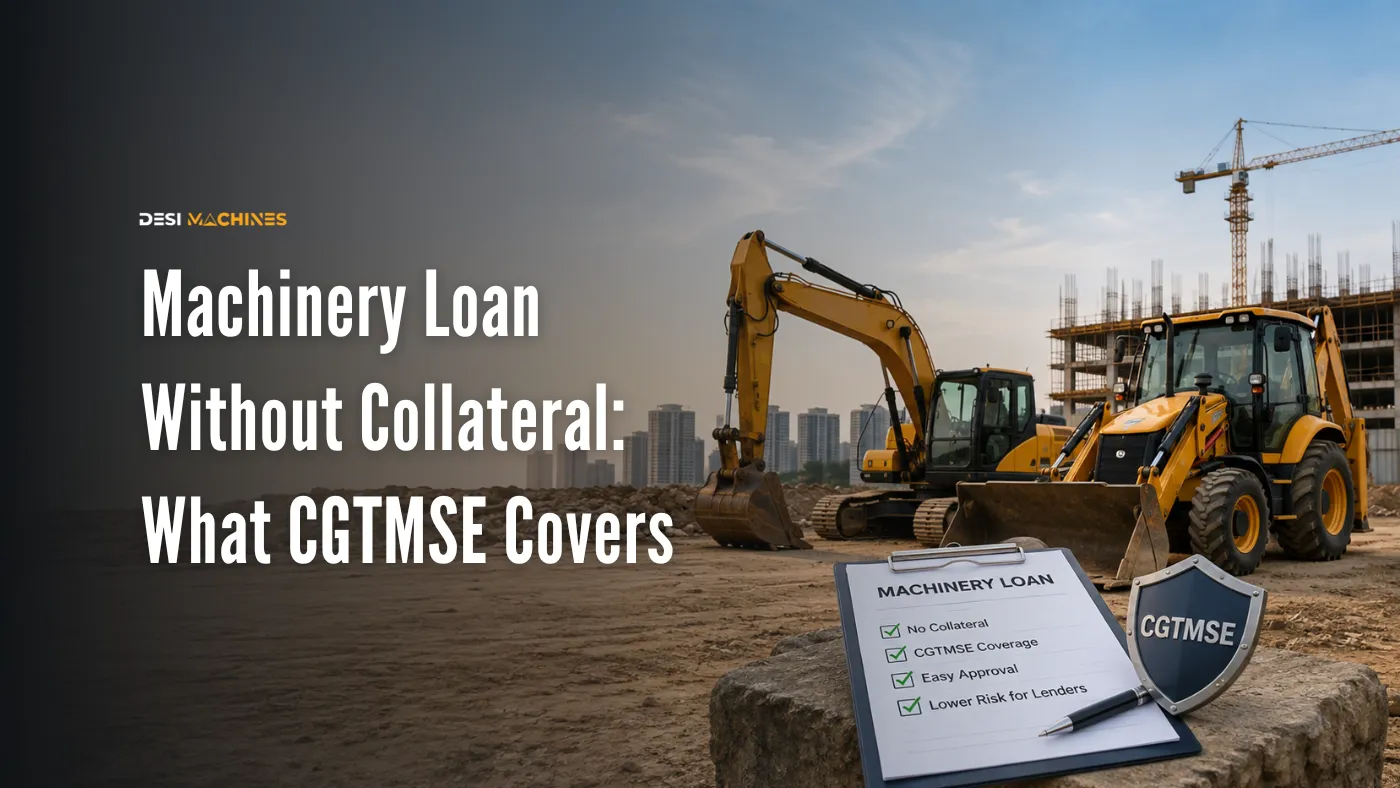
In short: A machinery loan without collateral is not an unsecured loan. The machine is still hypothecated to the lender as primary security — what you avoid is pledging a second asset like land or a fixed deposit. The scheme that makes this work for a micro or small enterprise is CGTMSE, which guarantees the lender 75% to 90% of the amount in default depending on your category, for an annual fee of around 0.55% on a facility in the Rs 10–50 lakh band. Note the direction of the protection: the guarantee covers the bank, not you.
What a machinery loan without collateral actually means
Owners hear “collateral-free” and picture a loan with nothing behind it. That is not the arrangement, and the misunderstanding causes real damage when a payment gets missed.
An equipment loan has primary security: the machine itself, hypothecated to the lender and endorsed on its registration. That charge is there from day one and it does not go away because the loan is called collateral-free.
What “collateral” means in this context is narrow and precisely defined. The CGTMSE scheme document puts it plainly: “Collateral security means the security provided in addition to the primary security, in connection with the credit facility extended by a lending institution to a borrower.”
In addition to. So the question a collateral-free machinery loan answers is not “is the loan secured” — it is “does the bank also want my land, my house or my wife’s fixed deposit”. Under this route, it does not.
That distinction matters when things go wrong. If you stop paying, the machine is still at risk. What is protected is everything else you own. The practical consequences of missing payments are set out in what a lender can and cannot do after a default.
The scheme that makes it possible: CGTMSE
The Credit Guarantee Fund Trust for Micro and Small Enterprises was set up by the Government of India and SIDBI. It does not lend. It stands behind the lender, so that a bank can fund a micro or small enterprise without a second asset and still have its downside covered.
Under the main scheme, an eligible borrower is a new or existing micro or small enterprise given a credit facility “without any collateral security and/or third party guarantees”. There is also a hybrid or partial collateral model, where the lender takes security for part of the facility and the Trust covers the unsecured remainder — useful if you have some security to offer but not enough for the full amount.
A guarantee from you personally does not disqualify the loan. The scheme excludes the proprietor, the partners in a partnership or LLP, the karta and coparceners of an HUF and the promoter directors of a company from its definition of a third party. Your own signature on a guarantee is treated as the borrower’s, not an outsider’s.
The ceiling depends on who is lending. The Trust covers facilities not exceeding Rs 10 crore from public sector, private sector and foreign banks and select financial institutions; Rs 200 lakh from small finance banks, regional rural banks, state financial institutions and urban co-operative banks; and Rs 50 lakh from microfinance institutions. A backhoe or a 20-tonne excavator sits comfortably inside the first limit.
This is a different mechanism from the subsidy and margin-money schemes. If you are starting out rather than adding a machine, read it alongside what PMEGP and Mudra actually offer a first-time buyer — Mudra runs to Rs 20 lakh, which is below the price of most new machines, and CGTMSE is what covers the gap above it.
How much cover, and what it costs
For guarantees approved on or after 1 April 2025, the extent of cover works out by category and facility size.
| Borrower category | Guarantee cover |
|---|---|
| Women entrepreneurs / MSE promoted by Agniveers | 90% |
| SC/ST entrepreneurs, persons with disability, MSEs in aspirational districts, ZED certified MSEs, transgender entrepreneurs | 85% |
| MSEs in the North East Region, J&K and Ladakh | 80% |
| Micro enterprises | 85% up to Rs 5 lakh, 75% above |
| All other categories of borrower | 75% |
The cover is not free. An annual guarantee fee applies, charged on the guaranteed amount for the first year and on the outstanding amount for the rest of the tenure, and it is inclusive of GST. The standard rates for guarantees approved or renewed on or after 1 April 2025:
| Size of credit facility | Standard annual fee |
|---|---|
| Up to Rs 10 lakh | 0.37% |
| Above Rs 10 lakh to Rs 50 lakh | 0.55% |
| Above Rs 50 lakh to Rs 1 crore | 0.60% |
| Above Rs 1 crore to Rs 2 crore | 0.85% |
| Above Rs 2 crore to Rs 5 crore | 1.00% |
Two adjustments sit on top of those numbers. A lender with a good portfolio can get a discount of up to 10% on the standard rate; a lender the Trust rates as higher risk can be charged a premium of as much as 70% above it. So the same borrower can face a different fee at two banks, which is a reason to ask more than one.
Put it against a real loan. On a Rs 40 lakh machine loan the standard fee is 0.55% a year, and lenders generally pass it on. Against the interest you are already paying, it is a small line — and it is the line that removes the demand for your land papers. Work it into the total cost the way you would any other charge, using the same arithmetic as a full equipment loan costing.
What it does not do for you
Read the direction of the guarantee carefully, because this is where owners get it wrong.
The guarantee is in favour of the lender. If your account goes bad, the bank lodges a claim with the Trust and recovers its guaranteed share. That settlement does not cancel your debt. The bank continues to pursue you for the money through the normal recovery process, the machine remains at risk, and your credit record carries the default exactly as it would otherwise.
It also does not replace credit assessment. A guarantee makes a lender comfortable with the security position; it does not make them comfortable with an application that has no cash-flow case behind it. The bank still wants to see the numbers, which is what a project report for a machinery loan is for, and it still applies the usual eligibility and document checks.
How to ask for it without getting a blank look
Branch staff do not always volunteer the scheme, partly because covering a loan is the lender’s choice and partly because the paperwork sits with them. Ask directly and ask in their language.
Have your Udyam registration ready — the cover is for micro and small enterprises, and that registration is how you prove you are one. Ask whether the branch is a member lending institution and whether they will place your facility under the credit guarantee scheme. If the answer is that they would rather take collateral, ask about the hybrid model, where they secure part and the Trust covers the rest.
If you already own a machine and are trying to raise money against it rather than buy a new one, that is a different product with a different security position — see raising a loan against machinery you already own before you compare offers.
The bottom line
A machinery loan without collateral keeps your land out of the transaction. It does not keep the machine out of it, and it does not protect you if the loan goes bad — the guarantee is the bank’s, bought at roughly half a percent a year on a mid-sized facility and passed on to you. That is a fair price for not signing away property, provided you go in knowing exactly what has been guaranteed and to whom.
If the numbers work, compare current backhoe loader models and prices and excavator models, and look at equipment finance options before you walk into a branch.
Source: CGTMSE scheme document for the Credit Guarantee Fund Scheme for Micro and Small Enterprises, coverage and fee rates as applicable to guarantees approved on or after 1 April 2025. Scheme terms, fee slabs and eligibility change from time to time and a lender’s participation is its own decision. Confirm the current terms with your bank and with the Trust before you rely on them.