Excavator
294 models
Excavator
294 models  Backhoe Loader
51 models
Backhoe Loader
51 models  Crane
68 models
Crane
68 models  Concrete Mixer
79 models
Concrete Mixer
79 models  Wheel Loader
54 models
Wheel Loader
54 models  Compactor / Roller
45 models
Compactor / Roller
45 models  Motor Grader
42 models
Motor Grader
42 models  Concrete Pump
66 models
Concrete Pump
66 models  Skid Steer Loader
11 models
Skid Steer Loader
11 models  Telehandler
13 models
Telehandler
13 models 


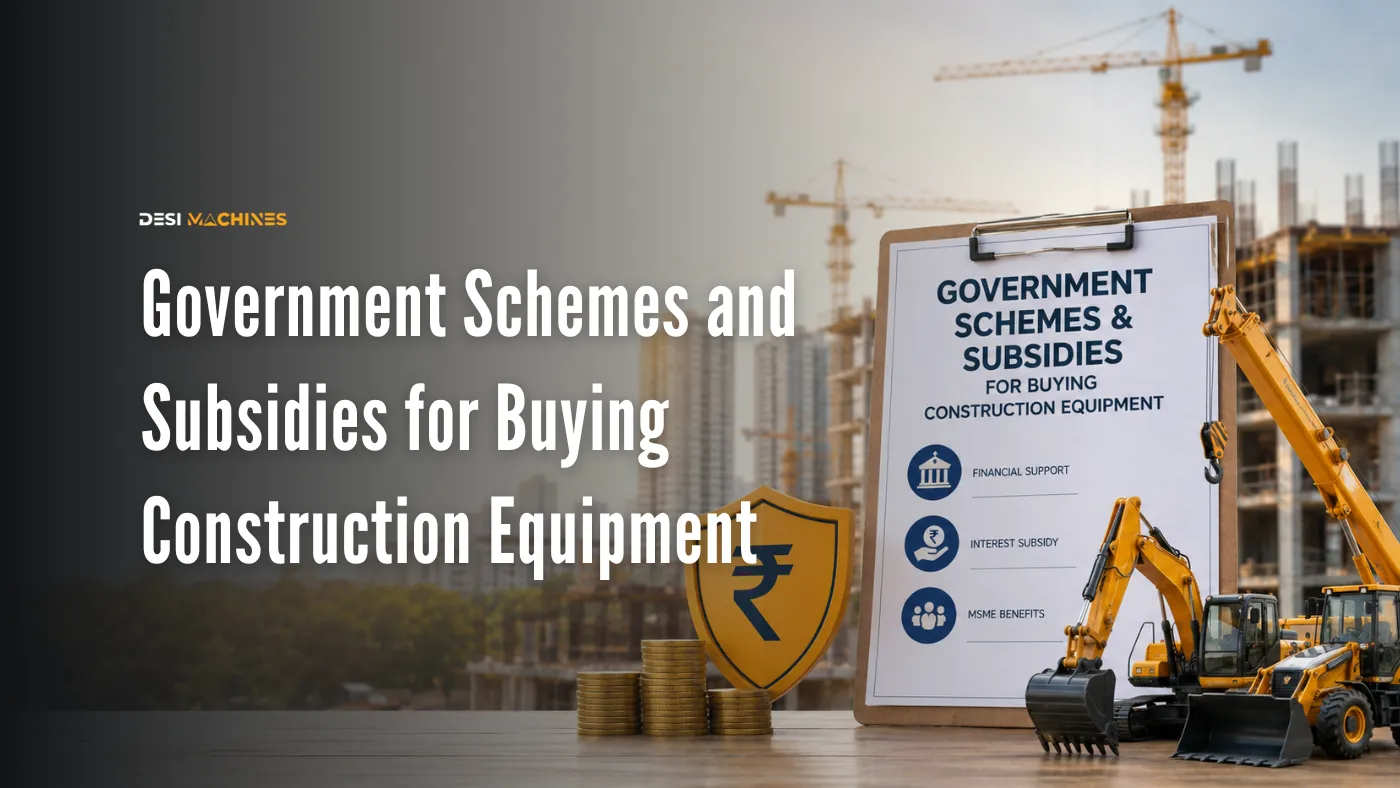
In short: There is no direct subsidy on construction equipment in India — no scheme cuts a cheque for 20% of a backhoe’s price. What exists is micro-enterprise support: PMEGP pays a margin money subsidy of 15% to 35% of an approved project cost (ceiling Rs 50 lakh for manufacturing, Rs 20 lakh for a service unit, which is what machine hire is), and Mudra lends up to Rs 20 lakh with a government-backed guarantee instead of collateral. Both sit below the price of a new backhoe loader, so for most buyers these schemes fund the first small machine or the margin, and a regular equipment loan funds the machine.
Why there is no direct subsidy on construction equipment
Ask ten first-time buyers how they plan to pay for their machine and at least three will mention a government scheme. The question is usually some version of: how much subsidy will I get on a JCB?
The honest answer is none, directly. The central schemes are built to start enterprises, not to discount assets. Nobody at the bank is looking at your machine’s price and applying a percentage to it. They are looking at a project — a unit that will run, employ people and generate income — and the machine is one line inside that project.
That distinction changes how you should apply. A file that reads “I want to buy an excavator” gets nowhere. A file that reads “I am setting up an earthmoving hire unit in this block, here is the work available, here is the machine it needs, here are the two people it employs” is the one that moves.
PMEGP: the margin money subsidy, and the ceiling that catches everyone
The Prime Minister’s Employment Generation Programme, run by the Ministry of MSME through KVIC, is the scheme people mean when they say subsidy. It gives what the guidelines call margin money — a one-time grant that sits in your loan account and is written off against the loan after the lock-in.
| Your category | Rural area | Urban area | Your own contribution |
|---|---|---|---|
| General | 25% | 15% | 10% |
| Special category (SC/ST/OBC, minorities, women, ex-servicemen, PH, NER, hill and border areas, aspirational districts) | 35% | 25% | 5% |
Now the number that decides whether any of this is useful to you. PMEGP caps the project cost at Rs 50 lakh for a manufacturing unit and Rs 20 lakh for a service unit. Renting out a machine, doing earthwork on contract, running a hire business — that is a service unit. Rs 20 lakh.
A new backhoe loader in India runs well past that, and a 20-tonne excavator is in another bracket entirely. So the arithmetic most buyers do in their head — 35% of a Rs 30 lakh machine, so Rs 10 lakh free — does not survive contact with the ceiling. On a Rs 20 lakh service project in a rural block, a general-category applicant is looking at margin money of about Rs 5 lakh (indicative), and the project has to be genuinely new.
Where PMEGP does work for machine owners:
- A smaller or used machine — a mini excavator, a compactor, a used backhoe — where the whole project fits under Rs 20 lakh.
- A manufacturing or fabrication unit that happens to need material handling, where the Rs 50 lakh ceiling applies.
- Funding the rest of the setup — yard, shed, tools, working capital — while the machine goes on a separate equipment loan.
One more thing the guidelines are specific about: transport activities such as buying a cab or van for carrying passengers are allowed, but only within a 10% ceiling on the share of projects financed under transport activities in a given area. Whether an earthmoving hire unit is treated favourably in your district is a decision the implementing agency and the bank make, not something you can read off a rate card. Ask your District Industries Centre or KVIC office before you build a plan around it. The scheme’s own eligibility criteria are published by the Ministry of MSME.
Mudra: Rs 20 lakh, no collateral, and a category ladder
Pradhan Mantri Mudra Yojana is not a subsidy at all — it is a loan, and people conflate the two constantly. What it gives you is access without security, which for a first-time owner with no property to pledge is often worth more than a grant.
| Category | Loan size | Who it suits |
|---|---|---|
| Shishu | Up to Rs 50,000 | Tools, small attachments, working capital |
| Kishore | Rs 50,000 to Rs 5 lakh | Repairs, a used compactor, margin money top-up |
| Tarun | Rs 5 lakh to Rs 10 lakh | A small used machine or a serious margin contribution |
| Tarun Plus | Rs 10 lakh to Rs 20 lakh | Only for borrowers who repaid an earlier Tarun loan |
The ceiling went from Rs 10 lakh to Rs 20 lakh with effect from 24 October 2024, and the new Tarun Plus slab is deliberately gated: you qualify for it by having taken a Tarun loan and paid it back. That is the scheme rewarding a track record, and it is the cheapest track record you will ever build. A first-time owner who takes Rs 6 lakh under Tarun for a used machine and repays it cleanly has done two things — bought an earning asset, and opened a Rs 20 lakh door. Loans up to Rs 20 lakh are guaranteed under the Credit Guarantee Fund for Micro Units, which is why the bank does not ask for separate security. The scheme categories are listed by MUDRA.
So how does a real first machine actually get funded?
For most owners buying a backhoe or an excavator, the structure ends up looking like this:
- The machine goes on a standard construction equipment loan, hypothecated to the lender, typically 75-85% of the invoice.
- The margin money — your 15-25% — is where a Mudra loan, a PMEGP-backed project or your own savings does the work. This is the number that actually blocks people, and it is worth reading how much down payment you need for construction equipment before you plan around a scheme.
- The working capital for the first three months of diesel, salary and site expenses is the part everyone forgets, and it is exactly what Kishore-sized borrowing is good for.
If you are still sizing the whole thing, our breakdown of how much capital you really need for your first machine puts the numbers in one place.
What decides whether your application clears
Schemes get refused for boring reasons far more often than for policy ones.
- The unit has to be new. PMEGP does not fund an existing business buying a second machine. If you already own a machine, you are on the ordinary finance track — see how owners fund machine number two.
- Your credit record still matters. A guarantee fund protects the lender, not you. A weak score gets the file rejected before the scheme is even considered — our guide to the CIBIL score you need for a machinery loan covers the fixable parts.
- Documents. Scheme files need the same KYC, business proof and projections as any other loan, plus the scheme forms. The eligibility and documents checklist is the same starting point.
- Where you apply. Scheme applications route through the bank branch that has to sanction the loan. A branch that has never financed an earthmover will be slower than an NBFC that finances them daily — the trade-offs are in our comparison of bank versus NBFC equipment finance.
State schemes: real, but you have to go and look
Several states run capital investment subsidies, interest subvention or stamp duty relief for MSME units through their industries departments, and some are more generous than anything central. They also change with each state budget, vary by district, and often exclude the sectors you would expect to be included.
There is no reliable single list of them that stays current, and copying one off a blog is how people end up planning around a benefit that lapsed two years ago. The only sound method is to walk into your District Industries Centre with your project note and ask what is live this year for your district and your activity. It is one afternoon, and it is the only version of the answer that is worth anything.
Above the Mudra ceiling the mechanism changes rather than disappearing. A bank can still fund a machine without asking for your land, backed by a government guarantee instead — the cover, the fee and the limits are set out in what a machinery loan without collateral actually involves.
The bottom line
Treat schemes as a way to lower your entry cost, not as a way to buy the machine. PMEGP can put Rs 4-5 lakh (indicative) of margin money behind a genuinely new small unit; Mudra can put up to Rs 20 lakh in your hands without collateral and, more usefully, build the record that makes the next loan easy. Neither will buy you a Rs 30 lakh backhoe on its own, and any agent who says otherwise is selling you a file-processing fee.
The machine itself is a finance decision. Work out the EMI you can actually carry, then see which scheme fits around it — start with our equipment finance options and lender comparison, and bring the scheme paperwork to the same branch.
Scheme rules, subsidy rates, ceilings and eligibility change with government notifications and vary by state and district. The figures here are indicative and were checked against the Ministry of MSME and MUDRA published guidelines. Confirm current terms with your bank, your District Industries Centre or the KVIC office before you apply or commit money.