Excavator
294 models
Excavator
294 models  Backhoe Loader
51 models
Backhoe Loader
51 models  Crane
68 models
Crane
68 models  Concrete Mixer
79 models
Concrete Mixer
79 models  Wheel Loader
54 models
Wheel Loader
54 models  Compactor / Roller
45 models
Compactor / Roller
45 models  Motor Grader
42 models
Motor Grader
42 models  Concrete Pump
66 models
Concrete Pump
66 models  Skid Steer Loader
11 models
Skid Steer Loader
11 models  Telehandler
13 models
Telehandler
13 models  Dozer
Dozer 


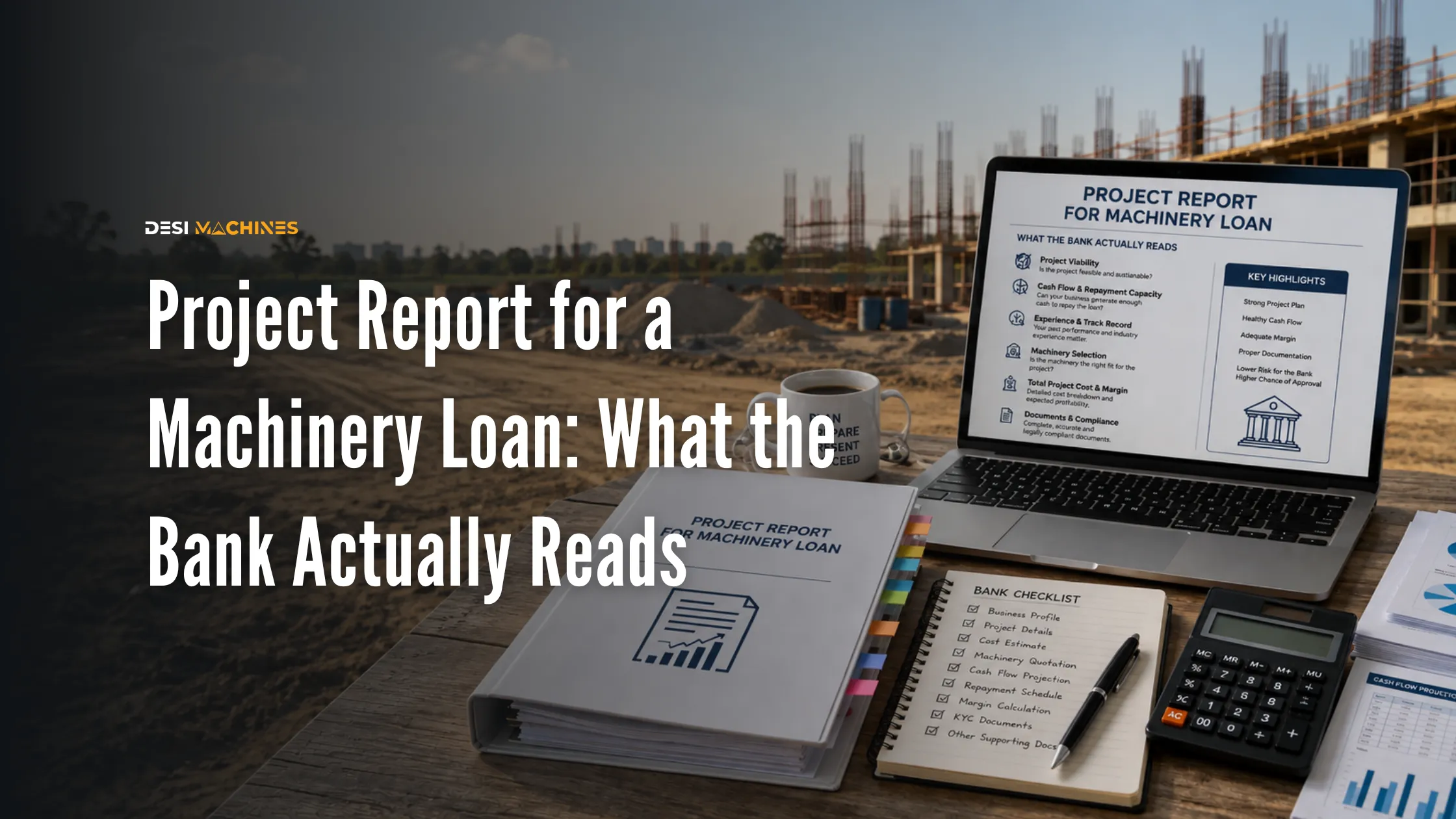
In short: A project report for machinery loan approval has one job — to show the bank that the machine’s own earnings will repay the loan. It sets out the cost of the project, the means of finance, and a month-by-month income projection that produces a debt service coverage the lender is comfortable with, commonly around 1.25 times. Most first-time files are not rejected on the machine. They are rejected because the income projection is optimistic and the coverage arithmetic is thin.
Ask for a machinery loan and somewhere in the document list sits the line “project report”. Many first-time buyers treat it as paperwork — a few pages about the machine, the business and a hopeful sentence about growth. The credit officer reads it differently. To that reader it is one question with a number attached: does this file pay for itself?
Getting that number right before you submit is the difference between an approval in three weeks and a file that goes quiet.
What a project report for machinery loan approval has to prove
Strip away the formatting and the report makes four claims, in this order.
That you know what the whole thing costs, not just the machine. That you are putting real money in. That the machine will earn a believable amount. And that what it earns, after running costs, comfortably covers the year’s EMI. Everything else in the document supports one of those four claims, and anything that supports none of them is padding.
The parts of the report, and what each one is for
| Section | What the bank is testing |
|---|---|
| Promoter profile and experience | Whether you have run this kind of work before, or are learning on borrowed money |
| The machine and the dealer quotation | That the asset exists, the price is real, and the model suits the stated work |
| Cost of project | Whether you have budgeted the extras or will come back short in month three |
| Means of finance | How much skin you have in it, and where your contribution comes from |
| Income projection | Whether the earnings assumption is defensible for your district and machine class |
| Repayment schedule and coverage | The ratio — whether the surplus services the loan with room to spare |
| Security offered | The machine itself under hypothecation, plus anything else on the table |
Keep it short. A tight eight pages that reconcile beat forty pages that do not.
Cost of project: the part people under-state
The machine price is the start of the number, not the number. Registration, insurance for the first year, the first set of consumables, transport to your site and the working-capital buffer all belong in the cost of project, because they are all real cash you will spend before the machine earns anything. Leaving them out does not make the file look leaner — it makes the promoter look inexperienced, and it is the same gap that catches first-time buyers in practice, which we set out in detail in our piece on the capital needed to buy your first machine.
Take a backhoe loader in the JCB 3DX class, an indicative ₹30–32 lakh on our own listings as of Aug 2026, and build the project around the quotation you actually hold.
| Cost of project (indicative) | Amount |
|---|---|
| Machine, as per dealer quotation | ₹32.00 lakh |
| Registration, first-year insurance, consumables | ₹1.20 lakh |
| Working-capital margin | ₹1.80 lakh |
| Total cost of project | ₹35.00 lakh |
| Means of finance (indicative) | Amount |
|---|---|
| Promoter contribution | ₹9.00 lakh |
| Term loan sought | ₹26.00 lakh |
| Total | ₹35.00 lakh |
The two tables must add to the same figure. It sounds obvious. Files arrive every week where they do not, and a mismatch on page two costs you the reader’s confidence for the rest of the document. How much you are expected to bring varies by lender and by whether the machine is new or used — the working ranges are in our guide to down payment on construction equipment.
The ratio the bank checks first
Debt service coverage is the projection reduced to a single number: the cash the machine throws off in a year, divided by what you owe the bank that year in interest and principal. Below 1.0 the machine cannot pay for itself. At 1.0 it exactly can, with nothing left for a bad month. Lenders generally want visible headroom, and a coverage near 1.25 times is a common working benchmark.
Run it on the same backhoe, on dry hire at the bottom of the band — ₹90,000 a month against a published Jul 2026 range of ₹90,000–1,40,000 in the equipment rental rate card — and on eleven billed months rather than twelve.
| Year one projection (indicative) | Amount |
|---|---|
| Dry-hire income, 11 billed months at ₹90,000 | ₹9.90 lakh |
| Less routine maintenance and wear parts | − ₹1.00 lakh |
| Less insurance premium | − ₹0.55 lakh |
| Less permits, parking, admin | − ₹0.45 lakh |
| Cash available for debt service | ₹7.90 lakh |
| Annual EMI on ₹26 lakh at 12% over 5 years | ₹6.94 lakh |
| Debt service coverage | 1.14 times |
All figures indicative, as of Aug 2026. That file is not comfortable. It works on paper and fails on a wet fortnight.
Now watch what a single assumption does. Bill twelve months instead of eleven and the coverage moves to about 1.27 — the same machine, the same loan, one more billed month. That is the whole business in one line, and it is why utilisation, rather than the hire rate, decides both your profit and your loan. The same arithmetic from the owner’s side is worked through in our piece on what one backhoe actually earns.
When the coverage comes out thin, there are three honest fixes and one dishonest one. Raise your own contribution, ask for a longer tenure, or shop the rate — the spread between lenders is real and set out in our comparison of bank and NBFC equipment loan rates. The dishonest fix is to raise the income projection until the ratio clears. Credit officers see hundreds of these files and know what a machine of that class earns in your district.
Where first-time files fall down
Top-of-band income, twelve months a year. The single most common tell. Nobody bills twelve full months on a first machine, and a report that assumes it invites the reader to distrust every other number.
Projections that contradict the returns. If the report shows income your filed returns and bank statements do not support, the file stalls at verification. Keep the story consistent across all three.
No buffer. A report with zero working capital says the first delayed payment becomes a missed EMI — and on government and EPC work, delayed payment is the norm rather than the exception, as we cover in the running bill cycle.
A machine that does not match the work. Asking to fund a 30-tonne excavator on the strength of small municipal contracts reads as a mismatch. State the work, then justify the machine class against it.
What to attach with it
The report travels with the file, not instead of it. Expect to attach identity and address proof for the applicant and any co-applicant, business registration, bank statements for the last six to twelve months, income tax returns where you have them, and the dealer’s quotation for the exact model and variant. The full checklist and who qualifies sit in our guide to construction equipment loan eligibility. If you are funding a used machine, the valuation carries far more weight and the tenure is tied to remaining life — that path is covered in used construction equipment loans.
The bottom line
A project report for a machinery loan is an argument made in numbers. Cost the whole project honestly, put in a contribution that makes the coverage work, project income you can defend in your own district, and show the ratio yourself rather than making the officer derive it. A file that does that reads as a business plan. A file that does not reads as a hope.
Build the report around a real quotation for a real machine — compare live backhoe loader models and prices and excavators, then check what the borrowing would cost through equipment finance before you fix the numbers on paper.
Interest rates, margin requirements, coverage benchmarks, prices and lending terms are indicative, vary by lender, applicant profile, location and date, and should always be confirmed with the bank, NBFC, dealer or your chartered accountant before any borrowing decision. DesiMachines is not liable for decisions taken on the basis of information that may have changed after publication.