
 Excavator
294 models
Excavator
294 models  Backhoe Loader
51 models
Backhoe Loader
51 models  Crane
68 models
Crane
68 models  Concrete Mixer
79 models
Concrete Mixer
79 models  Wheel Loader
54 models
Wheel Loader
54 models  Compactor / Roller
45 models
Compactor / Roller
45 models  Motor Grader
42 models
Motor Grader
42 models  Concrete Pump
66 models
Concrete Pump
66 models  Skid Steer Loader
11 models
Skid Steer Loader
11 models  Telehandler
13 models
Telehandler
13 models  Dozer
Dozer 


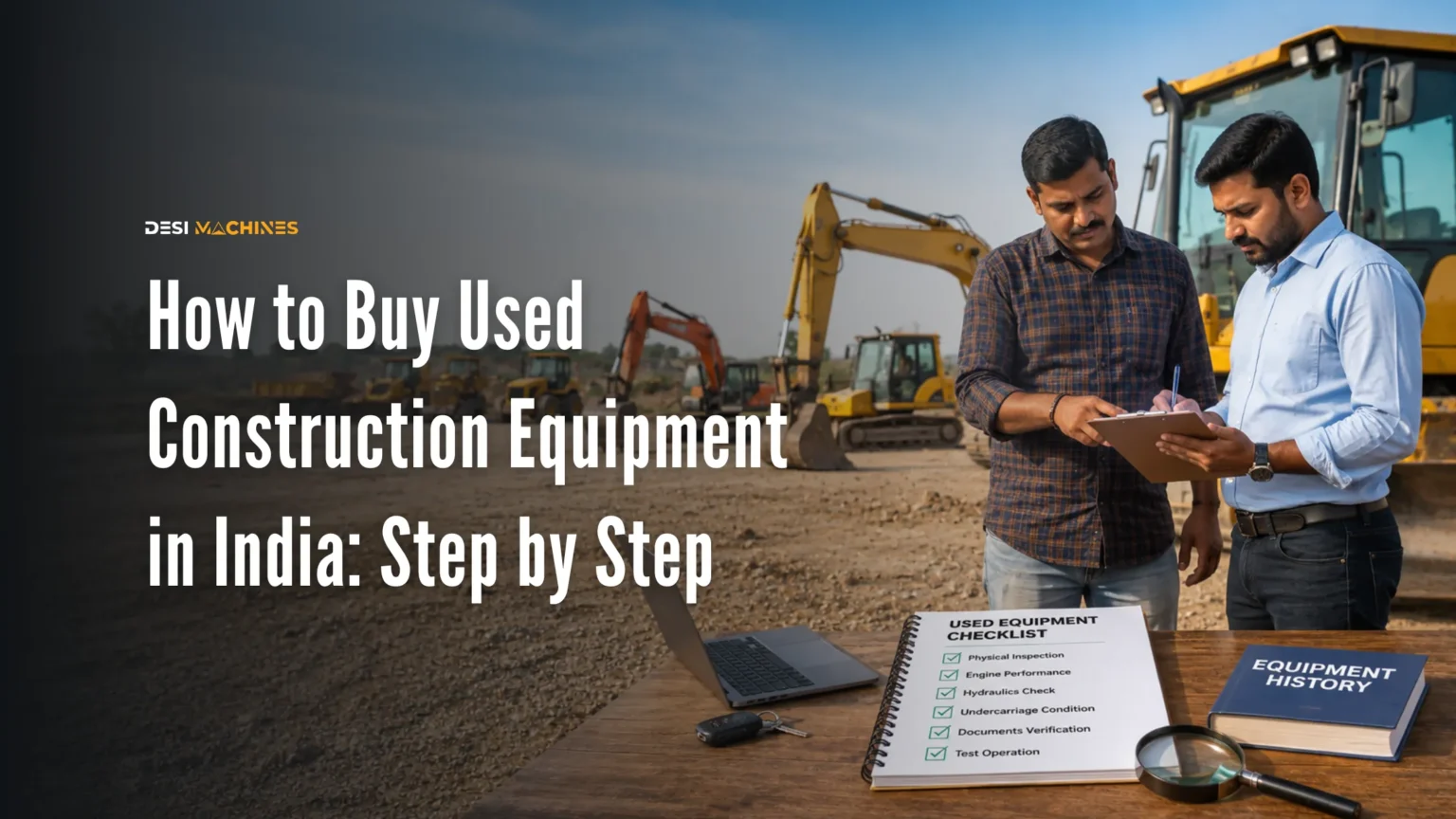
Buying used construction equipment means taking over a machine that has already worked on somebody else’s site — you check it, you pay for it, and you get the papers moved into your name. In India the job runs in roughly seven steps: fix the machine and the budget, find a genuine seller, ask the right questions before you travel, inspect and run the machine, settle a price, pay through the bank and collect the papers, and then service it in the first week.
Most first-time buyers get the middle steps right and the two ends wrong. They inspect the engine carefully but never confirm who legally owns the machine, or they pay a large advance in cash to a man they met once. This guide walks the whole sequence in order, so you know what happens at each step, what money moves when, and where a purani machine deal usually goes bad.
What is the first step in buying a used machine?
The first step is deciding what the machine has to do, before you look at a single listing. Write down the work you already have in hand — not the work you hope to get. A contractor digging water-supply lines in a district town needs a different machine from one loading trucks at a quarry, and the two mistakes cost the same money.
Three things to settle on paper first:
- The class of machine. A backhoe loader digs and loads and drives itself on the road, which suits scattered small jobs. A tracked excavator digs faster and lifts more but has to be carried on a trailer. A pick-and-carry crane lifts and shifts, it does not dig.
- The size. Machines are sold by operating weight — a 2 Ton (2,000 kg) mini excavator fits inside a compound wall, a 20 Ton (20,000 kg) machine does not. Buying one size too big is the most common and most expensive error, because fuel, tyres or tracks, and transport all scale up with weight.
- The total budget, not the machine price. Keep 10–15% of the machine price aside for what comes immediately after: a full service, fresh oils and filters, tyres or worn undercarriage parts, transport to your site, and insurance. A used machine almost never arrives ready.
If the work is only for a few months, buying may be the wrong answer altogether. Renting has its own process, covered in our guide to renting construction equipment in India, and it costs nothing to compare the two before committing.
Where do you find a genuine seller?
Used machines in India come from four kinds of sellers, and the risk is different in each. Knowing which one you are dealing with tells you how hard to check.
- The owner himself. Usually a contractor upgrading or closing a project. Best case: you can see the machine on his site, meet the operator who ran it, and hear the real service history. Ask to see it working, not parked.
- A used-equipment dealer or yard. Faster, more choice, sometimes a short warranty on the engine or hydraulics. You pay a margin for that, and the machine’s history is second-hand information.
- A financier taking back a machine. When an owner defaults, the lender repossesses and resells. Prices can be lower, but the machine has often stood idle for months and the paperwork needs care. Our guide to bank auction construction equipment covers what to check before you bid.
- Online listing platforms. Useful for seeing what a size class is selling for across states. Treat every listing as an advertisement, never as a valuation, and never send money to a listing.
Two rules hold for all four. Never buy a machine you have not stood next to, and be careful with a seller who cannot explain why he is selling. A straight answer — finished a project, moving up a size, buyer’s own health — is normal. A vague answer usually hides either a costly repair or a loan still running on the machine.
What should you ask the seller before you travel?
Ask on the phone, before spending a day and a tank of diesel going to see it. Five questions filter out most bad machines:
- How many hours has it run? The hour meter is the machine’s odometer. Get the number now so you can check it against the meter when you arrive.
- How many owners has it had? One careful owner beats three unknown ones. Multiple quick resales in a few years is a warning.
- Is the RC in your name, and is any loan still running on it? This one question saves the most deals. A machine with an unpaid loan cannot be transferred until the lender releases it.
- Where was it worked? Coastal salt air, quarry rock and canal-side mud each leave different damage. Rock work punishes the undercarriage and boom; sand and silt punish the hydraulics.
- What has been repaired or replaced? A rebuilt engine or a new pump is not automatically bad news, but it must be disclosed and it must show in the bills.
Ask for photographs of the hour meter, the chassis number plate and the RC book while you are still on the call. A seller who will not send those has already told you something.
How do you inspect a used machine before paying?
Inspect cold, then inspect running — in that order, because a warm engine hides starting trouble and a running machine hides leaks. Reach the site early and ask that the machine not be started before you get there.
The cold checks are visual: puddles or wet patches under the machine, oil weeping down cylinder rods, cracks or fresh welding around the boom and the loader arm, and the state of the tracks or tyres. Pull the engine oil dipstick and the hydraulic oil level. Milky oil means water has got in; metal glitter means something inside is wearing away.
The running checks come next. Watch the exhaust on start-up, listen for knocking, and then work every function — boom, arm, bucket, swing, travel, and on a backhoe the loader and the stabilisers. Each movement should be smooth and should hold its position when you stop. A boom that sinks slowly on its own points at worn cylinder seals or a tired control valve.
The full list of checks, system by system, with what a failure on each one actually looks like, is set out in our used equipment inspection checklist.
Take the machine’s own trade with you if you can: an experienced operator or mechanic who has run that class of machine will hear a problem you will only see six months later. Paying a mechanic for half a day is the cheapest insurance in this whole process.
Each machine class has its own weak points, and the model-specific checks are set out in our used buying guides for used excavators, used backhoe loaders, used wheel loaders and used hydra cranes.
How do you judge whether the price is fair?
Start from what the same machine costs new today, then work downwards. A used price only makes sense against that number, and it is the one figure a seller will never volunteer. Three machines that Indian first-time buyers ask about most often, at their current new prices:
| Machine | Usually bought for | New price today (indicative) |
|---|---|---|
| JCB 3DX backhoe loader | Water lines, plot levelling, small contracts, road-legal on its own wheels | ₹30–32 Lakh |
| JCB 30 PLUS mini excavator | Narrow lanes, compound walls, drainage and utility trenches | ₹26–28 Lakh |
| ACE 14XW pick-and-carry crane | Lifting and shifting loads inside factories and project yards | ₹18–20 Lakh |
Prices as listed on DesiMachines, indicative and current as of August 2026.
Against that anchor, four things move a used price: hours run, age, condition of the expensive wear parts, and how badly the seller needs to sell. Hours matter more than years — a six-year-old machine that has run 4,000 hours is usually a better buy than a three-year-old that has run 9,000. On tracked machines, the undercarriage alone can be a large repair, so a machine with worn tracks is not a bargain, it is a bill you have not been shown yet.
Brand matters at resale too, which is why it should matter to you now: the brands that hold their value best are the ones you will get your money back from. Our analysis of resale value across used excavator brands goes through where the differences actually show up.
Negotiate on findings, not on feeling. “The tracks need replacing and the boom cylinder is weeping” is a reason for a lower number. “It seems expensive” is not, and a serious seller will not move for it.
Not sure what the machine should cost before you start bargaining? Check the current price of the models people buy most and speak to a dealer — ten minutes there saves a lot of guessing at the seller’s yard.
Which papers must come with the machine?
The papers decide whether you own the machine or merely possess it. Verify every one of these before any large payment leaves your account:
- The RC (registration certificate) for any machine that runs on the road on its own wheels — backhoe loaders, wheeled cranes, wheel loaders, transit mixers. Tracked excavators are not road-registered, so for those the invoice chain matters more.
- The original purchase invoice and, on a resold machine, the earlier transfer papers. The chain should reach back to the first owner without a gap.
- A no-objection certificate from the lender if the machine was ever financed, plus proof the hypothecation has been removed. This is where used deals most often stall.
- Insurance papers, and the policy’s expiry date. Cover has to be transferred to your name, it does not follow the machine automatically.
- Chassis and engine numbers physically matched against the numbers printed in the papers. Check the plate on the machine yourself, in daylight.
- Service records where they exist — job cards, dealer bills, filter and oil change history.
The transfer itself has a procedure, and it is worth understanding before you hand over money rather than after. The full sequence for RC transfer and getting a lender’s hypothecation removed is set out in our owner’s paperwork guide. State transport department offices handle the registration side, and the national Parivahan portal is where a vehicle’s registration details can be checked online. A registered road vehicle carries a longer file again, including a fitness certificate and permit; the used transit mixer buying guide lists what a truck-mounted machine must come with.
How do you pay safely and get the machine into your name?
Pay in stages, and pay through the bank. A used machine deal in India normally moves like this:
- A token advance — the bayana — once you have agreed a price, against a written receipt that names the machine, its chassis number, the agreed price and the date. Keep this small.
- The main payment only after the papers check out clean and any loan on the machine has been cleared. Bank transfer, cheque or demand draft — never a large cash payment, because cash leaves you with no proof of what you paid to whom.
- A signed sale agreement listing both parties, the machine details, the price, what is included, and the date of handover. A one-page agreement is enough; no agreement is not.
- Transfer of the RC and the insurance into your name. Until this is done the previous owner is still the machine’s registered owner, and any liability that arises is still pointing at him — and at you, informally.
- Delivery, on a trailer for tracked machines. Agree in writing who pays for the transport and who carries the risk while the machine is on the road.
If a bank or NBFC is funding part of the purchase, start that conversation before you fix the price, not after. Lenders fund used machines at a lower share of the value than new ones and want the papers in order first. The documents and eligibility side is covered in our guide to construction equipment loan eligibility, and the lender options sit on our equipment finance pages.
What should you do in the first week after buying?
Treat the first week as part of the purchase, not as running cost. Four jobs, in this order:
- A full service. Change engine oil, hydraulic oil where the condition warrants it, and every filter — you do not know what was last put in. Match the intervals in a proper construction equipment service schedule from here on.
- Fix the small things now. Weeping seals, a cracked hose, a loose track. Small leaks turn into pump failures, and the repair cost multiplies.
- Get insurance in your own name from day one. Cover for the machine, and third-party protection for the work it does. The equipment insurance options are worth comparing before the old policy lapses.
- Start an hour log. Note hours run, diesel used and every repair from the first day you own it. This is the record that gets you a fair price when you sell, and it is the thing almost no seller could show you.
Buying a used machine in short
Decide the work and the size before you look. Find out who is really selling and why. Ask about hours, owners and any running loan on the phone. Inspect cold, then running, with a mechanic beside you. Price it down from what the machine costs new, using what you found. Verify the papers, pay through the bank in stages, and transfer the RC and insurance into your name. Then service it properly in week one.
None of this needs expert knowledge. It needs the steps in the right order, and the patience to walk away from a machine that fails one of them — there is always another machine.
The wider decision of whether used is right for you at all, how used pricing is built and how used-machine finance differs is covered in our pillar guide to used construction equipment in India. When you are ready to see what a comparable new machine costs, browse excavators and backhoe loaders and speak to a dealer directly.
Prices, specifications and features are indicative, vary by variant, location and date, and should always be confirmed with the official OEM or authorised dealer before any purchase decision. DesiMachines is not liable for decisions taken on the basis of information that may have changed after publication.