
 Excavator
294 models
Excavator
294 models  Backhoe Loader
51 models
Backhoe Loader
51 models  Crane
68 models
Crane
68 models  Concrete Mixer
79 models
Concrete Mixer
79 models  Wheel Loader
54 models
Wheel Loader
54 models  Compactor / Roller
45 models
Compactor / Roller
45 models  Motor Grader
42 models
Motor Grader
42 models  Concrete Pump
66 models
Concrete Pump
66 models  Skid Steer Loader
11 models
Skid Steer Loader
11 models  Telehandler
13 models
Telehandler
13 models 


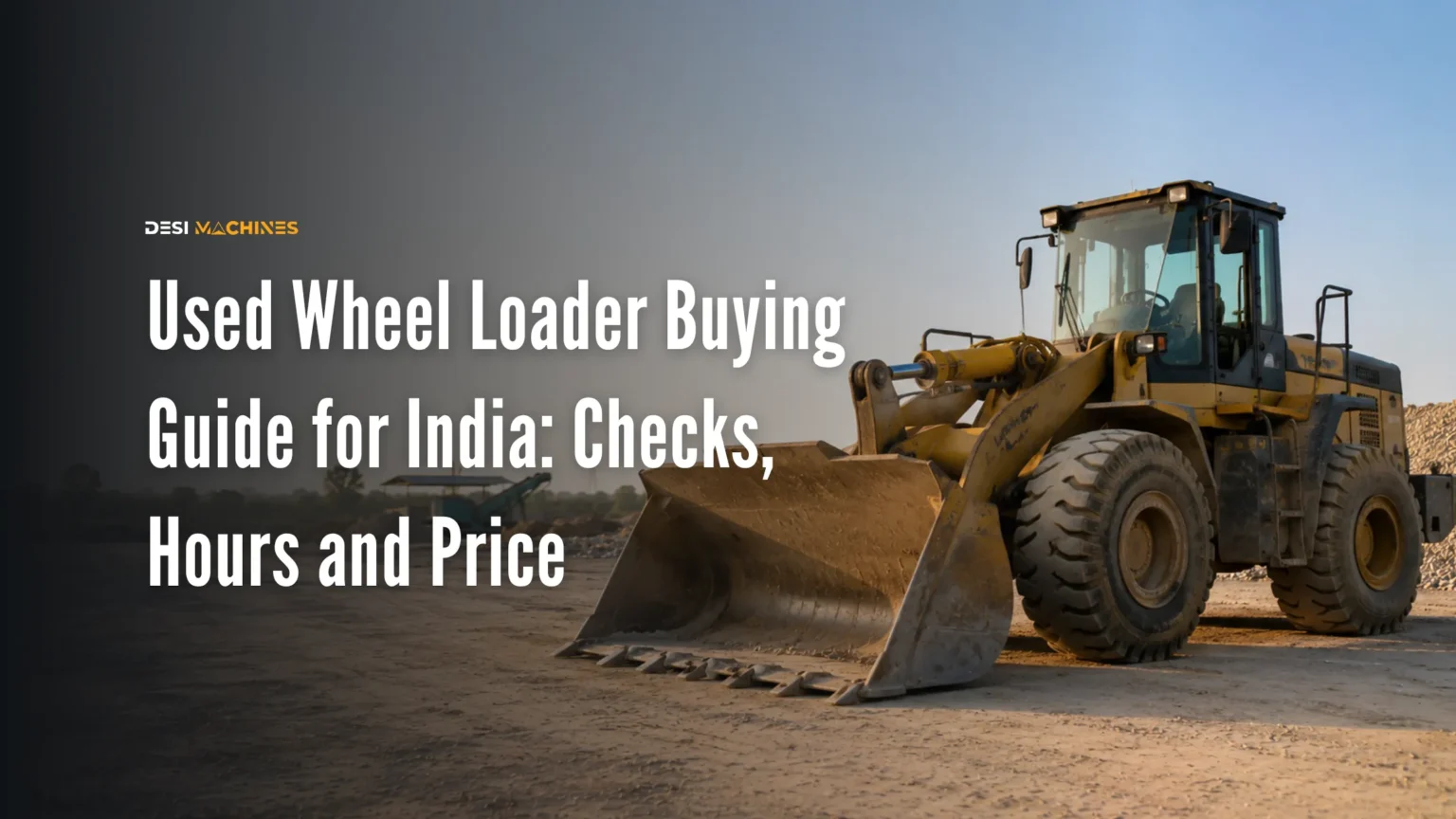
The risk is different from a used excavator. A wheel loader spends its life shuttling under load, so the wear sits in the transmission, the articulation joint and the tyres, and none of those three announce themselves on a ten-minute test drive. This guide covers what to check, what the hours really mean, what the machines cost new, and what papers must come with the machine.
What should you check on a used wheel loader?
Nine things, in roughly the order that a bad one will cost you money.
The articulation joint. A wheel loader bends in the middle to steer, and that centre pin carries the whole front end plus the load. Park the machine straight, get someone to turn the wheel slowly lock to lock, and watch the joint. Visible play, a knock, or grease weeping from a cracked seal means pins and bushings, and on a big machine that is a workshop job.
The transmission and torque converter. This is the most expensive thing on the machine after the engine. Warm it up, then run through the gears forward and reverse. Shifts should be firm without a bang and without a long slur. Then do a stall check with the seller’s permission: bucket into a pile, foot on the brake, throttle up, and watch whether the engine bogs correctly instead of the converter simply slipping. A converter that slips under load is telling you it is finished.
The tyres. On a payloader these are a running cost rather than a detail, and a machine sold on worn tyres has that cost sitting in it. Look at tread depth on all four, and look harder at the sidewalls for cuts and bulges from working against a rock face.
Hydraulic drift. Raise the bucket to full height, curl it, switch the engine off and leave it for ten minutes. The arms should stay where you put them. Any sag means cylinder seals or a tired control valve.
Lift arm pins and bushings. Work the bucket up and down empty and watch each joint. Movement at the pin, rather than smooth rotation, is wear you will pay to replace.
The bucket itself. Cutting edge, side plates and teeth are wear parts and a worn set is normal and cheap to fix. What is not cheap is a cracked or re-welded bucket shell, or a repair around the mounting brackets. Check what shape and size is fitted against what you actually load, using the wheel loader bucket types and sizing guide.
Engine and smoke. Cold start it yourself rather than arriving to a warm machine. Blue smoke means oil burning, and heavy blow-by at the oil filler cap means worn rings.
Brakes and the frame. Wet disc brakes on these machines are expensive; test them on a slope. Then look along the loader tower and the rear chassis for cracks and fresh paint over old welds.
The hour meter. Compare what it reads against pedal wear, seat condition and steering wheel polish. A machine showing 4,000 hours with a worn-through floor mat is telling you two different stories.
If you want the mechanical background before you inspect, the guide to how a wheel loader works explains what each system does and where it wears.
How many hours is too many on a used wheel loader?
There is no single number, but the bands below are how Indian dealers and buyers actually talk about it.
Under 3,000 hours is a young machine. Expect to pay close to the price a good used machine commands, and expect very little immediate spend beyond consumables.
Between 3,000 and 6,000 hours is the sweet spot most buyers land in. The first owner has taken the depreciation, the machine still has plenty of life, and the wear items are predictable: tyres, cutting edge, hoses, perhaps a set of pins.
Between 6,000 and 10,000 hours the machine is mid-life. It can still be a good buy at the right price, but budget for the transmission or the torque converter and get the service history in writing.
Over 10,000 hours it depends entirely on how it was used and maintained. A machine that has spent its life loading loose sand on flat ground is in a different condition from an identical one that has been ramming a crusher face, even at the same hours.
Application matters more than the number on the meter, and this is where wheel loaders differ from other machines. Crusher and quarry work is the hardest life a payloader gets, because every bucketful means driving into a solid face. Ask what the machine did, not just how long it did it for.
What does a wheel loader cost new in India?
You need the new price before you can judge whether a used quote is fair. These are current listed machines across the size range.
| Model | New price band (indicative, as of August 2026) | Where it usually works |
|---|---|---|
| ACE ALN 100 | ₹18.1–20.0 Lakh | Compact yard and municipal work |
| Liugong 818N | ₹33.3–36.8 Lakh | Small contractors, light loading |
| Tata Hitachi TL340H Prime | ₹44.7–49.4 Lakh | General construction and material handling |
| Hyundai HL930I | ₹45.6–50.4 Lakh | The common mid-size site machine |
| L&T 9020 | ₹50.4–55.7 Lakh | Aggregate and crusher feed work |
| XCMG ZL55GV | ₹74.1–81.9 Lakh | Heavy quarry and bulk loading |
| Hyundai HL650I-V | ₹80.8–89.3 Lakh | Large mine and port operations |
The spread is wide because a payloader is really several machines wearing one name. Compare the size classes in the wheel loader types by size class guide before you fix on a model, because buying a class too large is the most common and most expensive mistake in this category.
How much should a used wheel loader cost?
Work from the new price down rather than from the seller’s number up.
A machine two to three years old with under 4,000 hours, full papers and honest tyres typically sits well below the new band but nowhere near half of it. By six to eight years and mid-life hours the gap widens considerably, and past ten years the price is being set by condition and remaining tyre life rather than by age at all.
Two adjustments decide whether a discount is real.
The first is the deferred spend. Add up what you will have to do in the first six months, meaning tyres, cutting edge, hoses, a service and any pins, then subtract it from the asking price. A machine that looks cheaper than another is not cheaper once a full set of tyres is added back in.
The second is the finance. Used-machine loans carry higher rates and shorter tenures than new ones, so two machines at the same price can cost very different amounts by the end. Work out the total outgo before you decide, using the equipment finance options for the loan side.
Then check the number against what the machines are actually listed at. Browse the current range of wheel loaders and prices and speak to our team about what a comparable used unit is fetching in your state, because used values move by region far more than new prices do.
Why do tyres decide so much on a used payloader?
Because a wheel loader carries its whole working life on four tyres, and replacing them is one of the largest single bills the machine will ever hand you.
An excavator sits on tracks and works from a standstill. A payloader drives into the pile, reverses out, turns, drives to the tipper and does it again, hundreds of times a shift, always under load. That is what wears the tyres, and it is also why loader tyres are a heavy, expensive construction rather than ordinary truck rubber.
Two things to look for beyond tread depth. Cuts in the sidewall, which come from working against a rock face and cannot be repaired the way a tread puncture can. And mismatched tyres across an axle, which means the previous owner replaced them one at a time — usually a sign of a machine run on the cheapest option available rather than a maintained fleet.
Tyre condition is also the fastest way to read how the machine was worked. Even wear across all four suggests loose material on reasonable ground. Chewed sidewalls and uneven fronts suggest a quarry face and a hard life.
Which papers must come with a used wheel loader?
Get all of these before any money moves. A machine with a genuine service record and clean paperwork is worth more than a slightly better-looking one without.
The original invoice from the first sale, which establishes the chain of ownership.
The registration certificate if the machine is registered, along with any transfer paperwork. Registration rules for construction equipment vary by state, so confirm what your state requires.
A no-objection certificate and hypothecation removal if the machine was financed. This is the one that catches buyers out: a loan still showing against the machine follows the asset, not the seller. The process is set out in the RC transfer and hypothecation removal guide.
The service history, ideally from an authorised workshop, showing oil changes, filter changes and any major repair. Cross-check the hours in the records against the meter.
Insurance papers and the current status of the policy.
The same paperwork discipline applies to every second-hand machine, and the used construction equipment buying guide covers the general process, dealer channels and negotiation. The used excavator guide and the used backhoe loader guide do the same checks for those machines.
Is a used wheel loader worth buying?
For most loading work in India, yes, provided you buy on condition rather than on price.
The case for it is straightforward. A payloader is a simple machine doing a repetitive job, the wear points are known and inspectable, and the parts that fail are replaceable rather than terminal. Steady work — a crusher, a sand yard, a warehouse, a construction site with regular material movement — pays the same whether the machine is new or eight years old.
The case against is narrower but real. If the machine is going onto continuous quarry or mine duty, where downtime costs more per day than the saving, the reliability of a new machine and its warranty usually wins. The same is true if you have nobody who can maintain it, because a used loader rewards attention and punishes neglect faster than a new one.
Run the numbers on running cost too, not just purchase price. Fluid volumes and service intervals shape what the machine costs to keep, and the wheel loader fuel and oil capacities reference sets out what a service actually consumes across the common models.
Buying a used wheel loader, in short
Check the articulation joint, the transmission and the tyres before anything else. Those three carry the cost, and none of them shows up on a quick drive around the yard.
Treat 3,000 to 6,000 hours as the useful buying band, but ask what the machine was doing in those hours — crusher work ages a payloader far faster than yard work at the same reading.
Price it down from the new band, subtract the first six months of deferred spend, and settle the papers, the hypothecation and the service history before any money moves.
When you are ready, compare the current range of wheel loaders and prices and talk to our team in your state about comparable used stock.
Prices, specifications and features are indicative, vary by variant, location and date, and should always be confirmed with the official OEM or authorised dealer before any purchase decision. Price bands are taken from our listings at the time of writing. DesiMachines is not liable for decisions taken on the basis of information that may have changed after publication.