Excavator
294 models
Excavator
294 models  Backhoe Loader
51 models
Backhoe Loader
51 models  Crane
68 models
Crane
68 models  Concrete Mixer
79 models
Concrete Mixer
79 models  Wheel Loader
54 models
Wheel Loader
54 models  Compactor / Roller
45 models
Compactor / Roller
45 models  Motor Grader
42 models
Motor Grader
42 models  Concrete Pump
66 models
Concrete Pump
66 models  Skid Steer Loader
11 models
Skid Steer Loader
11 models  Telehandler
13 models
Telehandler
13 models  Dozer
Dozer 


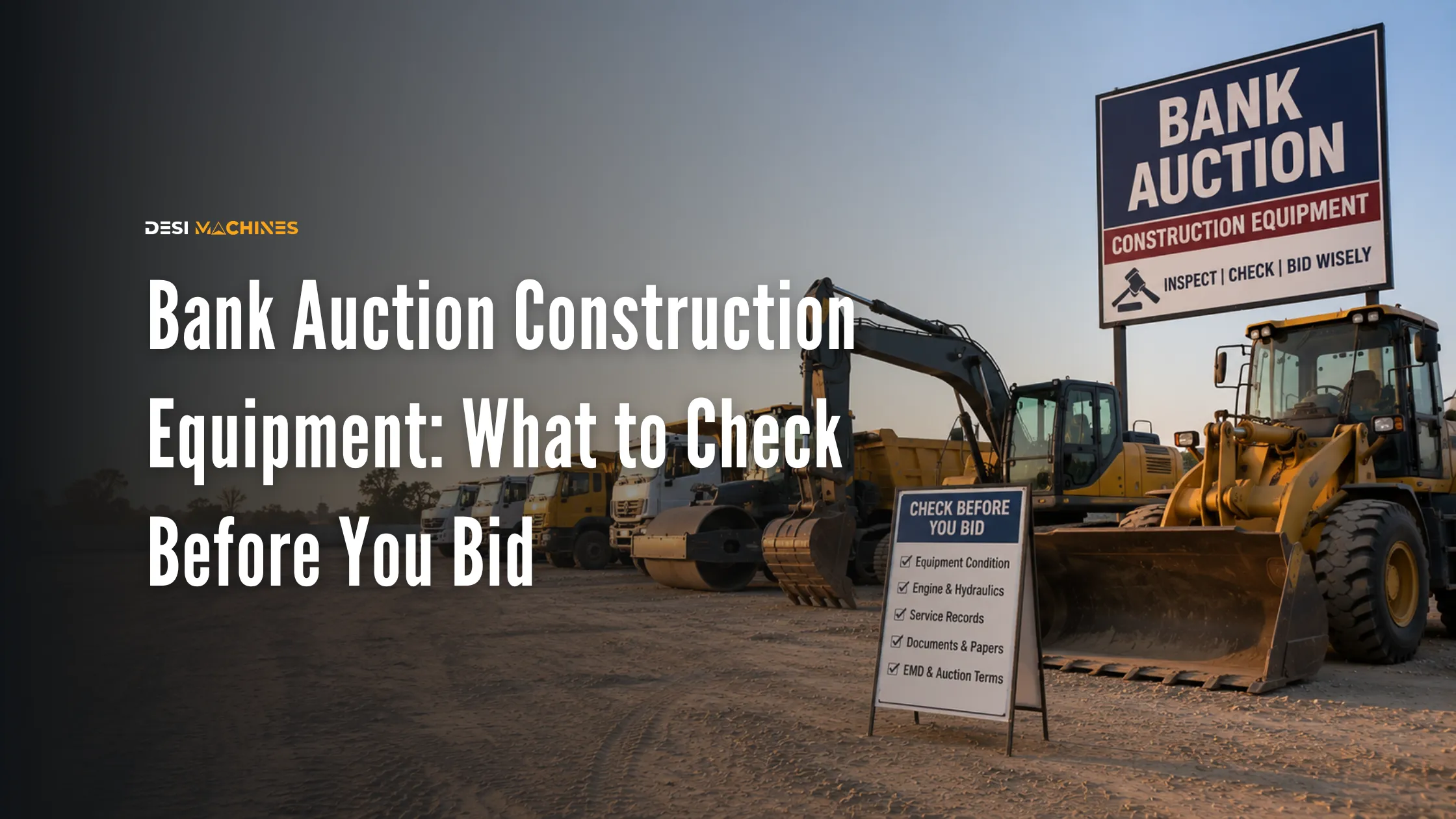
In short: Bank auction construction equipment is sold by a lender enforcing its security after a borrower defaults, and it is sold as is where is, with no warranty and a short inspection window. The legal title is usually the clean part; the machine’s condition is the risk. Before you bid, read the sale notice for the reserve price and the deposit terms, inspect with your own mechanic, check the hour meter against the machine’s actual wear, and add a refurbishment and transport allowance to your bid. Until the sale notice is published, the defaulting owner can still clear the dues and stop the sale.
A repossessed machine is the only place in the used market where the seller does not care what the machine is worth to you. The bank wants its money back and it wants the file closed. That indifference is exactly where the opportunity sits, and also where the trouble does.
Owners hear the headline first: a two-year-old machine at well under market. What they hear less often is that the same machine has been standing in a recovery yard through a monsoon, that nobody has turned it over in eight months, and that the person who could tell you what went wrong with it is the one who stopped paying for it.
Where bank auction construction equipment comes from
The route is statutory, and knowing it tells you what you are buying.
When a borrower defaults and the account is classified as a non-performing asset, the lender issues a written notice under section 13(2) of the Securitisation and Reconstruction of Financial Assets and Enforcement of Security Interest Act, 2002 requiring the borrower to clear the liability in full within sixty days. If that does not happen, section 13(4) lets the lender take possession of the secured asset and sell, lease or assign it to recover the debt.
So the seller is a secured creditor exercising a statutory power, not a trader. Two things follow. The bank’s right to pass title is solid, which is what makes these sales attractive. And the bank has no operating knowledge of the machine at all, which is what makes them risky.
There is a third consequence that costs bidders real money. Under section 13(8) of the same Act, as substituted with effect from 1 September 2016, if the borrower pays the full dues together with all costs, charges and expenses at any time before the date of publication of the notice for public auction or for inviting quotations or tenders, the asset shall not be sold, and where the creditor has already taken steps towards a sale, no further step shall be taken. In plain terms, a machine you have set your heart on can be redeemed and pulled off the list. Do not book a trailer or send a crew until the sale is confirmed in your name.
The full text is on the government’s statute portal, in the SARFAESI Act, 2002 on India Code, if you want to read the section yourself before you bid.
Read the sale notice before you read the price
Every serious bidder starts with the notice, and most first-timers start with the photographs. The notice is where the terms that decide your risk are written, and they differ between lenders and between sales.
Four lines to find and write down:
| What to look for | Why it decides your bid |
|---|---|
| Reserve price | The floor the bank will accept. It reflects a valuation, not the market, and a low reserve is not by itself a bargain. |
| Earnest money and deposit terms | What you pay to enter, what falls due immediately if you win, and how long you have for the balance. Missing a deadline can cost you the deposit. |
| Inspection date and place | Often a single day, at the yard. If you cannot attend with someone who can judge a machine, you are bidding blind. |
| Condition and encumbrance wording | The as is where is clause, and whether the bank is disclaiming knowledge of dues, charges or the machine’s history. |
Treat the deposit schedule as the hard constraint on the whole exercise. Auction money moves faster than any equipment loan file, which is why funding has to be arranged before the sale rather than after.
The inspection: what a standing machine hides
A repossessed machine has usually been idle for months, and idleness damages machines in ways that work does not. Seals dry out and weep. Batteries die. Hydraulic oil sits and draws moisture. Rodents get into looms. Tyres flat-spot. None of it shows in a photograph of a clean-looking machine on a yard.
Take your own mechanic and give them a list:
Start it cold, and watch the smoke. The first thirty seconds of a cold start tell you more than an hour of running. If the yard has already warmed the machine up for you, that is worth noticing too.
Check the hour meter against the wear. Pins, bushes, bucket teeth, track or tyre condition and the seat and controls all age with use. A low reading on a machine with heavily worn linkage is a question, not a bargain.
Work every hydraulic function to full extension. Slew a full circle, curl and dump, run the boom to both ends of travel. Drift and weep at the ends of travel are where seal and cylinder trouble shows first.
Look under the machine and behind the panels. Fresh paint on a chassis, a very clean engine bay on a very dirty machine, and a recently pressure-washed underside are all things worth asking about.
Find the plate and match the numbers. Engine and chassis numbers on the machine should match the numbers in the notice and in the papers. A mismatch is a stop, not a negotiation.
If you are new to judging condition, the checks in the used construction equipment buying guide apply here with more force than in a dealer yard, because there is nobody to go back to afterwards.
What the bid price is not
The number you shout is not what the machine costs you. Owners who do well at auctions price the whole landed cost before they raise a hand.
| Cost after the hammer | Why it lands on you |
|---|---|
| Recommissioning | Oils, filters, battery, hoses and seals on a machine that has stood idle. Assume it needs a full service before it earns anything. |
| Transport from the yard | The machine leaves on your trailer, on your timeline, from wherever the bank stored it. |
| Repairs found after the start | The faults an inspection cannot see. This is the line that decides whether the buy was good. |
| Paperwork and transfer | Sale certificate, hypothecation clearance and registration transfer where the machine is a registered vehicle. |
| Idle weeks | Between winning and earning there is a gap. On a financed purchase that gap costs you an idle day at ₹16,000–25,000 (indicative) the way any standing machine does. |
A useful discipline: write your maximum bid on paper before the sale, after subtracting every line above from what the machine is worth to you working. Then hold it. Auctions are designed to make you spend the number you were going to save.
The papers, and the loan
Ask the bank for the sale certificate, the delivery order, the hypothecation position and its no-objection certificate. Where the machine is a registered vehicle, the sale certificate on its own does not put it in your name. Getting the lender’s charge off the registration and the ownership transferred is a separate exercise with its own forms and clock, set out in RC transfer and hypothecation removal on a used machine.
Funding deserves the same forethought. Lending against a used machine is priced off a valuation and off the machine’s remaining life, and the rate and the funded share both sit less favourably than on a new purchase, as covered in used construction equipment loans and LTV. Because auction deposits fall due long before any file gets sanctioned, the workable sequence is to fund the purchase from your own arrangement and refinance the machine once it is in your name and running.
When an auction machine is the right buy
It suits an owner who already runs machines of the same make, has a mechanic on call, can fund the purchase without a sanction letter, and can afford to have the machine standing for a few weeks while it is put right. For that owner, a repossessed machine bought below the market with a known refurbishment bill is a genuinely good trade.
It suits a first-time buyer poorly. No warranty, no service history, no recourse and a compressed payment schedule is a hard combination to absorb on your first machine. If this would be your first purchase, a dealer-supported used machine or a new one on a structured loan will cost more and lose you less, and the resale side of that decision is worth reading in which machines hold their resale value.
The bottom line
Bank auction construction equipment gives you a lender’s clean title and none of a dealer’s comfort. The law behind the sale is settled, the condition of the machine is entirely your problem, and the defaulting owner can still redeem the machine right up to the day the sale notice is published. Read the notice, inspect with your own mechanic, price the recommissioning and the transport into your maximum bid, and arrange the money before the sale rather than after it.
If the sums do not clear that bar, the market route is still open. Compare what is currently listed across backhoe loaders and excavators, and check what you can borrow and at what rate on equipment finance before you decide which route buys you the better machine.
Auction terms, deposit schedules, reserve prices and statutory provisions vary by lender, by sale and over time, and the provisions cited here are from the SARFAESI Act, 2002 as amended. Confirm the terms of any specific sale from the lender’s own sale notice, and confirm current rates and figures with the bank, dealer or OEM before deciding. Prices and figures on this page are indicative, vary by variant, location and date. DesiMachines is not liable for decisions taken on the basis of information that may have changed after publication.