Excavator
294 models
Excavator
294 models  Backhoe Loader
51 models
Backhoe Loader
51 models  Crane
68 models
Crane
68 models  Concrete Mixer
79 models
Concrete Mixer
79 models  Wheel Loader
54 models
Wheel Loader
54 models  Compactor / Roller
45 models
Compactor / Roller
45 models  Motor Grader
42 models
Motor Grader
42 models  Concrete Pump
66 models
Concrete Pump
66 models  Skid Steer Loader
11 models
Skid Steer Loader
11 models  Telehandler
13 models
Telehandler
13 models  Dozer
Dozer 


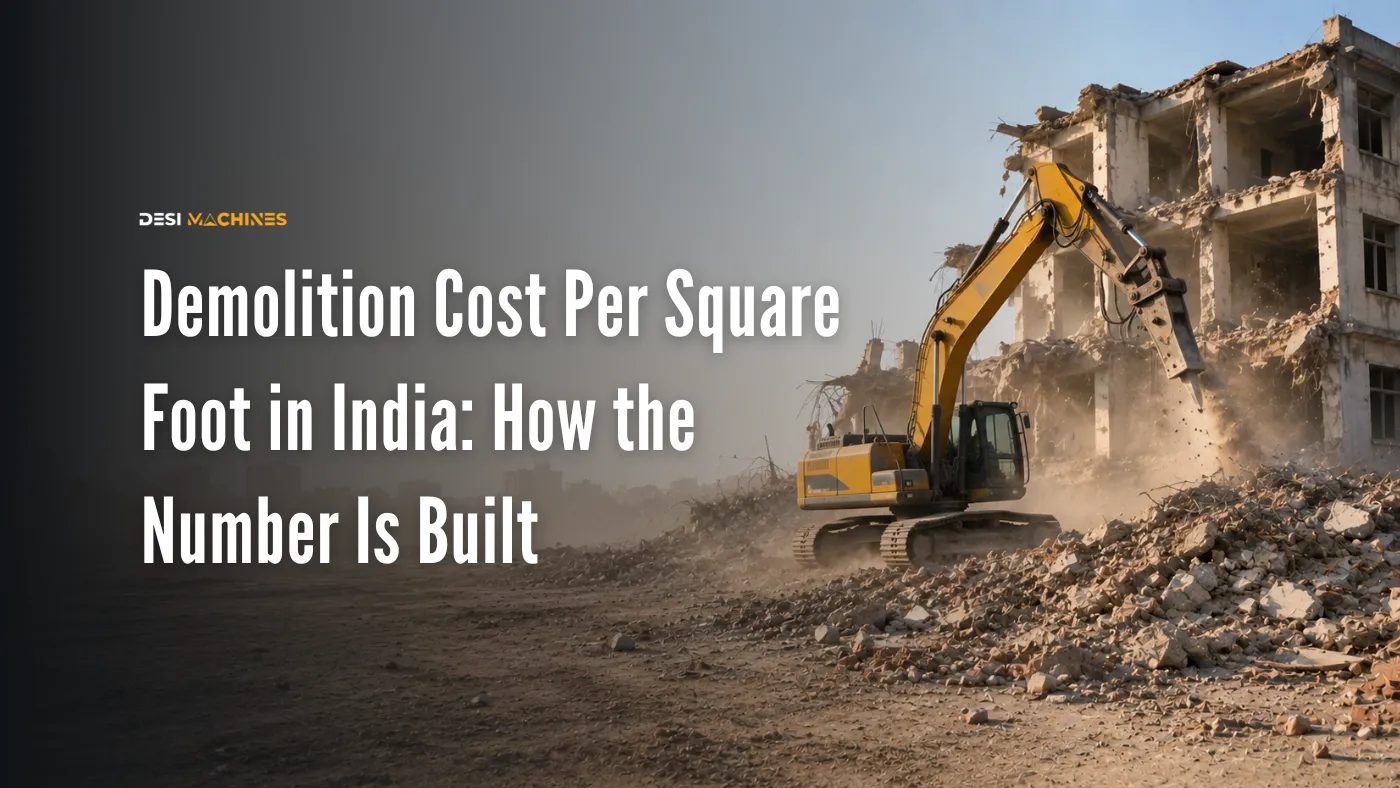
In short: The demolition cost per square foot is a derived number, not a published rate — it comes out of machine hours, debris trips and labour divided by built-up area, and then gets offset by whatever steel, brick and fittings come back out of the building. That offset is why two honest quotes for the same house can be far apart, and why some contractors will demolish an old structure for very little, or even pay you. A 20-tonne excavator on wet hire runs an indicative ₹1,400–2,200 an hour and a mini ₹500–900 an hour (indicative, as of Aug 2026). Settle who keeps the salvage before you compare a single quote.
Why the demolition cost per square foot is a derived number
Ask five contractors and you will get five figures, and they can all be honest.
The reason is that demolition has no natural unit. Earthwork has cubic metres of soil moved. Leveling has an area and a cut depth. Demolition has a building, and buildings differ in the one thing that decides the work: how much material is holding them up and how hard it is to break.
The per-square-foot figure is what you get after the job is priced, not the thing you price with. It is built from four heads and one credit:
| Head | What decides it |
|---|---|
| Machine time | Structure type, number of floors, access for the machine |
| Labour | Manual dismantling, sorting, cutting, site safety |
| Debris handling and disposal | Volume created, trips, distance to the approved site |
| Site preparation and safety | Utility disconnection, barricading, protection of neighbours |
| Less: salvage | Steel, brick, doors, windows, fittings recovered |
Divide the total by the built-up area and you have your rate. Do it the other way round — start with a rate you read somewhere and multiply — and you will be wrong in whichever direction your building differs from the one that rate came from.
The salvage credit is the whole argument
This is the part that separates demolition from every other site job an owner prices.
An old building is not only a cost. It is steel, brick, timber, doors, windows, grills, sanitary fittings and sometimes stone, all of which have a resale market in India. On an RCC structure the reinforcement steel alone can be a substantial recovery. On an old load-bearing house, brick that comes out whole is worth having.
So the quote you receive usually has an assumption baked into it about who ends up owning that material. A contractor who expects to keep everything can quote a low number, and on a building rich in steel may offer to do the work for nothing, or pay you for the right to take it down. A contractor who is told the owner keeps all recovered material will quote a much higher figure for exactly the same work.
Neither is cheating you. They are answering different questions. Before you compare two quotes, write down one line — who owns the recovered material — and make both parties price against it. Owners who skip that line are the ones who feel robbed later, usually when they watch the steel leave the site.
Machine or manual, and what it costs you in recovery
The instinct is that the machine is always cheaper. On the work itself it usually is. On the whole job it depends on what you wanted back.
An excavator with a hydraulic breaker takes down a structure quickly and turns most of it into rubble. That is fine when the building is modern RCC and the recoverable value is mostly steel, which survives breaking. It is a poor choice on an old brick building where the brick itself is worth money, because broken brick is malba and whole brick is stock.
Manual demolition is slower and carries more labour cost and more supervision, and it recovers far more intact material. In much of India the choice between the two is made on exactly this trade-off rather than on speed.
The attachment decides a lot of it. A breaker, a grab or sorting bucket, and shears for steel do different jobs and protect different things — the spread in what they cost to buy or hire is set out in the note on excavator attachment cost. Where access is tight, a mini excavator does work a full-size machine cannot reach at all.
Debris is the head that ruins the cheap quote
Demolition creates a startling volume of material, and it all has to go somewhere specific.
Construction and demolition waste is not ordinary rubbish and cannot be tipped on a convenient empty plot. It goes to a site the local body designates, and getting it there is charged by the trip. That makes disposal a function of two things you can check before signing: how much volume the structure will produce, and how far the approved site is from you.
A quote that looks better than the others is very often a quote that has left disposal to the owner. Ask the question directly — how many trips, at what rate, to which site — and the gap between quotes usually explains itself. The arithmetic is the same shape as costing haulage on an earthwork job, which is worked through in the note on the excavation rate per cubic meter.
What actually pushes the rate up
| Factor | Effect on your rate |
|---|---|
| RCC frame rather than brick | Up — more breaking, more machine hours, more chisel wear |
| Extra floors | Up — height limits what the machine can reach and slows everything |
| Attached or adjacent buildings | Up sharply — protection, and often manual work near the party wall |
| Narrow or shared access | Up — smaller machines, more trips, more handling |
| Long haul to the disposal site | Up — trips are the cost, distance is the multiplier |
| Good recoverable material | Down — the salvage credit does the work |
| Occupied neighbouring property | Up — working hours restricted, dust and noise control |
How to price your own job
Do it in this order and the number will be yours rather than someone else’s.
Start with the machine. Estimate the days an excavator will need on site, and price them against the hire rate you can actually get — the indicative bands for each machine class sit in the rental rate card. If the machine is your own, use its cost per hour rather than the market hire rate, or you will flatter the job.
Then add labour for dismantling and sorting, and site costs for barricading, dust control and utility disconnection. Then count debris in trips, not in vague volume, and price the haul to the actual approved site.
Now subtract what comes back out: steel by weight, brick by count if it survives, and fittings at whatever the local market pays. Divide the net by the built-up area, and you have a defensible demolition cost per square foot for your building — one you can hold a contractor to, because you know what is inside it.
The habit is the same one that works on land leveling cost per acre: derive the rate from your own inputs, then use published figures only as a sanity check.
Before anything starts
Permission from the local body comes first, and it is the owner’s responsibility rather than the contractor’s. Power and water disconnection are separate steps and have to be completed before a machine touches the structure. Neighbours need notice where the building is attached or close. None of this is expensive, and all of it stops the job if it is missing.
The bottom line
Demolition is priced backwards from most site work: you build the cost from machine hours, labour, trips and site protection, then take off a salvage credit that can be large enough to change the sign of the answer. Settle who owns the recovered material before you read a single quote, get disposal quoted in trips to a named site, and choose between machine and manual on what you want to recover rather than on speed alone.
If the job needs a machine of your own rather than a hired one, compare the live range of excavators on the class and reach the work actually needs, and price the purchase alongside the equipment finance before you commit.
Rates, disposal charges, scrap values and municipal requirements change, and every figure here is indicative and varies by structure, location, season and date. Confirm current terms with your contractor, the local authority and your dealer before you rely on any of it.