Excavator
294 models
Excavator
294 models  Backhoe Loader
51 models
Backhoe Loader
51 models  Crane
68 models
Crane
68 models  Concrete Mixer
79 models
Concrete Mixer
79 models  Wheel Loader
54 models
Wheel Loader
54 models  Compactor / Roller
45 models
Compactor / Roller
45 models  Motor Grader
42 models
Motor Grader
42 models  Concrete Pump
66 models
Concrete Pump
66 models  Skid Steer Loader
11 models
Skid Steer Loader
11 models  Telehandler
13 models
Telehandler
13 models  Dozer
Dozer 


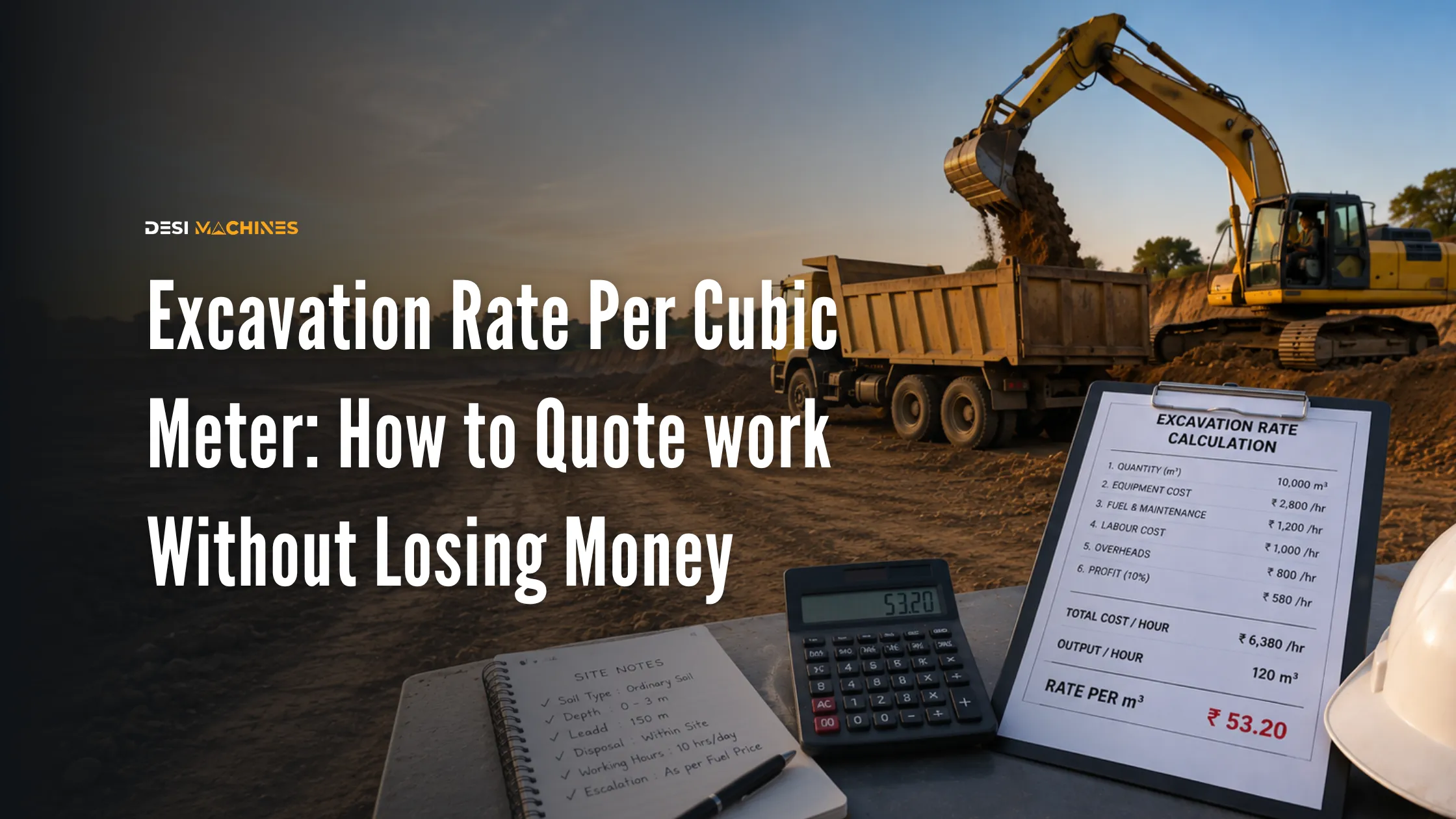
In short: Your excavation rate per cubic meter is your machine’s cost per hour divided by the cubic metres it genuinely moves in that hour, plus your margin. For a 20-tonne excavator costing an indicative ₹1,950 per hour (as of Aug 2026) and moving 70 m³ an hour, the machine alone costs about ₹28 per m³ — before lead, disposal, deductions and profit. That number is your floor, not the market rate, and the thing that moves it most is output, not diesel.
Most earthwork gets quoted the same way: the client names a rate per cubic metre, the owner does a quick sum in his head, and the machine goes to site. Three months later the money has come in and nobody can say whether the job earned anything. The arithmetic that would have answered it takes ten minutes.
A per-cum quote is a bet on output. You are agreeing to be paid for soil moved while your costs run on the clock. Get the output assumption wrong and the rate that looked comfortable at signing pays for your diesel and nothing else.
How the excavation rate per cubic meter is actually built
One note on units before the arithmetic, because it trips people up on paper. A cubic metre is written m³ here and m3 in most tender documents, BOQs and state schedules of rates — they are the same unit, and an earthwork excavation rate per m3 is the same number as a rate per cubic meter. Quantities in an earthwork item are measured in the ground before digging, not in the tipper after, which matters because loose soil occupies more room than the hole it came out of.
Two numbers decide it, and you already own both:
Rate per m³ = (machine cost per hour ÷ cubic metres moved per hour) + margin
The first number comes from your own books. Fuel, wear parts, operator, insurance, EMI and repairs for a year, divided by the hours you actually run — the method is set out in full in our guide to excavator cost per hour, and for a 20-tonne class machine it lands in an indicative ₹1,800–3,000 per hour depending almost entirely on how busy you keep it.
The second number is the one owners guess at. It is also the one that decides whether the job earns.
What your machine really moves in an hour
Bucket capacity times cycles per hour gives a theoretical figure that no Indian site delivers. A 1.0 m³ bucket at a 20-second cycle is 180 buckets an hour on paper — around 160 m³ once you allow for the bucket not filling completely. Then the tipper is late, the operator trims a batter, the machine shifts position, and the real hour is closer to 45 minutes of digging. Soil that was 100 m³ in the ground also becomes roughly 120–125 m³ once it is loose in the truck, so the measured quantity depends on whether the bill counts ground volume or truck volume.
| Machine class | Standard bucket | Indicative output, ordinary soil |
|---|---|---|
| Mini excavator (3–5 tonne) | 0.10–0.18 m³ | 10–20 m³/hr |
| Backhoe loader, e.g. JCB 3DX Plus | 0.26 m³ (dig end) | 15–30 m³/hr |
| 20-tonne excavator, e.g. Tata Hitachi EX 200 | 0.90–1.10 m³ | 60–90 m³/hr |
| 30-tonne and above | 1.40–1.90 m³ | 100–150 m³/hr |
Bucket capacities are as per the current Aug 2026 catalogue specification; output figures are indicative and assume ordinary soil, a short lead and tippers waiting rather than the machine waiting. Log your own machine for a week before you price anything. An hour meter and a tipper count will give you a better number than any table, including this one.
A worked example: 20-tonne excavator on ordinary soil
Take the ₹1,950 an hour from the cost-per-hour method and run it against three output assumptions:
| Machine cost per hour | At 50 m³/hr | At 70 m³/hr | At 90 m³/hr |
|---|---|---|---|
| ₹1,800 (busy machine) | ₹36/m³ | ₹26/m³ | ₹20/m³ |
| ₹1,950 (steady) | ₹39/m³ | ₹28/m³ | ₹22/m³ |
| ₹2,600 (under-used) | ₹52/m³ | ₹37/m³ | ₹29/m³ |
All figures indicative, as of Aug 2026. Read the table across and down. The same machine, on the same diesel price, carries a machine cost anywhere between ₹20 and ₹52 a cubic metre depending on two things you partly control: how many hours a year the machine works, and how cleanly the site lets it dig.
What this calculation gives you is a floor. It is the machine’s own cost, with no operator overtime beyond your standing wage, no tipper, no site establishment, no supervision and no profit. The crew around the machine is its own line with its own statutory floor, which is set state by state and revised through the year — see the labour rate per day in India before you price it in. The rate you quote has to sit above it with enough room that a week of rain does not wipe out the job. If your state schedule of rates shows a much larger figure for the same item, that is because the schedule item usually carries labour, lead, dressing, disposal and contractor’s profit inside it — a different scope, not a different machine.
Why the same machine quotes two different rates
Five site conditions move the per-cum number more than anything on the machine itself.
Soil class. Ordinary soil, hard murum and soft rock are three different jobs for the same bucket. Output can halve between the first and the third, and the rate doubles with it. Get the soil classification written into the work order.
Lead. Distance to the dump decides tipper cycle time, and if your rate includes the haul, a lead that grows from 500 metres to 3 kilometres eats the margin without anyone renegotiating.
Lift and depth. Deep cuts mean longer boom cycles, benching and often a second machine to relay material out. A trench at 4 metres does not cost what a 1.5-metre cut costs.
Water. Dewatering, slush and a monsoon month turn a clean quantity job into a stop-start one. Machines standing in water also cost more to maintain later.
Access and congestion. A machine that can dig and swing straight into a waiting tipper produces double what the same machine produces in a congested urban plot where it shifts every twenty minutes. Idle time is the quiet killer here, and what it costs is set out in our breakdown of equipment downtime cost.
Some work does not price per cubic metre at all. Foundation work is measured by the running metre of pile, and the rate is built from rig time, concrete and steel rather than from volume moved — the method is set out in our note on the piling rate per meter.
Per cubic metre or per hour — which basis should you take?
Both bases are normal in Indian earthwork, and the choice is a risk decision rather than a pricing one.
Take work per hour when the ground is unknown, the site is congested, the client keeps changing the sequence, or the quantity is small. On an hourly basis the client carries the risk of bad ground, and you get paid for the hours the machine is available. Current market hire levels by machine class are set out in the equipment rental rate card.
Take work per cubic metre when the soil is uniform, the quantity is large, the haul is short and you control the tippers. On clean bulk excavation a good operator will out-earn the hourly rate comfortably, because you are paid for production and your costs stay flat.
The mistake is taking per-cum work on a site that behaves like hourly work. If the bill of quantities says one thing and the site shows you another on the day of measurement, that is the moment to renegotiate, not after three running bills.
What comes off the bill before the money reaches you
A rate is not what you receive. On most contracts, three things sit between the measurement sheet and your bank account.
Retention money is held back from every running bill and released after the defect liability period. Tax is deducted at source on your payment, and the rate depends on how the contract is written, so ask your CA which section your work falls under before you quote. On material-bearing work, royalty or seigniorage on the earth or murum moved is often recovered from your bill by the department itself — why that happens, and who fixes the rate, is set out in our note on royalty on earthwork. Where the contract carries GST, the treatment of machine hire and works contracts is set out in our guide to GST on construction equipment.
Then there is the wait. Government and EPC running bills move slowly, and a healthy per-cum rate paid ninety days late is a working-capital problem dressed up as a good job. We have written separately on the running bill cycle and how to chase a contractor payment delay.
Not every earthwork job is measured in cubic metres. When a customer asks for a plot to be levelled and wants a per-acre price, the conversion and the trap that comes with it are worked through in land leveling cost per acre.
Work that was never in the schedule is a different problem again. When you hit rock or a service line nobody tendered for, the rate has to be built from scratch as a star rate for the extra item and sanctioned before it is payable.
The bottom line
An excavation rate per cubic meter is not a market number you look up. It is your own cost per hour divided by your own output, with your margin on top, and every site condition that slows the machine pushes it up. Owners who log the hour meter and the tipper count quote with confidence and walk away from bad rates early. Owners who guess find out at the end of the contract.
Work out your floor first, then decide what to quote above it. If the arithmetic says a bigger or faster machine would move the same quantity for less, compare live excavator models and prices and backhoe loaders and speak to a dealer before the next contract, and if the constraint is capital rather than the machine, look at what equipment finance would cost against the extra production.
Prices, rates, specifications and output figures are indicative, vary by variant, soil condition, location and date, and should always be confirmed with the OEM, dealer, bank or your own site records before any pricing or purchase decision. DesiMachines is not liable for decisions taken on the basis of information that may have changed after publication.
Bringing earth in is priced on a different build-up from taking it out — the cost heads and the shrinkage gap are set out in soil filling rate per cft.