Excavator
294 models
Excavator
294 models  Backhoe Loader
51 models
Backhoe Loader
51 models  Crane
68 models
Crane
68 models  Concrete Mixer
79 models
Concrete Mixer
79 models  Wheel Loader
54 models
Wheel Loader
54 models  Compactor / Roller
45 models
Compactor / Roller
45 models  Motor Grader
42 models
Motor Grader
42 models  Dozer
41 models
Dozer
41 models  Concrete Pump
66 models
Concrete Pump
66 models  Skid Steer Loader
11 models
Skid Steer Loader
11 models  Telehandler
13 models
Telehandler
13 models 


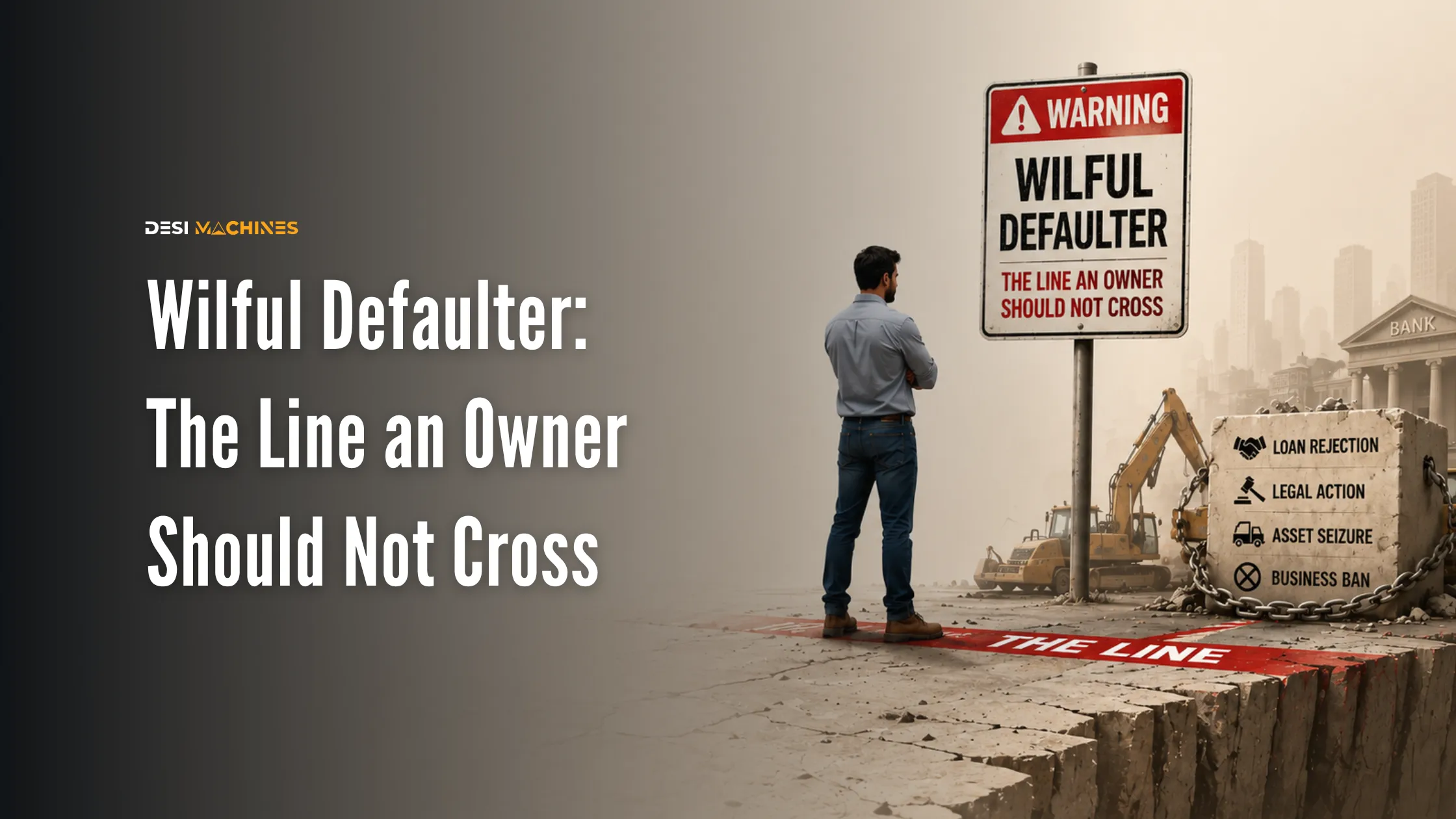
A wilful defaulter is not an owner who ran out of money. It is a borrower whose default was intentional and deliberate, or who diverted the loan, sold the secured machine without approval, or refused to pay while having the means. Lenders must examine this in non-performing accounts of Rs 25 lakh and above, the classification requires a show-cause notice and a hearing, and once it sticks the bar on new credit runs a year past removal and five years for a new venture.
Two owners, same arrears, different outcomes
Two owners default on machine loans of similar size in the same quarter.
The first has a JCB parked because the contractor he worked for has not released three running bills. He tells the lender early, sends the correspondence, keeps the machine insured and on his own premises, and pays what he can.
The second has been paid. The money went into a piece of land, the machine went to a buyer in another district without telling the financier, and the phone is switched off.
To the account statement these are the same event. To the rulebook they are not remotely the same, and only the second one is heading for a classification that will follow him for years after the debt is settled.
What makes a borrower a wilful defaulter
The Reserve Bank issued two parallel sets of directions in 2025 on the treatment of wilful defaulters and large defaulters, one for commercial banks and one for NBFCs. They are worded in the same terms, so the test does not change with the kind of lender that financed the machine.
The starting point is a warning against loose use of the label. Identification is to be made keeping in view the track record of the borrower and should not be decided on the basis of isolated transactions or incidents. The default must be intentional, deliberate and calculated, and it has to meet one of the defined conditions.
Those conditions, translated into the situations machine owners actually meet:
| What happened | How it is treated |
|---|---|
| Work stopped, payments stuck, you genuinely cannot pay | Default, not wilful default |
| You have the means to pay and do not | Wilful default |
| Loan taken for a machine, money used for something else | Diversion of funds |
| Borrowed funds taken out of the business entirely | Siphoning of funds |
| Hypothecated machine sold without the lender’s approval | Wilful default |
| Guarantee invoked, guarantor has the means and refuses | Wilful default by the guarantor |
The two that catch honest owners are the middle ones. Money is fungible and a bad quarter makes it tempting to move a disbursement into whatever is bleeding hardest. If a facility was sanctioned for a machine, spending it elsewhere is not a cash flow decision in the lender’s eyes; it is one of the listed conditions. So is selling a machine that stands as security without written consent, even when you are selling it to pay the same lender.
The threshold, and the six-month clock
Lenders are required to examine the wilful default aspect in all non-performing accounts with an outstanding of Rs 25 lakh and above. For machine finance that captures most single-machine loans and nearly every fleet facility.
Where the preliminary screening does suggest wilful default, the lender must complete the classification process within six months of the account being classified as non-performing. Where it does not, the question can be re-examined later under the lender’s board-approved policy, so a clean first screening is not permanent immunity.
A separate label, large defaulter, means an outstanding of Rs 1 crore and above where a suit has been filed or the account has been classified as doubtful or loss. That one carries no finding about your conduct. It is a reporting category, and it is often confused with the first.
You cannot be classified quietly
The process is deliberately adversarial, and knowing its steps is what lets you use them.
An identification committee examines the evidence. If it is satisfied that wilful default has occurred, it issues a show-cause notice to the borrower, and where relevant to the guarantor, promoter or director, and it must disclose all the material and information the notice is based on. You have 21 days to make submissions.
If the committee still proposes classification, it refers the matter to a review committee with written reasons, and you must be advised of the proposal and the reasons for it. You then have 15 days to make a written representation, and the review committee must offer you a personal hearing before passing a reasoned order that is communicated to you. If you do not attend, it decides on the record.
One limit is worth planning around: because this is an in-house proceeding, you are not entitled to be represented by a lawyer in it. A chartered accountant preparing the file and the reply is a more useful investment than a notice from an advocate, because the case is decided on records, disclosures and end-use evidence rather than on advocacy.
What it costs after the money is repaid
This is the part that makes the classification different in kind from ordinary arrears.
No additional credit facility may be granted to a wilful defaulter or to any entity associated with one. The bar continues for one year after the name is removed from the list. And no credit facility may be granted for floating a new venture for five years after removal. Restructuring an existing facility, meanwhile, stops being an ordinary negotiation and is governed by the stressed assets directions.
The reach matters as much as the duration. If the wilful defaulter is a natural person, every entity in which they are a promoter, a director, or a person in charge of management is deemed associated, so a classification against an individual proprietor can travel into the partnership or company he runs. And while the classification directions apply to specified categories of lender, the restrictions on further financial accommodation apply to all entities regulated by the Reserve Bank. There is no smaller lender to fall back on.
Lenders may also initiate criminal proceedings where the facts warrant it, and must have a board-approved policy on publishing photographs of persons declared wilful defaulters. Removal from the list does not stop criminal proceedings already begun.
Staying on the right side of the line
Almost everything that turns a difficult year into a classification is procedural, which means it is avoidable.
Use the facility for what it was sanctioned for, and keep the trail that shows you did. Do not sell, shift or scrap a hypothecated machine without written consent, and if you need to sell one to raise cash, ask first and route the proceeds as agreed. Tell the lender early when work has stopped, in writing, because a documented approach is the clearest evidence that a default is about capacity rather than intention. If a show-cause notice arrives, reply inside the 21 days with records rather than assurances.
If the underlying problem is the size of the instalment rather than a refusal to pay, the terms can be changed, at a price set out in loan restructuring on a machine loan. If the account has already gone bad and the aim is a clean exit, the route is in machine loan settlement. What the lender may and may not do while recovering is set out in machine loan default, and if you signed for somebody else’s machine, your own exposure is explained in what a loan guarantor actually signs. Where the lender itself is the problem, the escalation ladder is in the NBFC complaint route.
Where a bad year ends and wilful default begins
The distance between a bad year and a wilful defaulter classification is not the size of the arrears. It is conduct: whether you had the means, where the money went, whether the secured machine is still where it should be, and whether you engaged or vanished. An owner who communicates, keeps the end-use trail and answers the notice is in an argument about capacity. One who does none of those things is in a process with a five-year tail.
If the finance structure is the root of the strain, it is worth reviewing what is currently available in equipment finance before the account deteriorates further, because options narrow sharply once an account turns non-performing.
Regulations and lender policies change, and this is general information rather than legal or financial advice on your account. Confirm the current position and what applies to your facility with your bank, NBFC or a qualified professional before acting on it.