Excavator
294 models
Excavator
294 models  Backhoe Loader
51 models
Backhoe Loader
51 models  Crane
68 models
Crane
68 models  Concrete Mixer
79 models
Concrete Mixer
79 models  Wheel Loader
54 models
Wheel Loader
54 models  Compactor / Roller
45 models
Compactor / Roller
45 models  Motor Grader
42 models
Motor Grader
42 models  Dozer
41 models
Dozer
41 models  Concrete Pump
66 models
Concrete Pump
66 models  Skid Steer Loader
11 models
Skid Steer Loader
11 models  Telehandler
13 models
Telehandler
13 models 


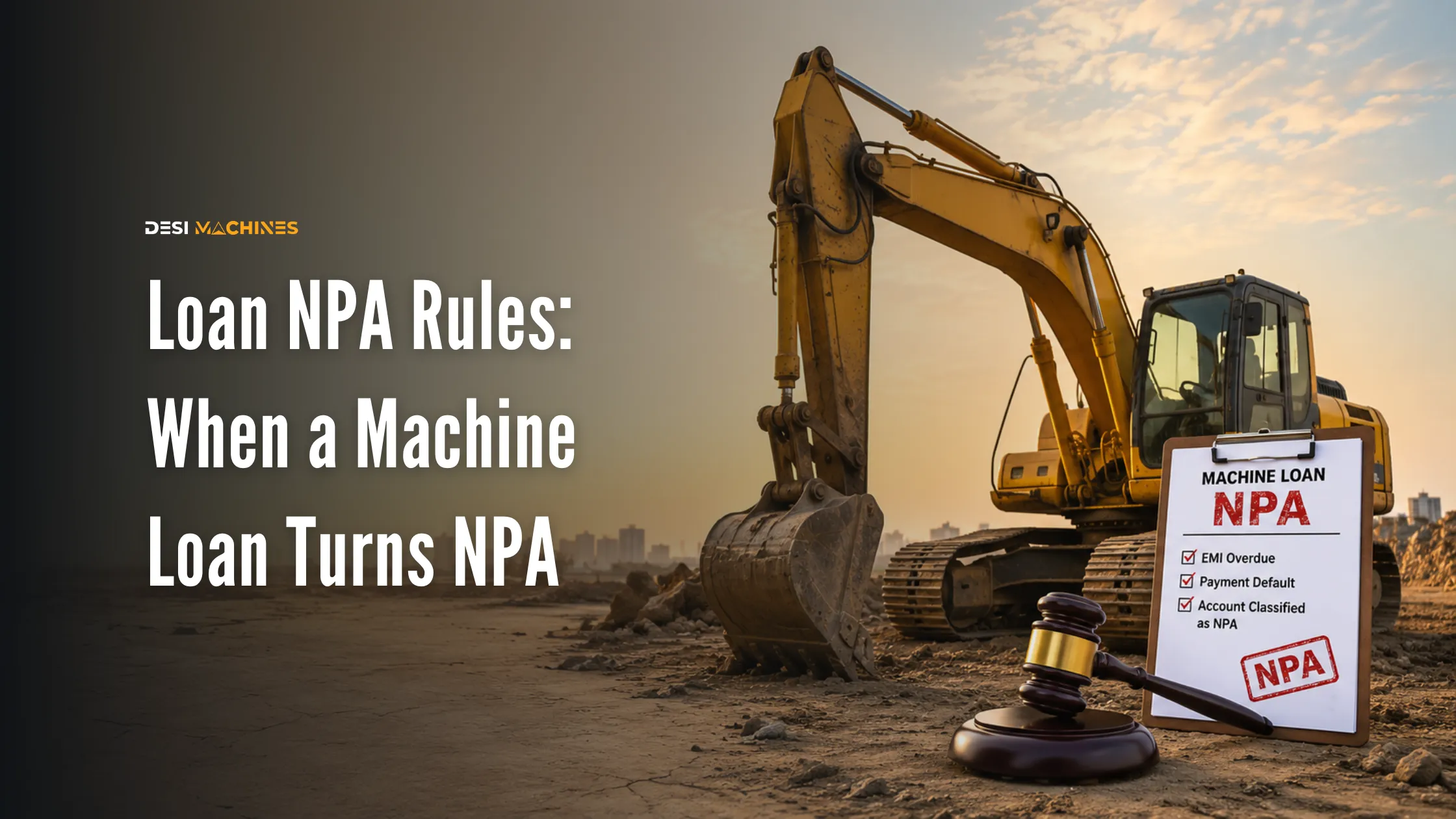
The loan npa rules that apply to your machine finance are date arithmetic, not a lender’s judgement call. Miss a due date and the account is flagged overdue that same day. Stay overdue and it is tagged SMA-1 at 30 days, SMA-2 at 60 days, and classified an NPA once the instalment is more than 90 days overdue. The 90-day norm applies across the applicable NBFCs from 31 March 2026. Nothing here is discretionary, and every stage is reported.
The word that starts the clock is “overdue”
Most owners think the trouble starts when the recovery calls start. It starts earlier, and it starts quietly.
Your lender flags a borrower account as overdue as part of the day-end process for the due date itself, whatever time of day that process happens to run. If the full dues for that date have not landed by then, the date of overdue is that date. There is no grace built into the rule, and there is no human deciding it.
That single sentence settles an argument owners have with branch staff constantly. Paying at eight in the evening on the due date is paying on the due date. The classification date is the calendar date the day-end process is run for, not the hour the money arrived.
The loan npa rules, stage by stage
Once an account is overdue and stays overdue, it moves through named stages. SMA stands for special mention account. It is not default. It is the regulator’s early-warning shelf, and your account sits on it in full view of the credit system.
The RBI sets this out with its own worked example, which is worth reading as a calendar rather than as a rule:
| Stage | Continuously overdue for | RBI’s illustration |
|---|---|---|
| Date of overdue | Day 0 (the due date) | 31 March |
| SMA-1 | 30 days | 30 April |
| SMA-2 | 60 days | 30 May |
| NPA | More than 90 days | 29 June |
Read the last row again. The account does not become an NPA on a review date, at a committee meeting, or after a notice. It becomes an NPA in a batch job on a Tuesday night, roughly three months after one instalment went unpaid.
Why this rule names your machine specifically
There is a line in the NBFC Directions that most borrowers never see. Among the conditions that make an asset non-performing, the list includes “the lease rental and hire purchase instalment, which has become overdue for a period of more than 90 days”.
That matters because a large share of construction equipment in India is financed by an NBFC rather than a bank, and often structured as hire purchase or a lease rather than a plain term loan. Owners sometimes assume those structures sit outside the asset-classification machinery. They do not. They are named in it.
The 90-day standard also finished phasing in recently. The Directions set a glide path for applicable NBFCs, tightening from more than 150 days overdue by March 2024, to more than 120 days by March 2025, to more than 90 days by 31 March 2026. An owner who remembers a more forgiving number from a few years ago is remembering a rule that has since been tightened twice.
What actually changes at each stage
The stages are not just labels. Each one moves something real.
At the date of overdue, penal charges begin. What a lender may charge there is itself capped and cannot be compounded, which is worth knowing before you accept a bounce entry you never agreed to. We have broken that down in EMI bounce charges on a machine loan.
At SMA-1 and SMA-2, the tag is reported and visible. Your existing lender starts internal follow-up, and any lender you approach for the next machine can see the account is under stress. This is the stage where most owners still have every option open and use none of them.
At NPA, the account is classified sub-standard to begin with. An asset stays sub-standard while it has been non-performing for a period not exceeding 18 months, and provisioning starts on the lender’s side. This is also the point where the security-enforcement route opens up, which we cover in what a lender can and cannot do on a machine loan default.
Getting back to standard is harder than getting there
Two traps sit on the way back up.
The first is partial payment. The count is on the account being continuously overdue. Paying something reduces the balance and buys goodwill, but it does not reset the ladder while dues for that date remain unpaid.
The second trap is the one that costs owners the most. Rescheduling on its own does not repair the classification. The Directions are explicit that assets are not upgraded merely as a result of rescheduling unless the conditions for upgrade are satisfied. Worse, if you walk in with a still-standard account and ask to restructure, the account is downgraded to sub-standard on restructuring. That is the real price of the conversation, and it is set out in machine loan restructuring and what it actually costs.
None of this makes restructuring wrong. It makes the timing and the sequence worth thinking about before you ask, rather than after.
Two things you are entitled to, and should use
Your loan agreement is required to spell out the exact due dates, the repayment frequency, the split between principal and interest, and worked examples of the dates on which the account would be classified SMA and NPA. If your agreement does not carry those examples, ask for them in writing.
Separately, every NBFC has to publish consumer education material on its website explaining the date of overdue, SMA and NPA classification and upgrade, with examples, referring specifically to the day-end process. Front-line staff are required to explain the same at sanction, disbursal and renewal. Reading your own lender’s version costs nothing and settles most disputes before they start.
If the record itself is wrong rather than the payment, that is a different fight with its own clock and its own compensation, covered in how to fix a wrong entry on your credit report.
Act in the first 30 days after a missed EMI
The loan npa rules reward one behaviour above all others: paying attention in the first 30 days. Between the due date and SMA-1 you have the widest set of options and the cheapest ones. By SMA-2 the tag is already out in the system. By day 91 the account is an NPA and the conversation changes completely, for you and for the lender.
If the pressure is on the cash cycle rather than the machine, look at the funding structure before the arrears build. Compare what is available across lenders on our construction equipment finance page, and if the account has already slipped, read what a settlement really costs you before agreeing to one. An NPA of Rs 25 lakh or more is also the point at which the lender must examine whether the default was wilful.
Rates, schemes, specifications and prices change — confirm current terms with the OEM, dealer, bank or insurer before deciding. Source: Reserve Bank of India (Non-Banking Financial Companies – Income Recognition, Asset Classification and Provisioning) Directions, 2025, read with the Commercial Banks counterpart. Nothing here is legal or financial advice on your specific account.