Excavator
294 models
Excavator
294 models  Backhoe Loader
51 models
Backhoe Loader
51 models  Crane
68 models
Crane
68 models  Concrete Mixer
79 models
Concrete Mixer
79 models  Wheel Loader
54 models
Wheel Loader
54 models  Compactor / Roller
45 models
Compactor / Roller
45 models  Motor Grader
42 models
Motor Grader
42 models  Concrete Pump
66 models
Concrete Pump
66 models  Skid Steer Loader
11 models
Skid Steer Loader
11 models  Telehandler
13 models
Telehandler
13 models  Dozer
Dozer 


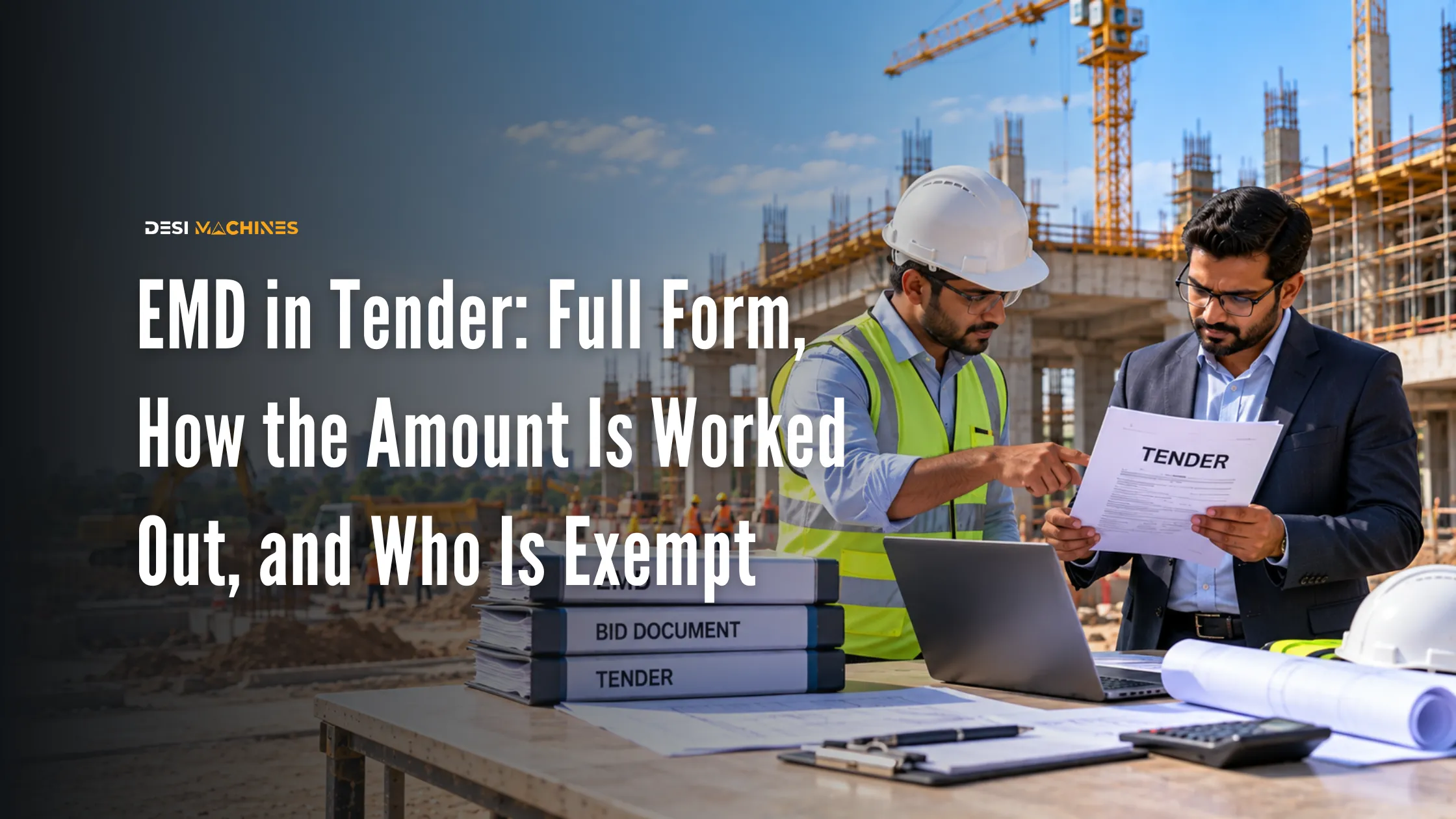
EMD in tender stands for earnest money deposit, and the General Financial Rules call the same thing bid security. It is money you lodge with your bid so your offer stays firm, and Rule 170 of the GFR, 2017 sets the amount at ordinarily two to five per cent of the estimated value of the work. Micro and Small Enterprises and startups are exempted by that rule. Many departments now ask for a signed bid security declaration instead of cash, which costs nothing up front but carries suspension from future bidding if you walk away.
Two per cent does not sound like much until you are bidding four tenders at once. On a two crore estimate that is four lakh, sitting with a department, earning nothing, for as long as evaluation takes. Multiply by four live bids and a small contractor has most of a month’s working capital parked in other people’s treasuries.
That is the real subject here. What EMD is, what fixes the number, and the two routes out of paying it at all.
What EMD in tender actually means
The full form is earnest money deposit. The tender document may call it EMD, bid security, or both in the same paragraph, and the General Financial Rules use bid security with earnest money given as the alternative name in the rule itself.
It exists to solve one problem for the buyer. Between the day bids are opened and the day a contract is signed, the department has committed nothing and the bidder could walk. Earnest money makes walking expensive. That is the whole mechanism, and it explains every rule that follows: what forfeits it, who is let off, and why it comes back when you lose.
The money stays yours throughout. The department holds it, it earns you no interest, and it is returned or adjusted once the bid has done its job.
How the EMD amount is worked out
Rule 170 of the General Financial Rules, 2017 is the source, and its wording is worth having exactly. On the amount, the rule reads that the amount of bid security should ordinarily range between two per cent to five per cent of the estimated value.
Two things follow, and both are commonly misread.
It is a percentage of the estimated value, meaning the department’s own estimate published with the tender, not of the price you intend to quote. Every bidder on that tender therefore lodges the same amount, whether they bid above or below the estimate. Quoting low does not reduce your earnest money.
And the band is a range the department chooses within, not a figure you calculate. The tender document names the exact amount or the exact percentage. Work it out yourself only as a sanity check on what is printed.
| Estimated value of work | At 2% | At 5% |
|---|---|---|
| Rs 25 lakh | Rs 50,000 | Rs 1,25,000 |
| Rs 1 crore | Rs 2,00,000 | Rs 5,00,000 |
| Rs 2 crore | Rs 4,00,000 | Rs 10,00,000 |
| Rs 5 crore | Rs 10,00,000 | Rs 25,00,000 |
The spread between the two columns is the point. On a five crore job the difference between a department choosing two per cent and choosing five is fifteen lakh of your money, decided by somebody else, before you have won anything. Read the figure in the tender before you decide how many bids you can carry at once. Our note on the bid capacity formula covers the other constraint on how much work you can chase in parallel.
State departments and PSUs write their own procurement manuals, and while most track the GFR band, the rule quoted above governs central government procurement. Check the tender rather than assuming the band.
Who is exempt from EMD
Rule 170 was amended to carve out two classes of bidder. As revised, the rule requires bid security from bidders except Micro and Small Enterprises as defined in the MSE Procurement Policy issued by the Department of Micro, Small and Medium Enterprises, and startups, which were added by the same policy decision.
This is the single largest saving available to a small contractor, and it is routinely left on the table for two reasons.
The first is that the exemption has to be claimed. You assert it in the bid and attach the registration that proves the status. A bid that stays silent gets treated as a bid that owes earnest money.
The second is that the status has to exist before the tender, not after. That means a live Udyam registration in the correct category, which is a half-day job done early and an impossible job done on the deadline. Our guide to Udyam registration for contractors covers how the classification is arrived at.
Departments do sometimes insist on EMD anyway, writing a clause saying no bid will be considered without it. That clause has been challenged in court by micro enterprises relying on Rule 170, so a tender condition contradicting the rule is not the last word. Raise it in the pre-bid meeting, in writing, where it can still be corrected for every bidder rather than argued about afterwards.
The declaration that replaces the deposit
Rule 170(iii) offers a different route, and it has quietly become the default in several departments. In place of a bid security, the rule allows ministries and departments to require bidders to sign a bid securing declaration, accepting that if they withdraw or modify their bids during the period of validity, or if they are awarded the contract and fail to sign the contract or to submit a performance security before the deadline, they will be suspended for the period of time specified in the request for bids document from being eligible to bid.
Read what changes and what does not. No money leaves your account, which is the point. But the sanction is heavier than forfeiture: instead of losing a deposit you lose the right to bid with that entity for a stated period. For a contractor who works largely with one department, a suspension is worse than losing four lakh.
So a declaration tender is not a free tender. It is a tender where the penalty for an unserious bid has moved from your bank balance to your order book, and it deserves the same seriousness about the bid validity period, because withdrawing inside that window is exactly what triggers it.
Getting it back, and what forfeits it
Forfeiture tracks the promise. Withdrawing or altering the bid while it is valid, or winning and then failing to sign or to furnish performance security by the deadline, are the triggers, and the tender document spells them out. Losing is not a trigger. A losing bidder’s money is due back once the tender is decided.
For the winner, the deposit usually converts rather than returns: it is released or adjusted once the performance security is furnished and the agreement signed. That handover is where the winner’s refund most often stalls. The mechanics of chasing a stuck one are covered in detail in our piece on the EMD refund process.
Keep a one-line register of every deposit lodged, with the tender reference, the amount and the date. Contractors lose this money by forgetting it, not by having it forfeited.
The bottom line
Treat earnest money as working capital with a return date, because that is what it is. Before you bid, read the exact figure in the tender rather than assuming a percentage, check whether the department has moved to a declaration, and if you qualify as a micro or small enterprise, claim the exemption in the bid itself. Those three habits free up more cash than most contractors get from any other change to how they tender.
Live work worth bidding for is listed on our opportunities page, and if earnest money and mobilisation are competing for the same rupees, equipment finance is the usual way owners keep both moving. Bidding well is covered end to end in how to bid for government construction tenders.
Rates, schemes, specifications and prices change, and procurement rules are amended and applied differently by state departments and PSUs. Confirm the current rule, the exact deposit and any exemption against the tender document and an official source before deciding.