Excavator
294 models
Excavator
294 models  Backhoe Loader
51 models
Backhoe Loader
51 models  Crane
68 models
Crane
68 models  Concrete Mixer
79 models
Concrete Mixer
79 models  Wheel Loader
54 models
Wheel Loader
54 models  Compactor / Roller
45 models
Compactor / Roller
45 models  Motor Grader
42 models
Motor Grader
42 models  Concrete Pump
66 models
Concrete Pump
66 models  Skid Steer Loader
11 models
Skid Steer Loader
11 models  Telehandler
13 models
Telehandler
13 models 


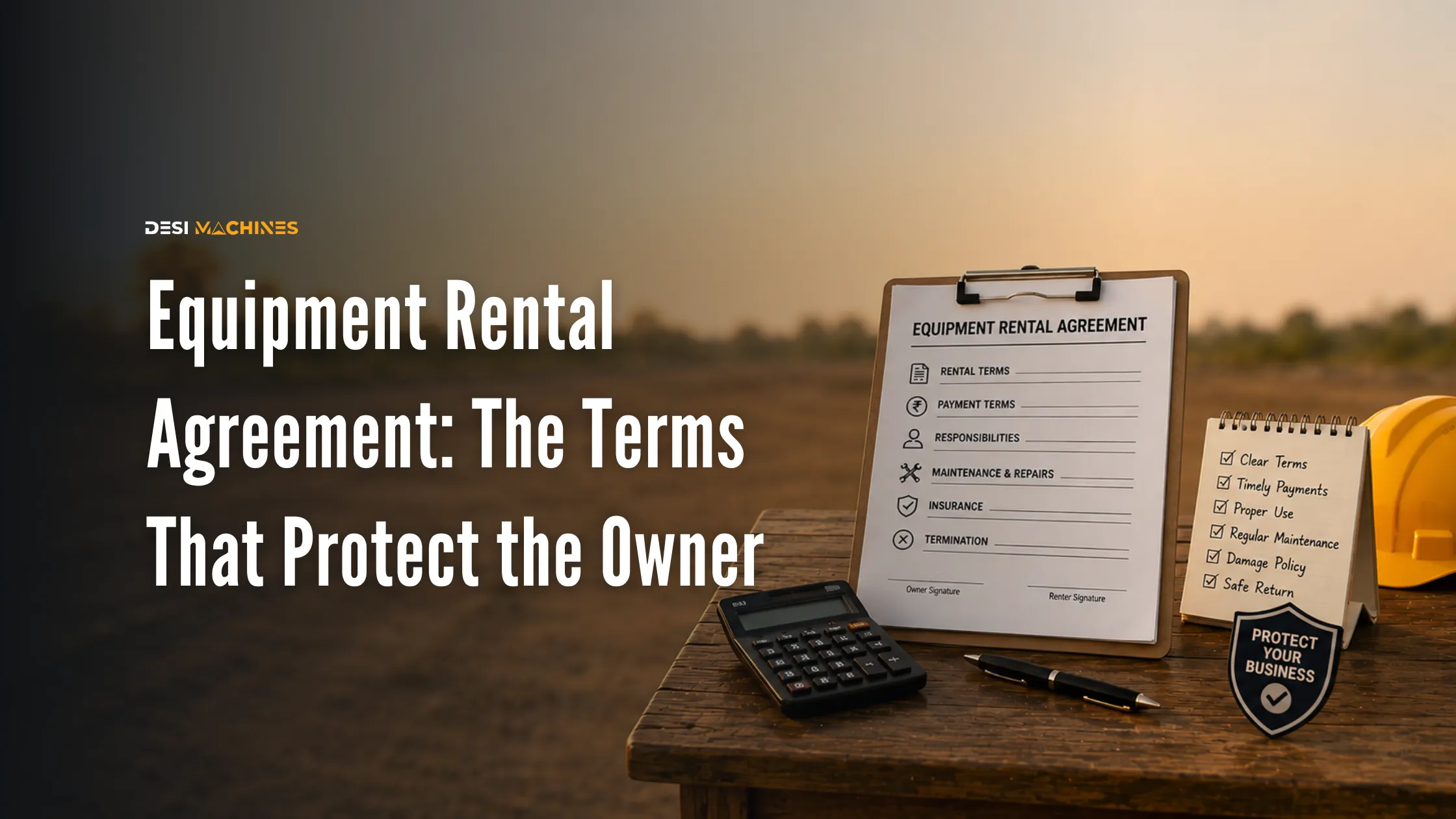
In short: A good equipment rental agreement does one job — it decides, in advance, who pays when things do not go to plan. Nine clauses do most of the work: the rate and what it is measured against, a minimum billable period, diesel, the operator, idle and breakdown hours, the condition record, insurance while on hire, the security deposit, and a dated payment term. Owners rarely lose money on the rate they agreed. They lose it on the hours nobody agreed how to count.
Most machine hire in India runs on a phone call and a rate. It works for years, until the month it does not — a gearbox fails on day nine of a thirty-day hire, or a site shuts for a fortnight and the hirer decides those days were never billable, or a machine comes back with a bent bucket and nobody can prove what it looked like going out.
None of those are rate disputes. They are gaps in what was agreed, and the owner absorbs them by default. This is the clause-by-clause view from the owner’s side. If you are still setting the business up, start with how to start an equipment rental business; if you are choosing between hire structures, the wet versus dry lease comparison covers that decision.
What an equipment rental agreement must fix in writing
You do not need a long document. You need a short one that is specific. These are the terms that actually get argued about:
| Clause | What it decides |
|---|---|
| Rate and basis | Per hour, per day or per month — and whether hours are counted on the hour meter or the clock |
| Minimum billable period | The floor you are paid for even if the machine is released early |
| Diesel | Who buys it, and at whose rate |
| Operator | Who supplies, pays and directs him |
| Idle and breakdown hours | Which non-working hours are billable and which are not |
| Condition record | The state of the machine at handover and return |
| Insurance while on hire | Whose policy responds on someone else’s site |
| Security deposit | What it can be adjusted against |
| Payment term | A date, not “after the bill is passed” |
The rate basis, and the minimum that comes with it
A rate without a basis is half an agreement. Per hour on the hour meter and per hour on the clock are different numbers on a site with delays, and a machine that runs eleven hours on a good day should not be billed as eight. State the basis, state the shift length, and state what happens beyond it.
Then add a minimum. A monthly hire released after eleven days leaves your machine idle mid-month with no realistic chance of a replacement booking — a minimum billable period is what stops the hirer’s flexibility becoming your idle time. Indicative July 2026 hire rates by machine class are set out in the equipment rental rate card, and a backhoe on dry hire sits at roughly ₹550–900 an hour, or ₹90,000–1,40,000 a month.
Diesel and the operator: name both
On dry hire the hirer brings the operator and the diesel, and the agreement should say so plainly. On wet hire you supply the operator — and the diesel question has to be answered explicitly, because getting it wrong is not a small error.
The arithmetic is stark. A wet rate carries a premium of about ₹300–400 an hour over dry. Fuel at an indicative 8 litres an hour costs roughly ₹760–830 an hour. A wet rate that includes diesel without pricing it therefore loses money on every hour the machine works, which is the worst kind of loss because it grows with utilisation.
The operator clause also needs a line on direction and liability: he is your employee, working under the hirer’s site instructions, and damage from instructions that breach the machine’s rated capacity is the hirer’s. Operator wages run an indicative ₹22,000–30,000 a month for an experienced backhoe hand — see the operator salary guide — and that wage is due on idle days too.
Idle time, breakdown and standby
This is the clause owners most often leave out and most often need. Three situations, three different answers, and all three should be written down:
The site stops. Rain, a permit, a materials delay — the machine is on site and available. These hours are normally billable at a reduced standby rate. Say what that rate is.
The machine stops. A breakdown is your risk, not the hirer’s. Billing pauses. Fair, and worth conceding in writing because it buys you the previous clause.
The machine stops because of how it was used. A hydraulic failure from lifting beyond rated capacity is not a breakdown in the same sense. Separate it, or the second clause swallows the case.
An idle day is not a zero for the owner. On a 20-tonne excavator it costs an indicative ₹16,000–25,000 once the EMI share, a retained operator and fixed overheads are counted, as worked through in our analysis of what one machine earns. A standby rate is how you stop carrying that alone.
Condition, damage and insurance
Photograph the machine before it leaves. Hour meter, tyres, bucket and teeth, glass, any existing dents — dated, and signed by whoever collects it. It takes ten minutes and it is the difference between a claim and an argument.
The agreement should then say the machine returns in that condition, fair wear excepted, with repairs from misuse billed to the hirer. Insurance needs its own line: a machine on hire is on a site you do not control, operated by people you did not train, and a standard policy may respond differently in that situation. Confirm how yours behaves during hire before you need to find out — the cover options are set out under equipment insurance. Which policy actually responds once the machine is on the hirer’s site, and why a contractor’s all-risks cover may not reach your plant at all, is set out in insurance for rented equipment.
Deposits, payment terms and getting paid
Take a deposit. It covers the first repair bill or the last unpaid invoice, and asking for one filters out the customers most likely to become a problem. Write down what it can be adjusted against and when it comes back.
Then put a date on payment. “After the bill is passed” is not a term. Hire money in this trade commonly settles 60 to 90 days after the work while your EMI — about ₹44,500 a month on a ₹20 lakh loan at 12% over five years (indicative) — arrives monthly regardless. You are financing the customer in the gap. Invoice in the same week the work is done, state an interest or stoppage right on overdue amounts, and be prepared to use it. Owners who never enforce a payment clause end up training their customers to pay last.
Government and EPC clients are a different problem. There the delay is structural rather than deliberate, and a registered micro or small supplier has statutory levers a private hirer does not — see contractor payment delay on government and EPC machine work.
The bottom line
Write the agreement for the bad month, not the good one. Rate, minimum, diesel, operator, idle hours, condition, insurance, deposit and a payment date — nine lines, most of them a sentence each, and they cover nearly every dispute a hire business will have in its first five years. A one-page hire note signed before the machine leaves the yard protects you better than a long contract nobody reads.
If you are still building the fleet side of this, compare current models under backhoe loaders and check what the money costs through equipment finance before you commit to hire terms.
Rates, schemes, specifications and prices change — confirm current terms with the OEM, dealer, bank or insurer before deciding. This is general guidance and not legal advice; have any hire agreement reviewed before you rely on it. Figures are indicative as of July 2026 and taken from our listings and published analyses at the time of writing.