Excavator
294 models
Excavator
294 models  Backhoe Loader
51 models
Backhoe Loader
51 models  Crane
68 models
Crane
68 models  Concrete Mixer
79 models
Concrete Mixer
79 models  Wheel Loader
54 models
Wheel Loader
54 models  Compactor / Roller
45 models
Compactor / Roller
45 models  Motor Grader
42 models
Motor Grader
42 models  Dozer
41 models
Dozer
41 models  Concrete Pump
66 models
Concrete Pump
66 models  Skid Steer Loader
11 models
Skid Steer Loader
11 models  Telehandler
13 models
Telehandler
13 models 


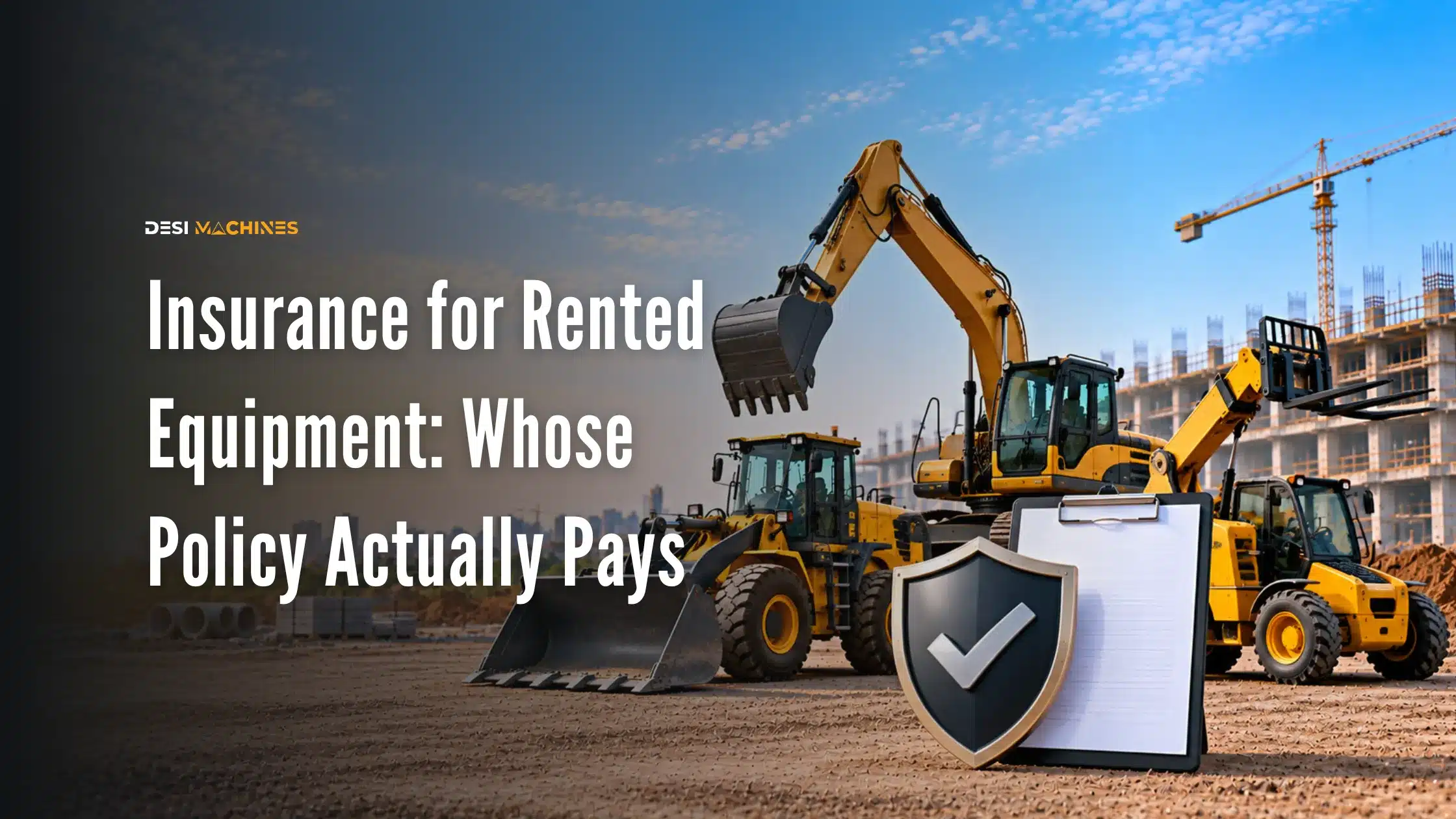
Insurance for rented equipment usually falls back on the owner’s own Contractors’ Plant and Machinery (CPM) policy, not on the hirer’s Contractors’ All Risks (CAR) policy — a CAR policy is built around the contract works, and plant is only covered if a plant section is added to it. Two things decide whether your cover actually responds once the machine is on someone else’s site: the location basis written into your policy, and who was operating when the damage happened. Both are fixable in the hire agreement, and both are cheap to fix before the machine leaves and expensive to argue about afterwards.
Hiring your machine out is the fastest way to fill an idle month. It is also the point at which your insurance quietly stops matching your situation. The policy you bought describes a machine working on your own jobs, under your own operator, at a location you named. The moment a trailer takes it to a contractor’s site, three of those four facts change and nobody tells the insurer.
Most owners find this out in the worst way: a claim goes in, the surveyor asks where the machine was and who was driving, and the answers do not match the policy schedule.
What insurance for rented equipment actually has to do
There are two separate risks on a hire, and owners tend to think only about the first.
The first is damage to the machine itself. That is what a CPM policy is for. HDFC ERGO describes its Contractors’ Plant and Machinery cover as responding to loss or damage to construction mobile equipment from an accident arising out of external perils, and says the cover operates while the machine is at work, at rest, or being dismantled for cleaning or overhauling. That “at rest” wording matters on a hire, because a good share of hire-site damage happens overnight when nobody is working.
The second is damage your machine causes to somebody else — a wall, a pipeline, a parked vehicle, a person. On the CPM wording Tata AIG publishes, third-party liability is listed as an add-on, not as part of the base cover. On your own site you may be relaxed about that. On a hirer’s site, working next to property and people you have never seen, it is the cover most worth checking.
If you are still deciding what to carry in the first place, the cover types and what each one is for are set out in our guide to construction equipment insurance.
Whose policy responds when the machine leaves your yard
This is where the money is decided, and the honest answer is that both sides can hold cover — so the real question is who actually did.
Tata AIG’s CPM page lists machinery rental company owners as buyers of the policy, to protect equipment they have rented out, and separately lists contractors and users of machinery as buyers, on the basis that they are liable for damage whether they own the machine or have hired it from another company. Both sentences sit on the same page. Neither cancels the other. What they tell you is that the industry expects somebody to have bought cover for this exact situation, and does not much care which of you it was.
| Policy | What it is built for | Covers your machine on hire? |
|---|---|---|
| Your own CPM policy | Physical loss or damage to your plant, at work or at rest | Yes, if the location basis and use still match |
| Hirer’s CAR policy | The contract works being built | Only if a plant section was added to it |
| Hirer’s own CPM policy | Plant he owns or has hired in | Only if your machine was declared on it |
The middle row is the one that catches owners. A contractor who says “don’t worry, the site is insured” is usually describing a CAR policy, and a CAR policy is about the works, not about your backhoe. Tata AIG’s own CAR page makes the point plainly: plant and machinery cover is something you add to a CAR policy. If it was not added, there is nothing there for your machine.
So ask two questions, in writing, before the machine moves: which policy is he relying on, and is plant a section on it. A hirer who cannot answer has told you the answer.
The location clause that decides your claim
A CPM policy is not automatically an anywhere-in-India policy. Tata AIG offers the cover on three bases: a single site, selected locations within a city, or across India on a floater. The premium follows the basis, so an owner who bought the cheapest option bought the narrowest one.
If your schedule names one site and the machine is now on a hirer’s job two districts away, you are not necessarily uninsured, but you are relying on an insurer’s goodwill rather than on your policy. HDFC ERGO confirms the same logic from the pricing side: premium depends on the type of equipment, the risk, the location or locations, and the use of the equipment. Location is a rated factor, which is another way of saying the insurer cares about it.
There is a second trap in the same area. The journey itself is usually excluded — Tata AIG lists loss or damage while the machine is in transit outside the construction site among the standard exclusions. Cover for the trailer ride is a different product, which we cover in transit insurance for construction equipment. Owners who assume their CPM follows the machine down the highway are assuming the one thing the wording rules out.
Before you agree the hire, it is worth reading your schedule against the cover options set out on the equipment insurance page and asking your insurer to move you to a floater basis if you intend to hire out regularly. The difference in premium is small next to one declined claim.
What a CPM policy will not pay for on a hire
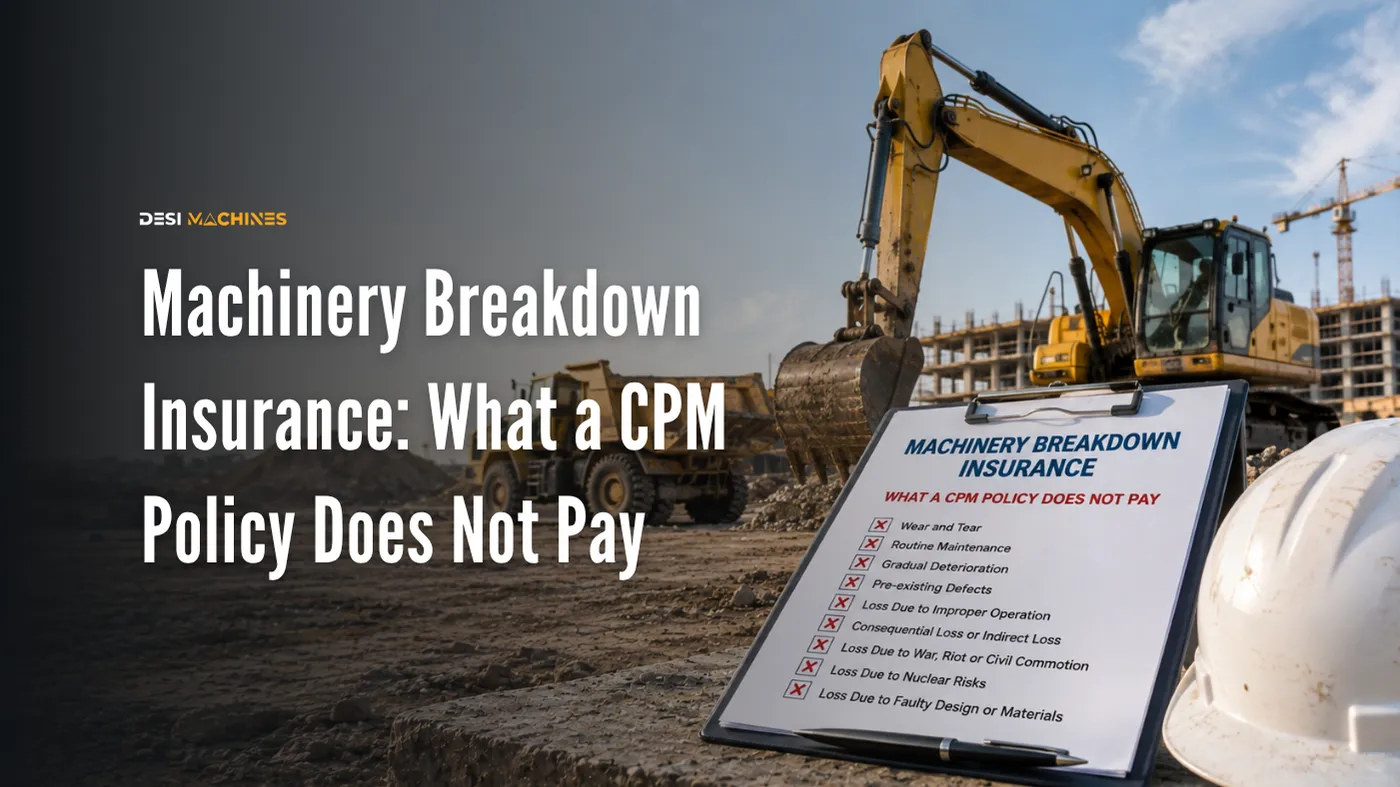
Exclusions matter more on a hire than on your own work, because you are no longer the one deciding how the machine gets used. These are drawn from the standard exclusions Tata AIG publishes, and the insurer notes that the published list is not exhaustive.
| Excluded | Why it bites harder on a hire |
|---|---|
| Electrical or mechanical breakdown | The commonest failure on a hard-worked machine is the one CPM does not pay for |
| Use for a purpose other than intended | You are not on site to see what the machine is being asked to do |
| Wilful act or negligence | The operator is often the hirer’s man, not yours |
| Replaceable parts (drills, blades, moulds) | Wear items get consumed fastest on somebody else’s job |
| Transit outside the construction site | Every hire begins and ends with a movement |
| Wear, tear, rust and corrosion | A machine on continuous hire ages faster than the policy assumes |
The breakdown exclusion is the one owners argue about most, and it is a genuine gap rather than an insurer being difficult: a different policy is built for it. The split between the two, and which one your losses actually fall under, is set out in machinery breakdown insurance.
The negligence exclusion deserves its own thought. On your own site you can vouch for your operator. On a hire you are underwriting somebody you have not met, which is a strong argument for supplying your own operator on a wet-hire basis and pricing it in.
Which policy answers, situation by situation
The sections above set out the principle. Below is the same reasoning arranged as the eight situations that actually produce an argument on a hire, so you can find yours before you ring anybody. The right-hand column is the part to settle in writing, because it is what the insurer will ask about first.
| What happened | Which policy is meant to answer | What decides it |
|---|---|---|
| Machine damaged at the hirer’s site, your operator on the seat | Your own CPM policy | Whether the location basis on your schedule reaches that site |
| Machine damaged at the hirer’s site, his operator on the seat | Your CPM, with the negligence exclusion live | Tata AIG excludes loss caused by a wilful act or by negligence, so who was operating becomes the argument |
| Machine damaged on the journey out or back | Neither CPM nor CAR | Damage in transit outside the construction site is a published exclusion; transit cover is what pays for the ride |
| Your machine damages a wall, a pipeline, a parked vehicle or a person | Your CPM, but only if third-party liability was added | Third-party liability is sold as an add-on, not as part of the base cover |
| Machine stolen overnight from the hirer’s site | Your CPM theft cover | Same-day intimation, the FIR, and a clear record of who held the machine overnight |
| Engine or hydraulics fail on their own | Neither — breakdown is excluded | Whether machinery breakdown cover was bought as a separate policy |
| The fault lies with the supplier or the manufacturer | Neither | Loss the supplier or manufacturer is responsible for is a standard exclusion |
| The hirer says “the site is insured” | His CAR policy, and only if a plant section sits on it | Ask which insurer, which policy number, and whether plant is a section on it |
Two of those rows are where owners actually lose money: the journey, and the operator. Both are decided before the machine leaves your yard, not after it comes back on a trailer.
Put it in the hire agreement, not on a phone call
Almost every insurance argument on a hire is really a documentation argument. Six lines settle it, and they cost nothing to add:
Whose policy responds. Name it, with the insurer and policy number, and take a copy. The location basis. State that the machine is covered at the hirer’s site, not merely somewhere. The excess and who bears it. HDFC ERGO points out that the excess varies with the sum insured, the machine type, and whether the loss is an Act of God claim, so it is a real figure worth naming. Who operates. Your man or his, and who is responsible if an untrained driver is put on the seat. Overnight custody. Who is responsible for the machine when work stops. Notification. The hirer tells you the same day, in writing, and does not attempt a quiet repair first.
That last line saves more claims than any other. Late intimation and a machine that has already been moved or repaired are among the reliable ways to lose a payout, which is the pattern we set out in what to do when an equipment insurance claim is rejected.
These clauses belong alongside the rate, the deposit and the payment date in the same document — the full list is in our equipment rental agreement checklist. If hiring out is becoming a real part of your income rather than a way to fill gaps, the wider economics are covered in how to start an equipment rental business.
Does the hirer’s insurance cover your rented machine?
Do not assume the hirer’s site insurance reaches your machine, because a CAR policy on its own does not. Assume instead that your CPM policy is the one that has to respond, then make it fit the job: get the location basis widened to a floater if you hire out regularly, check whether third-party liability is actually on the policy, arrange separate cover for the trailer ride, and put whose-policy-and-whose-excess in the hire agreement in writing.
An hour with your schedule and your broker before the machine leaves is worth more than any argument you can win after it comes back damaged. Compare cover options and talk to an insurer through our equipment insurance page before your next hire goes out.
Policy terms, exclusions, excesses and add-ons differ between insurers and between policy versions, and the wordings referred to here are those published by the named insurers at the time of writing. Rates, schemes, specifications and prices change — confirm current terms with the OEM, dealer, bank or insurer before deciding.
Sources: Tata AIG, Contractors’ Plant and Machinery Insurance and HDFC ERGO, Contractors’ Plant and Machinery Insurance Policy.