Excavator
294 models
Excavator
294 models  Backhoe Loader
51 models
Backhoe Loader
51 models  Crane
68 models
Crane
68 models  Concrete Mixer
79 models
Concrete Mixer
79 models  Wheel Loader
54 models
Wheel Loader
54 models  Compactor / Roller
45 models
Compactor / Roller
45 models  Motor Grader
42 models
Motor Grader
42 models  Concrete Pump
66 models
Concrete Pump
66 models  Skid Steer Loader
11 models
Skid Steer Loader
11 models  Telehandler
13 models
Telehandler
13 models 


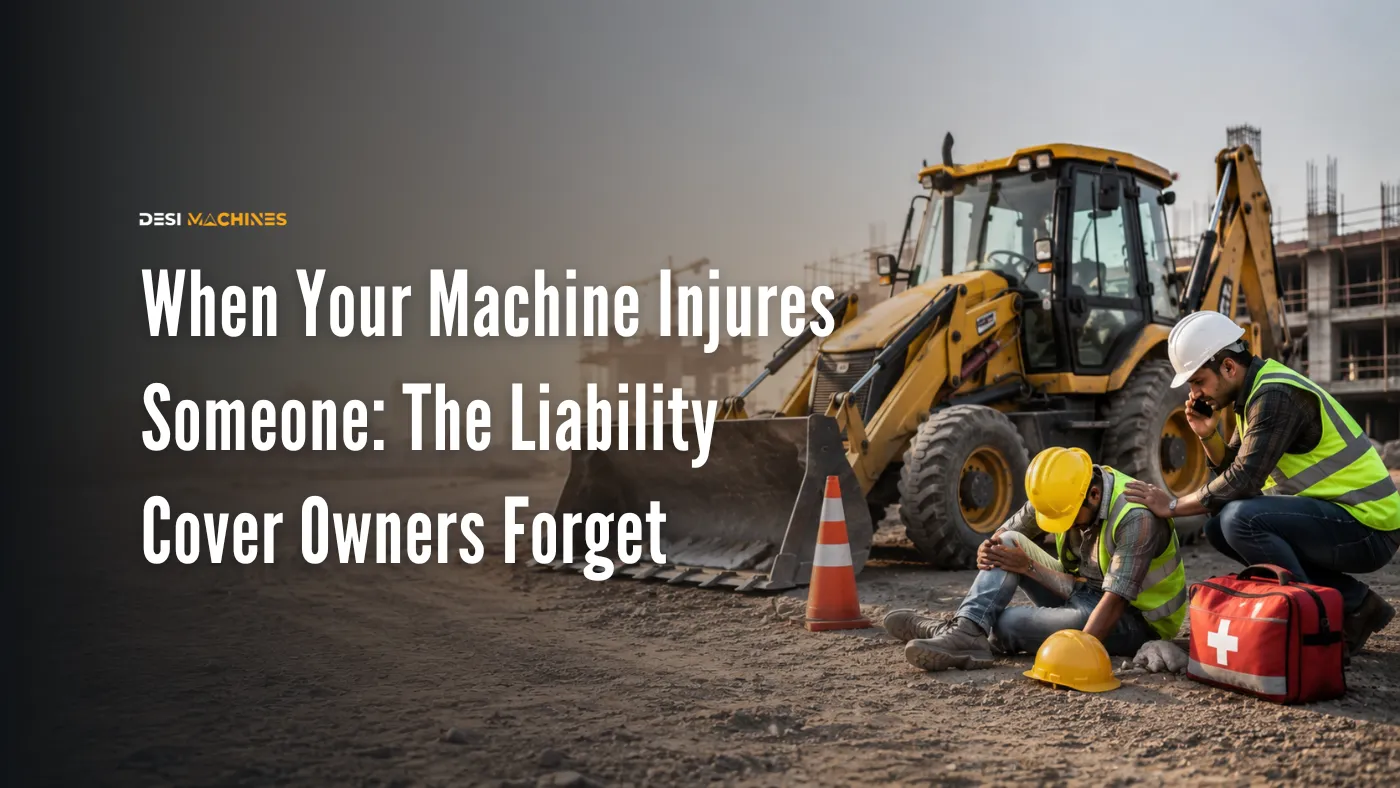
In short: Third party liability construction equipment cover pays for injury or property damage your machine causes to other people — and it is almost never included in the CPM policy that covers the machine itself. You need three things in place, not one: a CPM policy for damage to your own machine, a third party liability section or policy for outsiders, and an Employee’s Compensation policy for your own operator, whose injuries the liability section will not touch. Machines that travel on public roads also need motor third party cover under Section 146 of the Motor Vehicles Act.
The claim that ruins owners is not the one they insure against
Ask an owner what could go wrong with a Rs 30 lakh machine and you will hear about theft, fire, a rolled machine, a hydraulic failure. All of that is insurable, and most owners do insure it. The CPM policy that covers the machine is well understood and widely bought.
The claim that actually finishes a small operation is different. A bucket swings and clips a scooter on the road outside the site. A trench collapses onto a boundary wall. An operator’s hand goes into a moving part. None of those are damage to your machine, so none of them are CPM claims — and the money comes out of your own pocket unless a liability cover is sitting behind you.
This is the gap. Owners buy asset protection and skip liability protection, because the asset is what they paid for and the liability is abstract until the day it is not.
What third party liability construction equipment cover actually pays for
A liability cover responds when a third party — someone who is not you and not your employee — suffers injury or property damage that you are legally liable for.
| What happened | Which cover responds |
|---|---|
| Your excavator overturns and is damaged | CPM policy (own damage) |
| The machine’s load falls on a passer-by | Third party liability section |
| You damage a neighbour’s wall or a buried cable | Third party liability (property damage) |
| Your machine hits a vehicle while driving on a public road | Motor third party policy |
| Your own operator is injured on the job | Employee’s Compensation policy |
| The machine is stolen from site | CPM policy (theft peril) |
Read the middle rows again. Three of these six situations are not covered by the policy most owners think of as “my machine’s insurance”. That is the whole point of this article.
The road machines: what the law already requires
If your machine travels on a public road under its own power — and a backhoe loader almost always does — it is a motor vehicle in a public place for the purposes of the Motor Vehicles Act, 1988. Section 146 makes insurance against third party risk compulsory, and using an uninsured vehicle in a public place is a punishable offence.
Two practical consequences owners get wrong:
- A CPM policy does not satisfy this requirement. Motor third party cover is a separate policy, tied to the registration.
- The motor policy responds to what happens on the road. Once the machine is working inside a site, the liability that matters is the site liability section, not the motor policy. Owners who carry only the motor policy because the RTO asked for it are uncovered for most of their working hours.
Tracked machines that are trailered between sites and never driven on a road sit outside the motor requirement, but they are not outside liability — they simply need the exposure covered on the plant and site policies instead.
Your operator is not a third party — and that is the expensive part
This distinction costs owners more than any other line in this article. A third party liability section explicitly excludes your own employees. If your operator is hurt, that claim does not go there.
It goes to you, as the employer. The Employee’s Compensation Act, 1923 places liability on the employer to pay compensation for personal injury caused by an accident arising out of and in the course of employment. The cover that transfers that liability to an insurer is a Workmen’s Compensation or Employee’s Compensation policy, and it is priced off your wage bill, so it is one of the cheaper covers an owner buys relative to what it carries.
Skipping it is common for a simple reason: on paper the operator is “informal”, paid in cash, not on any roll. That arrangement does not remove the liability. It removes your evidence, your defence and your policy — and leaves the compensation claim standing. If you employ an operator, put him on record and insure the exposure. What that record costs is set out in our breakdown of heavy equipment operator salaries in India.
Getting the limit right, not just the policy
Buying liability cover is only half the job. The limit decides whether it works.
Liability limits are normally written as any one accident and any one year. If both are set at the same figure, one serious claim exhausts your cover for the rest of the policy year, and a second incident is uninsured. Owners rarely notice this until the renewal after a claim.
Three things to settle with your insurer before you sign:
- Where you work. A machine on a rural earthwork contract and the same machine on a metro site next to a public footpath do not carry the same exposure. Price the limit for the worst site you take work on, not the average.
- The geographical and contractual scope. If you take work across state lines or subcontract to a principal contractor, check the policy follows you. Contract conditions routinely push liability onto the plant owner.
- What a higher limit costs. Ask for the quote at two or three limits. The step-up in premium is often modest against the step-up in protection, which makes this one of the few insurance decisions where buying more is straightforwardly sensible.
The same variables that move your liability premium move your CPM premium — our explainer on what decides your machine’s insurance premium covers the levers you actually control.
A five-minute check on your own file
Pull out your policy schedule and confirm:
- Is there a liability section with a limit against it, or only own-damage perils?
- Are the any-one-accident and any-one-year limits different, and are both adequate?
- Do you hold a valid motor third party policy for every machine that uses a public road?
- Do you hold an Employee’s Compensation policy, and does the wage roll on it match who is actually operating the machine?
- If you work on other people’s sites, do you have written confirmation of what their project policy does and does not cover for hired-in plant?
Any “no” on that list is an open exposure, and every one of them is fixable at the next renewal.
The bottom line
The machine is the asset, but the liability is the risk that has no ceiling. A damaged excavator costs you a repair bill you can estimate. An injury claim is decided by a tribunal, not by your balance sheet. Cover the machine, then cover the people around it and the person operating it — three policies, not one.
If you are reviewing your cover or insuring a new machine, start with our construction equipment insurance page and ask your insurer for the liability section in writing, with limits shown separately.
Two things decide whether that cover is worth anything on the day you need it. The first is the wording, and the reasons insurers actually refuse to pay are set out in why an equipment insurance claim gets rejected. The second is the gap most owners never think about — a machine on a trailer between two sites is not on either site, and that leg is covered separately, as explained in transit insurance for construction equipment.
Insurance wordings, exclusions and limits vary by insurer and by policy, and the legal provisions here are summarised in plain terms rather than reproduced in full. Nothing here is legal or insurance advice. Confirm your own cover, limits and obligations with your insurer or broker before you rely on them.