Excavator
294 models
Excavator
294 models  Backhoe Loader
51 models
Backhoe Loader
51 models  Crane
68 models
Crane
68 models  Concrete Mixer
79 models
Concrete Mixer
79 models  Wheel Loader
54 models
Wheel Loader
54 models  Compactor / Roller
45 models
Compactor / Roller
45 models  Motor Grader
42 models
Motor Grader
42 models  Dozer
41 models
Dozer
41 models  Concrete Pump
66 models
Concrete Pump
66 models  Skid Steer Loader
11 models
Skid Steer Loader
11 models  Telehandler
13 models
Telehandler
13 models 


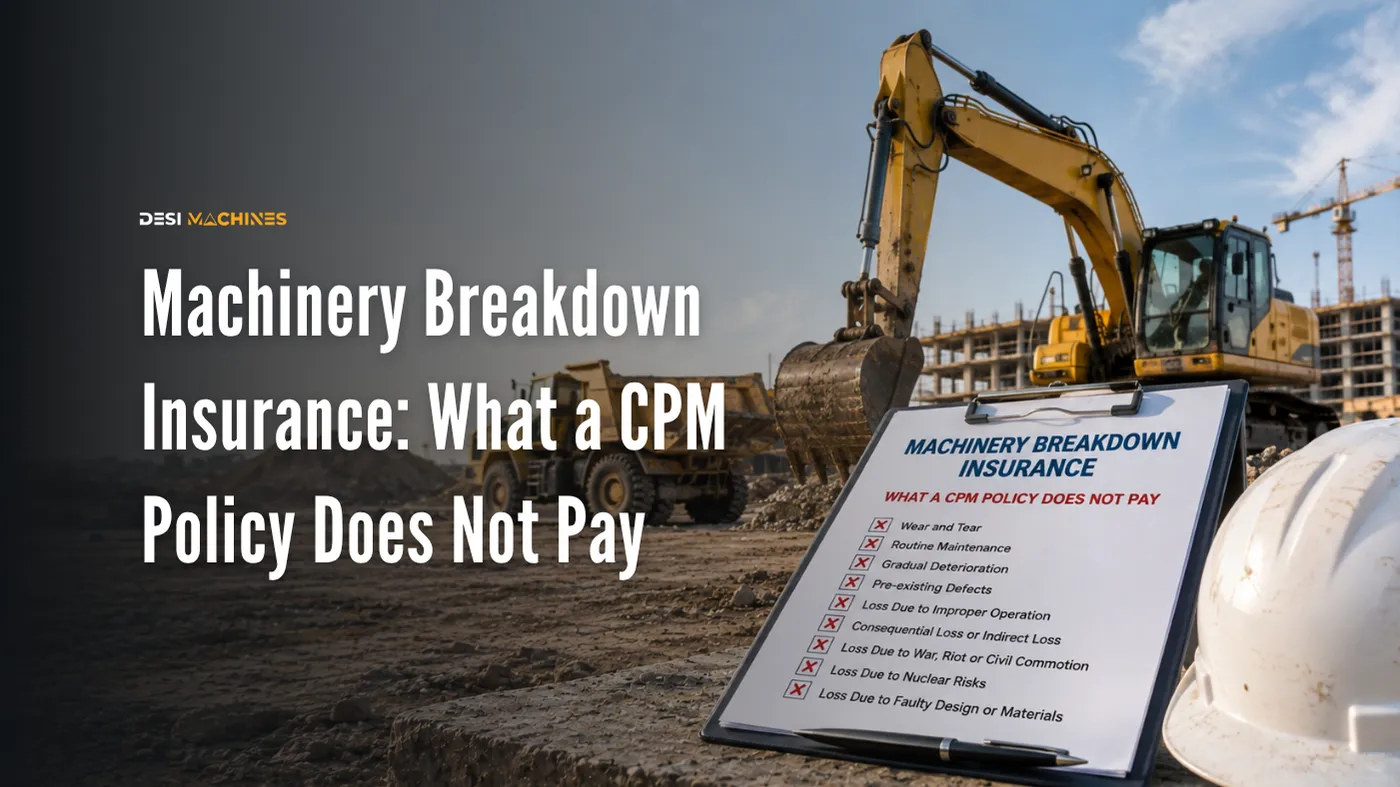
Machinery breakdown insurance covers the one thing a contractors’ plant and machinery policy deliberately leaves out. Filed CPM wordings exclude electrical or mechanical breakdown, failure, breakage or derangement — so a pump that fails or an engine that seizes is not a CPM claim. A machinery breakdown policy is aimed at exactly that, but excludes fire, theft, flood, storm and earthquake, which is what CPM is bought for. The two are close to mirror images, and the gap between them is where owners discover they were never covered.
The hydraulic pump goes on a machine three years into its life. The repair quote arrives and it is the kind of number that changes the month. The owner rings his agent, mentions that the machine is fully insured, and finds out on that call what the word “fully” was doing.
This is the most common insurance surprise in the business, and it is not a case of a claim being unfairly rejected. It is in the wording, in the exclusions, on a page nobody read at the time of buying.
What a CPM policy actually promises
A contractors’ plant and machinery policy indemnifies you against unforeseen and sudden physical damage by any cause not excluded, to the property listed in the schedule, whilst at the location stated there, where that damage means the machine needs immediate repair or replacement.
Hold on to two words in that promise. Physical damage, and unforeseen and sudden. The policy is built around something happening to the machine from outside — an overturn, an impact, a collapse, a fire, a theft. Our note on what construction equipment insurance covers sets out that side of it in full.
Then comes the exclusions list, and this is the paragraph that decides your pump claim.
The exclusion that catches owners
Filed CPM wordings exclude loss or damage due to electrical or mechanical breakdown, failure, breakage or derangement. The same clause reaches freezing of coolant or other fluid, defective lubrication, and lack of oil or coolant.
Read as an owner, that covers most of what actually stops a machine: the engine, the hydraulic pump, the final drive, the alternator, the slew motor. None of it is a CPM claim, because none of it is external damage.
There is a second exclusion beside it, and it explains a lot of small refusals. Filed wordings exclude replaceable parts and attachments — bits, drills, knives and other cutting edges, saw blades, dies, moulds, patterns, pulverizing and crushing surfaces, screens and sieves, ropes, belts, chains, elevator and conveyor bands, batteries, tyres, connecting wires and cables, flexible pipes, and joining and packing material. Those are wear items. They belong in your maintenance cost per hour, and an insurer was never going to fund them.
The consequential damage clause worth knowing
The breakdown exclusion does not end where most summaries stop it. Filed wordings continue: if, as a consequence of such breakdown or derangement, an accident occurs causing external damage, such consequential damage will be indemnifiable.
That sentence is doing real work. The failed component is yours. The damage that failure then causes to the rest of the machine may be a claim.
Which of those two descriptions your loss ends up wearing is decided by the facts and by what was recorded at the time — the breakdown report, the site record of what happened in what order, the strip-down findings from the workshop. The same file discipline that decides whether an insurance claim gets rejected is what decides this one. Photograph the damage before anything is dismantled, and have the workshop write down the sequence rather than just the parts list.
What machinery breakdown insurance does instead
A machinery breakdown policy is written for the gap. It indemnifies unforeseen and sudden physical damage from any cause not excluded to the insured items, necessitating their immediate repair or replacement.
Two features of the cover are worth noting. It applies to insured items after successful completion of their performance or acceptance tests, so it is a policy for machines in service rather than for commissioning. And it responds whether the items are at work or at rest, while being dismantled for cleaning or overhauling, during those operations, when being shifted within the premises, and during subsequent re-erection. A machine stripped in your yard for an overhaul is inside the cover, which is not obvious and is often when things get damaged.
The insurer’s liability for any one item is capped at the sum insured set against that item in the schedule, aggregated over the policy period, unless the sum insured is reinstated after a claim for the balance period. Under-declare an item and you have capped your own recovery.
The mirror image, set out plainly
Here is why owners cannot treat one policy as a substitute for the other. A machinery breakdown wording’s general exceptions exclude fire and its consequences, smoke, soot, aggressive substances, lightning, explosion of most kinds, theft, collapse of buildings, subsidence, landslide, rockslide, escaping water, flood, inundation, storm, tempest, earthquake, volcanic eruption or other Acts of God, and impact by craft.
That list is a fair description of why anyone buys a CPM policy in the first place.
| What happened | CPM policy | Machinery breakdown policy |
|---|---|---|
| Machine overturns on a slope | Its territory | Not its territory |
| Hydraulic pump fails internally | Excluded as breakdown | Its territory |
| Machine stolen from site | Its territory | Excluded |
| Flood damages the machine | Its territory | Excluded |
| Breakdown then causes external damage | Consequential damage indemnifiable | Its territory |
| Tyres, cutting edges, belts, batteries | Excluded as wear items | Check the schedule |
Two more CPM exclusions are worth reading before you assume a machine is covered everywhere it goes. Filed wordings exclude loss or damage to vehicles designed and licensed for general road use unless those vehicles are used exclusively on a construction site. And they exclude loss or damage whilst in transit from one location to another, with public liability not payable while the plant is on public roads — which is the whole reason transit cover is a separate purchase.
What to do before your next renewal
Ask for both wordings in full, not a benefit summary. The summary is where the exclusions go to hide.
Then put your own failure history against them. An owner running three machines past their warranty period, whose losses over four years have been a pump, a turbocharger and a final drive, is buying the wrong policy if he only holds CPM. An owner whose losses have been an overturn and a site theft is covered by the policy he already has and does not need a second premium.
Check the fit for how you actually work. A machinery breakdown wording is drafted around insured items at the premises stated in the schedule. That reads naturally for a crusher, a batching plant or a workshop machine. For plant that moves site every few weeks it needs a written answer from the insurer about how the policy responds after a move — get that before you pay, not after a loss.
And set the sums insured against what replacement actually costs today. The per-item cap is the number your claim is measured against, and it is the cheapest thing on the schedule to get wrong. What drives your premium is worth understanding at the same time, because a wider cover bought sensibly often costs less than owners assume.
Which half of the risk does each machine policy cover?
Machinery breakdown insurance and a CPM policy are two halves of the same problem, and each excludes what the other is for. CPM will not pay for electrical or mechanical breakdown, failure, breakage or derangement, nor for tyres and cutting edges. A machinery breakdown policy will not pay for fire, theft, flood, storm or earthquake. Between them sits the consequential damage clause, where a breakdown that goes on to cause external damage may still be indemnifiable.
Before your next renewal, do three things: get both wordings and read the exclusions rather than the brochure, list your own last four losses and see which policy each one would have landed in, and set the per-item sums insured against current replacement cost. If you are weighing the premium against the exposure, our note on what a machine costs you while it is standing is the other half of that sum — and you can compare live equipment insurance options alongside your finance position.
The clauses described here are taken from contractors’ plant and machinery and machinery breakdown policy wordings filed with the Insurance Regulatory and Development Authority of India by general insurers. Wordings, exclusions, excesses and endorsements differ between insurers and between policy years, and your own schedule and wording govern your cover. Confirm what your policy does and does not pay with your insurer or broker in writing before you rely on it.
Rates, schemes, specifications and prices change — confirm current terms with the OEM, dealer, bank or insurer before deciding.