Excavator
294 models
Excavator
294 models  Backhoe Loader
51 models
Backhoe Loader
51 models  Crane
68 models
Crane
68 models  Concrete Mixer
79 models
Concrete Mixer
79 models  Wheel Loader
54 models
Wheel Loader
54 models  Compactor / Roller
45 models
Compactor / Roller
45 models  Motor Grader
42 models
Motor Grader
42 models  Concrete Pump
66 models
Concrete Pump
66 models  Skid Steer Loader
11 models
Skid Steer Loader
11 models  Telehandler
13 models
Telehandler
13 models  Dozer
Dozer 


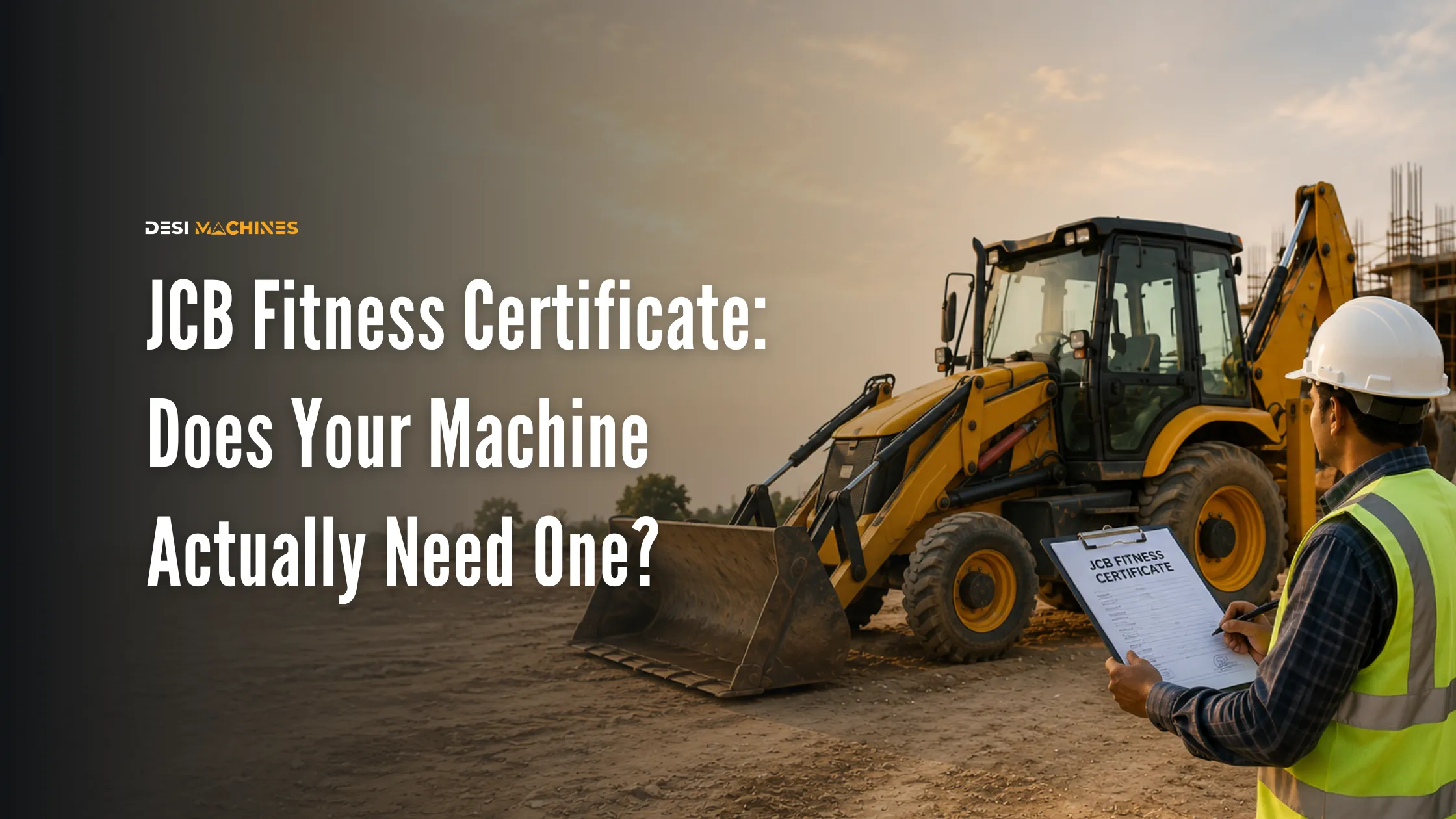
In short: A JCB fitness certificate is not automatically required for every machine. Section 56 of the Motor Vehicles Act, 1988 attaches the requirement to a transport vehicle, and section 2(47) defines that as a public service vehicle, goods carriage, educational institution bus or private service vehicle. A backhoe working your own sites is usually outside that list. What decides your case is the vehicle class printed on your RC — and where the certificate is required, section 56(1) makes registration itself invalid without it.
Why owners get contradictory answers
Ask three people whether your machine needs a fitness certificate and you will get three answers, all delivered with confidence. A transporter says yes, every commercial vehicle needs one. A dealer says no, it is a non-transport vehicle. Someone at the RTO counter asks to see the RC before answering.
The third response is the correct one, and this article is mostly an explanation of why.
The confusion is real rather than careless. Construction machines sit awkwardly across categories the Motor Vehicles Act drew for trucks and buses, and the answer changes depending on how a particular machine was registered.
What section 56 actually says
Start with the text, because the scope is in the first six words. Section 56(1) provides that “a transport vehicle shall not be deemed to be validly registered for the purposes of section 39, unless it carries a certificate of fitness” in the prescribed form, issued by the prescribed authority or by an authorised testing station, to the effect that the vehicle complies with the requirements of the Act and the rules.
Two things follow. The obligation is limited to a transport vehicle. And for a vehicle inside that category, fitness is not an optional extra — without it the registration is not treated as valid at all.
There is also a protection worth knowing. If the authority or testing station refuses to issue the certificate, the proviso to section 56(1) requires it to supply the owner with its reasons in writing. A verbal refusal at a counter is not the process the Act describes.
When a JCB fitness certificate is actually required
This is where the JCB fitness certificate question is actually decided. Section 2(47) defines a transport vehicle as “a public service vehicle, a goods carriage, an educational institution bus or a private service vehicle.” A backhoe loader is plainly not a bus or a public service vehicle, which leaves goods carriage.
Section 2(14) defines a goods carriage as “any motor vehicle constructed or adapted for use solely for the carriage of goods, or any motor vehicle not so constructed or adapted when used for the carriage of goods.”
A backhoe loader is not constructed solely to carry goods — it is built to dig and load. And in normal use it is not carrying goods from place to place either; it is working. On the statutory text, a machine used on your own sites usually falls outside the definition, and therefore outside section 56.
Now the caveat that matters more than the analysis. Registration practice varies, and a good number of machines are registered under a class that puts them on the transport side of the line. The Act tells you what the categories mean; your RC tells you which one your machine was placed in. If the two seem to disagree, the RTO that registered it is the authority to resolve it with, not a WhatsApp group.
| What to check | Where to find it | Why it decides the answer |
|---|---|---|
| Vehicle class on the RC | The registration certificate itself | This is what the RTO acts on, whatever the category theory says |
| Whether the machine carries goods | How you actually use it | Section 2(14) catches a vehicle “used for the carriage of goods” even if not built for it |
| Whether it is hired out | Your contracts | Hire and reward use pushes a machine toward the transport categories |
| Whether it leaves enclosed premises | Site reality | Section 2(28) excludes machines adapted for use only in a factory or enclosed premises |
| What the registering RTO says | The RTO, in writing | Practice varies by state; a written answer is worth having on file |
If you are buying a used machine, this is one of the lines to read before money moves — the class on the RC travels with the machine, and so does any mess in its papers. The sequence is set out in RC transfer for construction equipment, and the tax side of the same registration is covered in JCB road tax in India.
What cancellation costs you
For machines that do need a certificate, section 56(4) is the provision to respect. The prescribed authority may cancel a certificate of fitness at any time, for reasons recorded in writing, if satisfied the vehicle no longer complies with the Act and the rules.
The consequence runs further than the certificate. On cancellation, the registration certificate of the vehicle and any permit granted in respect of it are deemed suspended until a new fitness certificate is obtained. A machine in that position is not merely overdue on paperwork — its registration is suspended, and everything an owner does with it after that point sits on a weak footing.
Downtime is the quiet cost here. A machine held up for a testing appointment in the middle of a season earns nothing, and the arithmetic of that is set out in what equipment downtime costs. Book the test around your work, not around a deadline.
The paperwork that travels with the machine
Four different documents get talked about as if they were one, and most of the confusion owners run into is really a mix-up between them. Fitness is not a licence, and neither of them is registration. This is what each one actually certifies:
| Document | What it certifies | Who or what it attaches to |
|---|---|---|
| Registration certificate (RC) | That the machine itself is registered, and the vehicle class it was registered under | The machine — section 39 requires registration before a motor vehicle is driven in any public place or in any other place |
| Certificate of fitness | That the vehicle complies with the Act and the rules, so its registration counts as valid | The machine, but only where it is a transport vehicle under section 2(47) — section 56(1) |
| Driving licence | That the person at the controls is licensed for that class of vehicle | The operator, not the machine — a separate question with a separate answer |
| Insurance | That third-party liability and damage to the machine are covered | The machine and the people around it, under the policy wording |
Fitness is one item in a set, and owners tend to discover the rest one demand at a time. The registration position comes from section 39, which requires a motor vehicle to be registered before it is driven in any public place or in any other place — wording that does not stop at the site gate. The licence question is separate again and turns on the class of licence the operator holds, which is set out in the JCB licence rules in India.
Keep the set together and current: the RC, the fitness certificate where one applies, insurance, and the operator’s licence. Where machines are hired out, the hirer will ask for all of it, and a gap costs you the contract rather than a fine. Owners letting machines out should also read what a proper operator hiring process looks like, since the licence and the machine’s papers are checked together.
Cover is the other half of the file. What a policy pays and what it quietly excludes is set out in the construction equipment insurance guide, and you can compare machine insurance options against what your current policy actually carries.
The bottom line
A JCB fitness certificate is required when the machine is a transport vehicle, and the Act’s own definitions mean many machines working their owner’s sites are not. That is a narrower rule than the one owners are usually given, and it is worth knowing because the wrong assumption costs either an unnecessary test or a suspended registration.
Do one thing this week: take out the RC and read the vehicle class. That single line tells you which set of rules you are living under, and it takes a minute.
If the machine’s papers are in order and the next question is what it is worth or what replaces it, compare live backhoe loader models and prices and excavator models, and price the funding through equipment finance options before you commit.
Rates, schemes, specifications and prices change — confirm current terms with the OEM, dealer, bank or insurer before deciding. The statutory positions here are drawn from the Motor Vehicles Act, 1988 as it stood in August 2026; registration practice varies by state, your RC and your RTO govern your case, and nothing here is legal advice.