Excavator
294 models
Excavator
294 models  Backhoe Loader
51 models
Backhoe Loader
51 models  Crane
68 models
Crane
68 models  Concrete Mixer
79 models
Concrete Mixer
79 models  Wheel Loader
54 models
Wheel Loader
54 models  Compactor / Roller
45 models
Compactor / Roller
45 models  Motor Grader
42 models
Motor Grader
42 models  Concrete Pump
66 models
Concrete Pump
66 models  Skid Steer Loader
11 models
Skid Steer Loader
11 models  Telehandler
13 models
Telehandler
13 models  Dozer
Dozer 


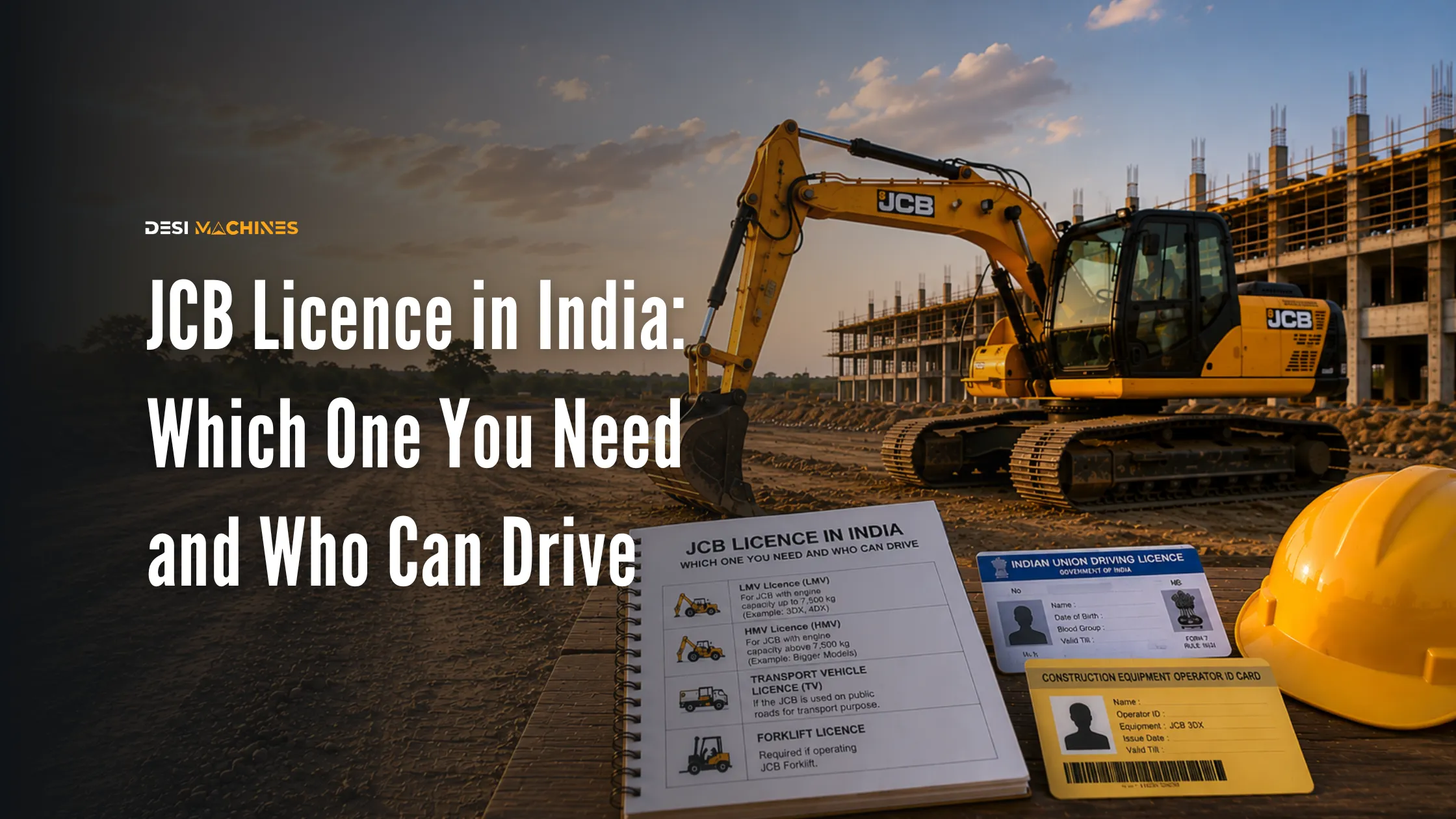
In short: A JCB licence is not a thing Indian law issues. The Motor Vehicles Act, 1988 asks for a driving licence that entitles the holder to drive that class of vehicle, and only when the machine is in a public place. The registration gate is drawn wider — section 39 catches a machine driven in any public place or in any other place, which we work through in construction equipment registration at the RTO. On a fully enclosed private site the Act may not treat the machine as a motor vehicle at all. Take it onto a road and three things bite at once: the operator needs the right class, he needs to be eighteen (twenty for a transport vehicle), and under section 5 the owner who handed over the keys is liable too.
What a JCB licence actually is
Search for a JCB licence and you will find people asking for a licence category, a fee and an age limit, as though the RTO keeps a JCB counter. It does not. There is no JCB endorsement, no backhoe endorsement and no excavator endorsement in the Act.
What the law says is narrower and more useful. Section 3 of the Motor Vehicles Act, 1988: “No person shall drive a motor vehicle in any public place unless he holds an effective driving licence issued to him authorising him to drive the vehicle.” The same section adds that a transport vehicle needs a licence that specifically entitles the holder to drive one.
So two questions decide everything, and neither of them is about the brand on the boom.
Question one: is the machine in a public place?
This is the line most owners miss, and it is the reason two honest answers can both be right.
Section 2(28) defines a motor vehicle as a mechanically propelled vehicle adapted for use upon roads, but it expressly leaves out “a vehicle of a special type adapted for use only in a factory or in any other enclosed premises.” A machine that genuinely never leaves an enclosed site sits outside that definition, and the licensing chapter never reaches it.
The moment the same machine tracks or drives down a public road to reach the next job, it is squarely inside. And registration is stricter still: section 39 requires a motor vehicle to be registered before it is driven “in any public place or in any other place” — that second phrase does not stop at the site gate.
Be honest with yourself about the boundary. A quarry with a gate is enclosed. A road-widening job, a canal bank, a village approach road and a plot you cross to get to are not. If you are working the second kind, plan for the full requirement. Our note on off-highway vehicles and what the classification changes is worth reading alongside this.
Question two: which class sits on the licence?
Section 10(2) sets out the classes a learner’s or driving licence can be expressed for. The list includes motor cycle without gear, motor cycle with gear, invalid carriage, light motor vehicle, transport vehicle, road-roller, and a catch-all for a motor vehicle of a specified description.
Notice what is there and what is not. A road-roller gets a class to itself. A backhoe loader does not. That is why the RTO’s answer for your machine turns on weight and on how the machine is described in its own papers.
| What the Act defines | The weight line | Why it matters to you |
|---|---|---|
| Light motor vehicle | Unladen weight up to 7,500 kg (for a motor car, tractor or road-roller) | The class most owners expect their operator’s licence to cover |
| Heavy goods vehicle | Unladen weight above 12,000 kg (for a tractor or road-roller) | A heavier machine pushes the operator into a heavier class |
| Road-roller | Named as its own class in section 10(2) | A compactor operator’s licence is not interchangeable with a car licence |
| Transport vehicle | No weight test — depends on use | Needs a licence that specifically entitles him, plus age twenty |
Most backhoe loaders in Indian yards sit close to that 7,500 kg line rather than comfortably under it, which is precisely why owners get different answers from different people. Do not settle it by argument. Take the machine’s registration papers to your RTO and get the class confirmed in writing before you put a new operator on it.
Age: eighteen, twenty, and no flexibility
Section 4 is short. No one under eighteen may drive a motor vehicle in a public place. And no one under twenty may drive a transport vehicle in a public place.
This matters more on sites than owners admit. A capable seventeen-year-old who has grown up around machines is still an unlicensed driver in law, and the consequences of that land on the owner as much as on him.
How an operator actually gets the right class
There is no JCB counter, so the route is the ordinary licensing route with the correct class asked for. An operator who holds nothing applies for a learner’s licence at the RTO having jurisdiction where he lives or works, sits the test, and after the statutory waiting period takes the driving test on a vehicle of the class he wants endorsed. An operator who already holds a car licence does not start again — he applies to add the class, which is an addition to an existing licence rather than a fresh one, and the test is taken on the heavier vehicle.
Three things decide how long it takes. The class has to exist for the machine, which is the weight question above. The age bar has to be cleared — eighteen generally, twenty for a transport vehicle — and no RTO waives it. And the machine’s own registration papers have to describe it in a way that matches the class being asked for, which is why owners with an unregistered or wrongly-described machine get stuck at this step rather than at the test. Fees, documents and the waiting period are set by state rules and change; ask your own RTO for the current list rather than working from what a dealer or another owner tells you.
The owner is on the hook, not just the operator
Section 5 is the sentence every machine owner should read twice: “No owner or person in charge of a motor vehicle shall cause or permit any person who does not satisfy the provisions of section 3 or section 4 to drive the vehicle.”
Causing or permitting is a low bar. You do not have to instruct anyone. Leaving the keys with a helper who “manages” while the regular operator is on leave is enough to get you there.
The money consequence usually arrives through the insurance side rather than the courtroom. An unlicensed driver at the wheel is one of the cleanest reasons an insurer has to contest a claim, and a machine is an expensive thing to be uninsured on for an afternoon. If you have not thought that through, read what we have written on third-party liability on construction equipment before your next hire.
Training, and what a certificate is really worth
Operator training and licensing are two different systems and they solve two different problems. The RTO issues the class. A training centre issues a certificate that says the man can actually run the machine.
Employers screen on the second one. A certificate plus real seat hours is what gets an operator hired and what moves his pay, which is the pattern behind the ranges in our breakdown of JCB operator salary in India. But a certificate has never made anyone legal on a public road, and no training provider can issue you a driving class.
Course fees vary widely by state and by provider, and we are deliberately not putting a number on them here — confirm the current fee directly with the training centre you are considering rather than working off a figure you read somewhere.
What to do before you hand over the keys
A short sequence keeps you out of all of this:
| Step | What you are checking |
|---|---|
| See the physical licence | Not a photo on a phone. The classes are printed on it. |
| Match class to machine | The class must cover what he will actually drive, on the road, not what he drove last year. |
| Check the validity date | An expired licence is the same as no licence for section 5 purposes. |
| Check age against the class | Eighteen for a motor vehicle, twenty for a transport vehicle. |
| Keep a copy on file | It is your evidence that you did not “cause or permit” anything. |
If you are hiring rather than employing, the same checks apply and they belong in the conversation before the rate does. Our guide on how to hire a JCB operator covers the trial run and the pay structure around it, and the paperwork side of the machine itself sits in RC transfer for construction equipment.
The bottom line
Stop looking for a JCB licence. Ask instead whether the machine goes into a public place, which class your operator’s licence carries, whether he clears the age bar for that class, and whether you can prove you checked. Those four answers are the whole of it, and the last one is the one that protects you.
Buying the machine is the other half of the decision. Compare current backhoe loader models and prices and excavator models and speak to a dealer about what your work actually needs. The full text of the Act is on India Code if you want to read the sections yourself.
Rules, licence classes, fees and age limits change, and RTO practice varies by state. Confirm the current requirement with your RTO or another official source before you put an operator on a machine. DesiMachines is not liable for decisions taken on the basis of information that may have changed after publication.